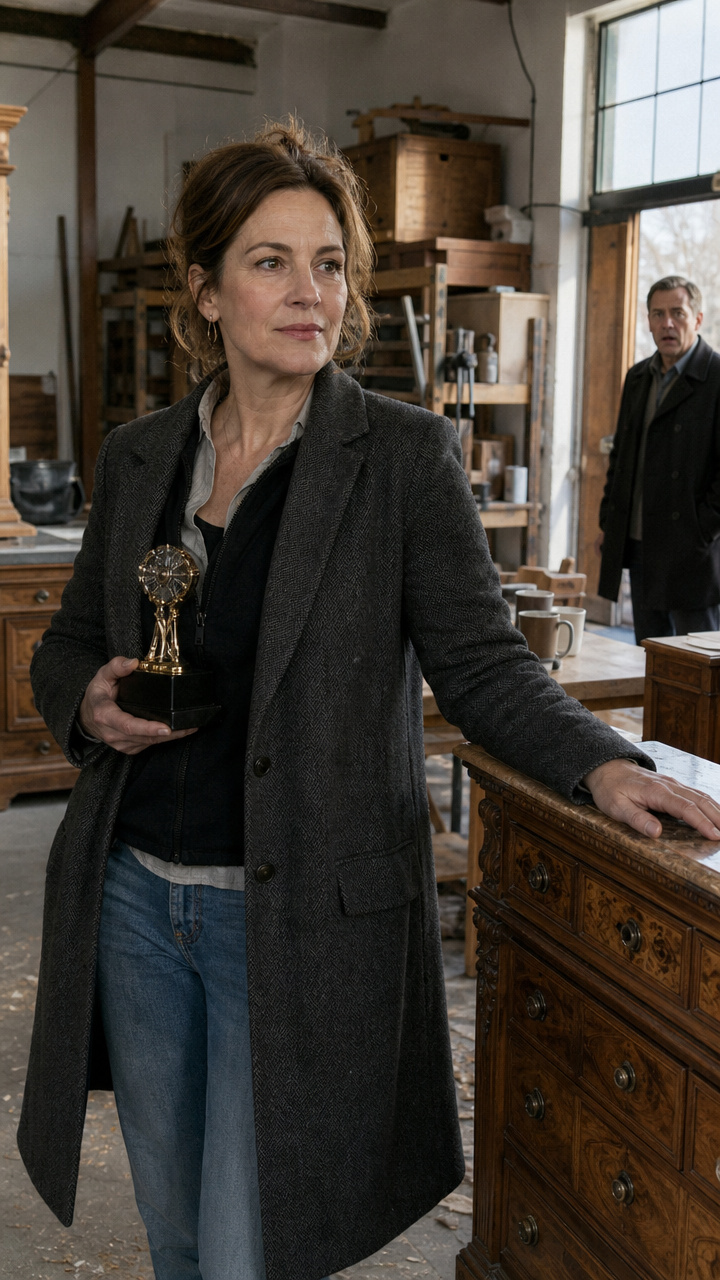
The workshop smelled of fresh wood shavings and coffee.
James stood by the window, studying a set of architectural drawings.
“You’re late,” he said with a smile.
“I ran into someone from my past.”
“Was it a bad meeting?”
“No. It taught me a great deal.”
James put the drawings aside.
“Then sit down. I brought you soup. I’m willing to bet you didn’t eat properly again today.”
He opened a thermos and poured steaming soup into a bowl.
As I watched his large, slightly rough hands, a quiet warmth spread through me.
We had been together for years.
We had never rushed toward marriage, never tried to remake each other, and never demanded proof of love.
We simply loved one another.
One evening, James asked, “Do you know what I love most about you?”
“That I can repair a hundred-year-old cabinet?”
He smiled.
“No. I love that you aren’t afraid to begin again.”
I rested my head against his shoulder.
For a long while, neither of us spoke.
A month later, we received an unusual commission.
An elderly woman brought an old armchair into the workshop.
Its back had broken, the wooden arms were cracked, and the upholstery was almost completely ruined.
“It belonged to my husband,” she explained softly. “We were together for fifty-four years. He always sat in this chair beside the window. My children want to buy me a new one, but I want to keep this.”
She ran her fingers across the worn wood.
“When I look at it, I sometimes feel as if he is still here with me.”
I promised her that we would do everything we could.
The restoration took almost two months.
We carefully repaired the wooden parts, reinforced the frame, and searched for fabric that matched the original as closely as possible.
When we returned the chair, the woman stood in front of it for a long time without speaking.
Then she lowered herself into the seat.
Her eyes closed.
“Hello, darling,” she whispered.
I turned away so she wouldn’t see my tears.
In that moment, I finally understood why I had never been able to abandon my work.
I wasn’t merely repairing furniture.
I was rescuing memories.
I was protecting love.
I was preserving small fragments of lives that time was slowly trying to erase.
That evening, James and I locked the workshop together.
He reached for my hand.
“What are you thinking about?”
I looked down at my palm.
It was marked by tiny scars, traces of paint, and thickened skin from years of work.
Once, I had been embarrassed by those hands.
Now, I was proud of them.
“I’m thinking about how strange life can be,” I said. “Sometimes someone leaves, and you believe they’ve taken everything important with them.”
“And then?”
I smiled.
“Then you realize they left you the most important thing of all.”
“What’s that?”
“Yourself.”
James gently kissed my fingers.
A few days later, Emily arrived with a surprise.
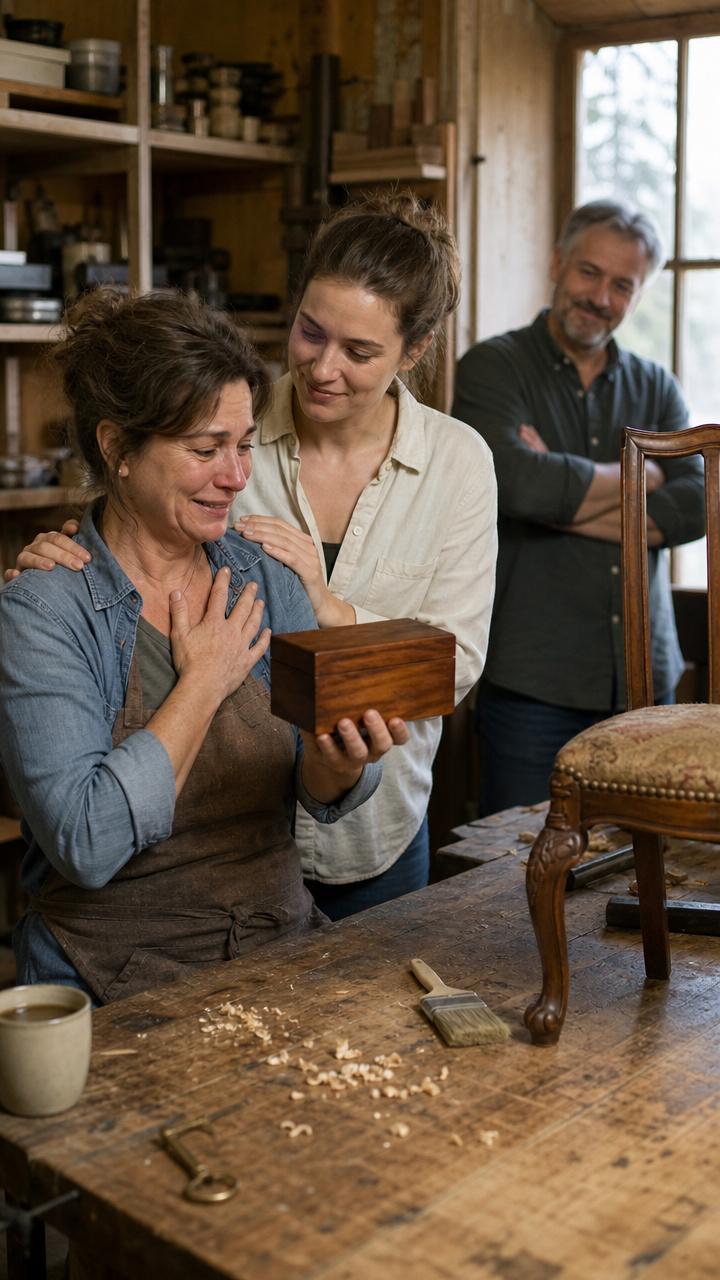
She handed me a small wooden box.
“Mom, I made this for you.”
A message had been carved into the lid:
“For the woman who taught me that it is never too late to begin again.”
Inside lay the old key to my very first workshop.
Emily had found it years earlier and transformed it into a keepsake.
I wrapped my arms around her.
“I’m so proud of you, Mom,” she whispered.
And in that moment, I understood something completely.
Happiness does not begin when someone else finally recognizes our value.
It begins on the day we stop questioning it ourselves.
If Mark ever asked me again whether I regretted his leaving, I could answer without hesitation:
“No, I don’t regret it. After you walked away, I learned that my life was far greater than anything you had ever imagined for me.”
But I no longer needed to say those words.
I had nothing left to prove.
Not to him.
Not to anyone else.
Not even to myself.
Because at last, I had come home.
Not to an apartment.
Not to a workshop.
But to my own life.
And that was the greatest victory of all.