The stairwell smelled of fresh paint and someone’s homemade fruit drink. The elevator moved somewhere below us.
I listened to my own heartbeat and felt surprised.
I wasn’t afraid.
Not at all.
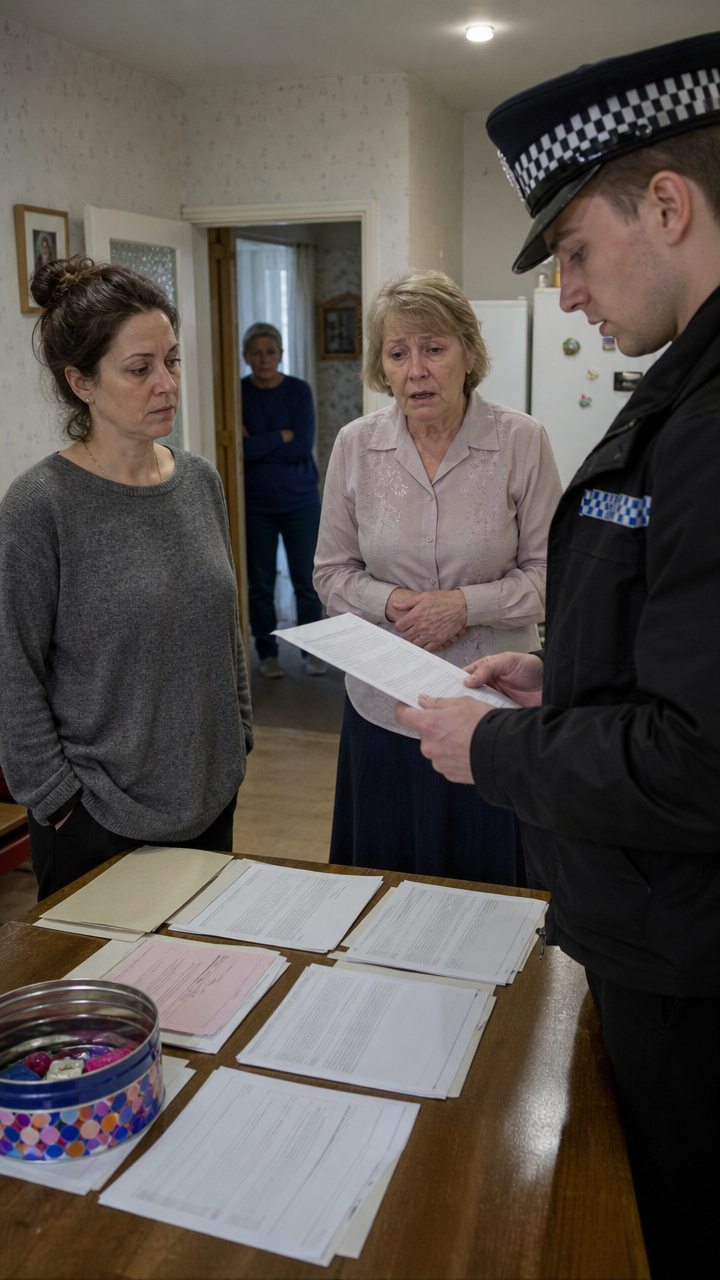
That evening, I took a small metal candy tin down from the top shelf. It held my grandfather’s papers and my personal documents.
I found the latest utility bill, circled the total, and left it on the table beside Margaret’s room.
She pretended to be asleep.
Daniel came home Friday, listened to everything, and scratched the back of his head.
“She won’t pay,” he said. “You know that.”
“I know. The bill can stay there.”
We had dinner alone, late, beneath a single lamp. He told me about a compressor that had broken down in another town, and I laughed.
Nothing came from Margaret’s room.
The bill remained untouched on the table. By the time the edge began to yellow, it had become almost part of the furniture.
Ten days after our conversation, I came home from my shift and saw an empty wall in the living room.
A pale rectangle remained on the wallpaper—the place that had been protected from the sunlight for six years.
The sideboard had stood there since 2020.
It was made of Karelian birch, built in the late 1950s by a furniture factory that no longer existed.
My grandfather had kept his tools inside it. He had been a dental technician too, working in the profession for forty years. He was the one who had first guided me toward my career.
He died in 2014.
I inherited a small apartment from him on Civic Street, along with that sideboard.
Now the sideboard was gone.
I set my bag on the floor and searched the apartment.
Margaret was sitting in her room, watching a gardening program.
“Where is it?”
“Sold,” she answered without looking away from the screen. “It was falling apart. The doors squeaked, and moths would have gotten into it. I listed it, someone came and took it. He paid me twenty dollars, by the way. You should be thanking me.”
“Twenty dollars?”
“You need to buy proper furniture instead of clinging to junk. I ran a dormitory for thirty-seven years. Everything was handled properly there: if something broke, it was written off, removed, and replaced. That was order.”
I stood in the doorway and counted to ten.
Then to twenty.
My grandfather had kept his plaster molds in that sideboard.
After work, he always wiped one of the doors with his sleeve.
When I was about eight, I had begun copying him.
“You sold it without asking me?” I said at last.
“Why would I ask? The apartment belongs to my son. The furniture is shared.”
That was when I finally understood that this had stopped being about furniture a long time ago.
I stepped into the hallway and opened the classified listings website.
It took me less than four minutes to find her post.
Our sideboard.
Photographed in our living room.
Against my wallpaper.
The caption read: “Must go soon, cheap, pickup only.”
The listing was marked sold.
And just below it was another advertisement with the same photographs. The seller was different, and the price was much higher.
The reseller had not even bothered to take new pictures.
I contacted him.
He answered quickly.
He sounded like a man in his forties.
“I’ve already listed it,” he said over the phone. “I’ll let it go for one hundred and twenty. I can’t go lower—I loaded it and transported it.”
“I’ll take it.”
One hundred and twenty dollars for the piece that had been taken from my home for twenty.
Another seventy for the van and the movers.
Nearly two hundred dollars to buy back my own sideboard.
It arrived Saturday morning.
Daniel was repairing a faucet and came out into the hallway, wiping his hands on a rag.
“Claire, let’s put it back in the living room and forget the whole thing,” he suggested.
“No.”
The movers brought the sideboard inside and waited.
“Into the back bedroom,” I said. “By the window, along the wall.”
Daniel looked at me.
“That’s Mom’s room.”
“Exactly.”
Margaret appeared in the doorway, staring as though she could not believe what she was seeing.
The sideboard fit almost perfectly, taking up half the wall and blocking part of the wardrobe. One door could open only halfway before hitting the dresser.
“Have you lost your mind?” Margaret demanded. “Why would I want this enormous thing?”
“You made the decision to sell it. Now you can live beside it. But it is never leaving this apartment again.”
“Daniel! Are you seeing what she’s doing?”
Daniel wiped his hands on his jeans and walked into the kitchen.
He had always hated choosing sides.
But that day, he did not take hers either.
The movers were paid and left.
I closed the door.
A thick, padded silence settled over the apartment.
I leaned my forehead against the doorframe.
The smell of old varnish and dust rose around me.
It was exactly the smell of my grandfather’s home.
And suddenly, something in me loosened.
For the first time in months.
That evening, Daniel and I drank tea.
He eventually gave a small, helpless laugh.
“It takes up half the wall. She has to walk sideways to get past it.”