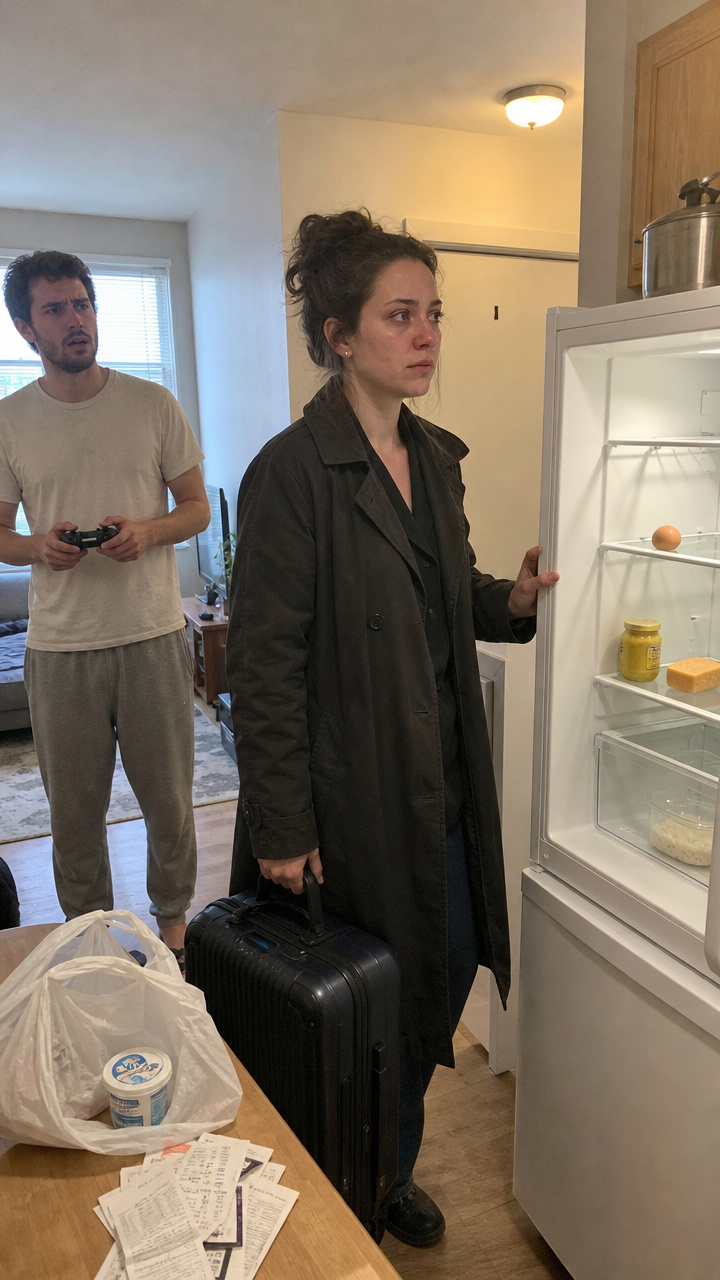
Claire asked why.
His friends were planning to spend the weekend at a country resort. Ryan wanted to go with them because, as he explained, it would be awkward to be the only one who stayed home.
Claire refused to lend him the money.
He walked around with a dark expression for several days, but eventually went anyway after borrowing the amount from his brother.
He returned glowing with excitement, carrying photographs from beside the pool and wearing a new designer cap that had cost eighty dollars.
Of course, he had to repay his brother from the next paycheck.
That meant the household expenses once again fell almost entirely on Claire.
At some point, she decided to create a detailed monthly budget.
She was not trying to count every loaf of bread or carton of milk. She simply wanted Ryan to see the actual numbers.
The results were impossible to misunderstand.
Utilities came to nearly nine hundred dollars.
Groceries cost more than three thousand.
Household supplies required another six hundred.
Internet and subscriptions cost over two hundred.
There were also drinking water and medication.
During the same period, Ryan had ordered pizza once and bought one package of coffee.
His beloved car, however, had swallowed more than twenty-five hundred dollars.
His gym membership cost nine hundred.
He had spent another seven hundred on supplements and sports nutrition.
When Claire showed him the figures, Ryan grimaced.
“What is this? Are you preparing a financial report on our relationship?”
“I’m trying to understand why we both work, but I pay for nearly every household expense.”
“Because those things are necessary for you. I don’t need half of what you buy.”
“You don’t need food?”
“Don’t twist my words.”
“What about electricity? Water? Laundry detergent? Toilet paper? You can live without those too?”
“I could live much more simply.”
Claire asked him to explain what exactly he meant by living simply.
He had no answer.
Because in Ryan’s version of a simple life, everything necessary would still be available exactly where it belonged. He simply would not be paying for it.
Preferably, no one would remind him how much groceries, utilities, or everyday necessities cost.
Any attempt to discuss a shared budget felt to him like a personal insult.
Using things purchased with someone else’s money, however, did not embarrass him in the slightest.
There was another incident Claire could not forget.
In August, she came down with a severe cold.
For three days, she worked from home with a high fever because she could not completely abandon several urgent projects.
On the first evening, Ryan promised to bring her medicine and some food.
When he came home, he took two energy drinks, a roasted chicken, and several protein bars out of the grocery bag.
All of it was for him.
He had forgotten the medicine.
When Claire asked him to go back to the pharmacy, he snapped that he had already parked the car and was not going anywhere else.
She had to order the medicine herself.
The next day, Ryan finished the chicken and casually asked what they were having for dinner.
That was the first time Claire seriously admitted to herself that the man beside her was not an equal partner.
He was someone who had found a comfortable place in her apartment and learned how to enjoy the benefits of another person’s labor.
Even then, she did not end the relationship immediately.
Relationships rarely end on the exact day a serious problem first becomes visible.
People spend months, sometimes years, trying to explain a partner’s behavior. They tell themselves the other person is tired, that the situation is temporary, that they should wait a little longer, or have one more honest conversation.
Claire did the same.
But that morning changed everything.
Before leaving for work, she transferred seven hundred dollars to Ryan and sent him a detailed shopping list.
His reply was brief:
“Okay.”
He knew perfectly well what he was doing.
He had read her request, received the money, and decided that repairing his car mattered more than filling the refrigerator they shared.
He had not even bothered to call and warn her.
He had not asked whether he could use the money for another purpose.
He simply made the decision himself and announced it when there was almost nothing left to eat.
That was why Claire no longer saw what happened as an ordinary household misunderstanding.
The seven hundred dollars were only the final proof of a much larger injustice.
Losing the money was not the real reason she ended things.
The real reason was that, behind this one incident, she suddenly saw the entire structure of their life together.
She remembered the argument they had had the previous winter.
Claire had asked Ryan to pay half of the utility bills.
He had been outraged. The apartment legally belonged to her, he said, so the expenses of maintaining it were her responsibility alone.
At the same time, he took long, hot showers every day, left the television running, and sent a load of gym clothes into the washing machine almost every other day.