
“Claire, could you come home a little earlier today? Aunt Margaret should arrive around five.”
Daniel said it that morning while standing in the hallway and pulling up the zipper of his jacket. His eyes never left his phone as he skimmed through a stream of messages. Claire sat at the kitchen table with a mug of hot coffee, still struggling to wake up, and looked at her husband as if he had reminded her not about a relative’s visit, but about some unpleasant duty she would rather have forgotten.
“I remember,” she replied. “You already told me yesterday.”
“Of course. It’s just that Margaret will probably be exhausted after the trip. I’d like everything at home to be… calm.”
Claire had long ago learned what Daniel meant whenever he used the word calm. In reality, it meant something very simple: no one was allowed to object to his aunt, no matter how unreasonable she behaved.
They had been married for three years. The apartment they had moved into after the wedding belonged to Claire; she had inherited it from her grandmother. It was an ordinary two-bedroom place, but warm and comfortable, with a decent renovation, a bright living room, and a spacious enclosed balcony.
When they had first married, Daniel repeatedly said how lucky he was to have her. He thanked her for saving him from spending half his salary on rent and insisted that he deeply valued the trust she had placed in him.
At the time, Claire truly believed their life together was built on sensible foundations. She had the apartment, Daniel had a steady position at a service company, and together they could quietly plan for the future.
But eventually she discovered that Daniel’s gratitude had been temporary. His habit of treating someone else’s property as though it naturally belonged to him, on the other hand, grew stronger with every passing year.
Margaret was the older sister of Daniel’s late mother. Years earlier, when Daniel’s mother had been seriously ill and his father was hardly ever home, Margaret had taken the boy in. Daniel often said that his aunt had practically saved him and raised him.
There was always an unspoken rule hidden inside that story: Margaret could do whatever she pleased. No one was supposed to challenge her, correct her, or remind her where another person’s boundaries began—even when she had stopped noticing those boundaries herself.
Claire had seen her only three times.
The first occasion had been their wedding. Margaret had examined the bride from head to toe before declaring that young women from the city were “far too thin and far too made-up.”
The second time, she came to town for a friend’s milestone birthday and spent the night at their apartment. The next morning, Claire discovered that every dish in the kitchen cabinets had been moved to different shelves.
“It’s more practical this way,” Margaret explained.
A costly face cream Claire usually kept in the bathroom also disappeared. Some time later, she found it tucked beneath the sink.
“There’s no reason to leave all that chemical stuff lying around in plain sight,” Margaret had said.
The third time they met was the previous winter, at the memorial gathering for a distant relative. Margaret spent nearly the entire evening explaining that Daniel needed “a proper homemaker, not some young lady who only knew how to dress herself up.”
Even then, Claire understood one essential truth: Margaret never felt like a guest in anyone else’s home. She entered as if she were an inspector, fully entitled to judge, rearrange, criticize, and issue instructions.
“How long is she planning to stay?” Claire asked, taking a sip of coffee.
“A week. Maybe ten days. She has a doctor’s appointment and some pension paperwork to deal with. I told you that.”
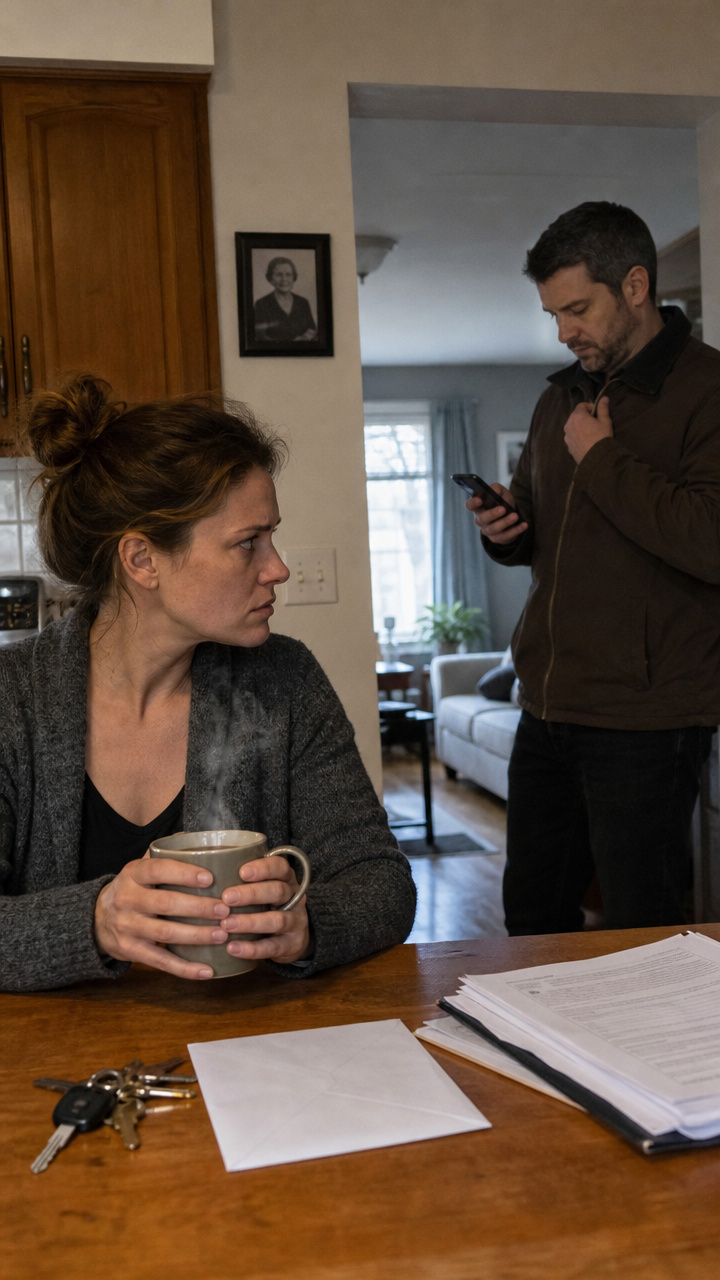
“You said she was coming for a few days.”
“And what am I supposed to do if she can’t finish everything? Send her to stay in a hotel?”
“Why not?” Claire asked evenly.
Daniel finally looked up from his phone.
“Because she’s my aunt.”
“And this is my apartment, Danny. If someone is going to live here for ten days, I’d like to know that in advance instead of discovering the details one piece at a time.”
He let out a long, weary breath.
“There it is. Claire, could you please stop picking at every word for once? She’s not young, the trip was difficult, and she has business to take care of here. She’ll stay for a little while and then leave.”

Claire said nothing.
She did not want to begin the day with an argument over a woman who had not even arrived yet. Besides, the day ahead promised enough trouble on its own: the end-of-month reports, several difficult clients at the salon where Claire worked as an administrator, and a manager who firmly believed every employee was required to smile regardless of what was happening.
Margaret arrived at exactly five o’clock.
She carried a small suitcase, an enormous plaid bag, and the expression of someone already prepared to uncover a long list of shortcomings in another person’s home.
She wore an old light-beige coat, a scarf tied tightly beneath her chin, and worn ankle boots.
Claire had returned from work only half an hour before and had not even had time to change. She greeted the visitor in the dark blue dress she had worn to the salon, her hair still loose around her shoulders.
“Oh, I see you dressed up,” Margaret said instead of offering a greeting as she stepped inside. “I expected to find the lady of the house at home, but you look as though you’re about to go somewhere for the evening.”