My name is Rachel Turner, and I was sixteen years old when my parents told me I had ruined their lives.
I still remember the way my mother stood in the kitchen, arms folded so tightly across her chest it looked like she was holding herself back from touching me. My father didn’t yell at first. That would have felt more honest. He just stared at me like I had become something filthy overnight. I was three months pregnant, terrified, and still trying to believe that if I kept saying, “I’m sorry,” somehow things would calm down.

My mother said, “You are not keeping that baby in this house.”
My father pointed toward the front door and said, “If you go through with this, you’re on your own.”
I thought he was bluffing. I thought parents said cruel things when they were angry and then regretted them later. But when I told them I wasn’t giving up my baby, my father went upstairs, brought down a trash bag, and threw it at my feet.
“Pack,” he said.
That was the last night I lived in their home.
I ended up staying with my best friend’s aunt for the rest of my pregnancy. The baby’s father disappeared before our son was born, which meant every fear my parents had thrown in my face became mine to survive. I finished high school through night classes, worked mornings at a diner, and learned how to stretch twenty dollars farther than anyone should have to. When my son Caleb was born, I was exhausted, broke, and more in love than I knew a human being could be.
There were years when I thought about calling my parents. On Caleb’s first birthday. On his first day of school. The night he won a middle school science award and cried because I was cheering too loudly from the back row. But every time I imagined their voices, I remembered the front door slamming behind me.
So I built a life without them.
I became a nurse. Caleb grew into a brilliant, steady young man with more discipline than most people twice his age. We rented small apartments, then a townhouse, then finally bought a modest home together when I was in my thirties. We made it without my parents, without their money, without their approval, and eventually, without even missing them.
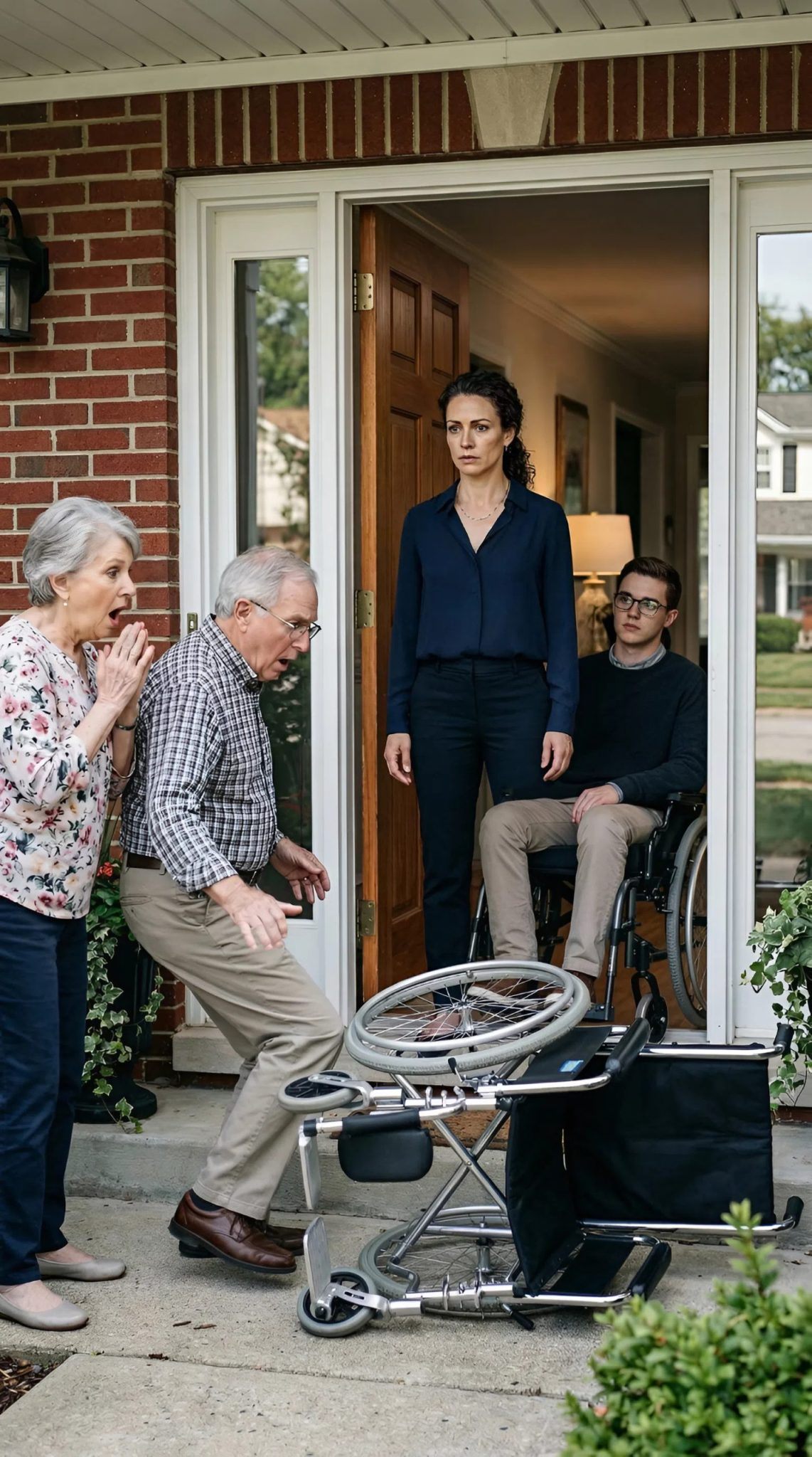
Then, twenty years after they threw me out, they showed up unannounced at my front door.
My mother smiled like no time had passed.
“We heard our grandson is home from college,” she said. “We came to meet him.”
And just as I opened the door wider, the sound of motorized wheels came down the hallway behind me.

My parents heard it too.
That soft electric hum rolled through the house, and their faces changed before they even saw Caleb. My mother’s smile tightened. My father straightened as if preparing himself for something formal, something impressive. I stepped aside, not to welcome them in, but because I wanted them to see exactly what they had come for.
Caleb turned the corner in his wheelchair with one hand on the control and a medical journal open across his lap. He had his backpack slung over one shoulder and that same calm expression he had worn since childhood whenever people underestimated him.
He looked at my parents, then at me.
“Mom,” he said, “who’s here?”
For a second, no one spoke.
My mother recovered first. “Caleb,” she said in that sugary voice she used on strangers, “I’m your grandmother.”
He glanced at me again. “The one who kicked you out?”
The silence that followed was so sharp it almost rang.
My father’s face hardened. “That’s not how it happened.”
I laughed. I truly could not help it. “Then please,” I said, “tell us how it happened.”
Neither of them answered.

Caleb set the journal aside and rolled a little closer. He was twenty years old then, already in a competitive pre-med program, already smarter and kinder than anyone who had ever judged the shape of his life from a doorway. He had been paralyzed in a car accident at fourteen. A drunk driver ran a red light while we were coming home from a school fundraiser. The surgeons saved his life, but not the use of his legs. He adapted faster than I did. That was Caleb. He never confused tragedy with defeat.
But my parents? They couldn’t hide their disappointment.
It flashed across my mother’s face first, quick and ugly. Not grief. Not concern. Just shock that the grandson they had imagined meeting didn’t match the version they had probably bragged about to their church friends after rediscovering our address.
My father looked at the wheelchair, then at me. “You never told us.”
I stared at him. “You never asked.”
My mother stepped forward with tears suddenly gathering in her eyes, but even that felt performative. “Oh my God, sweetheart, what happened to you?”
Caleb’s voice stayed calm. “Life.”
Then he looked at me and asked, “Do you want them here?”
That question hit harder than anything my parents had said. Because he wasn’t asking out of fear. He was asking out of loyalty.