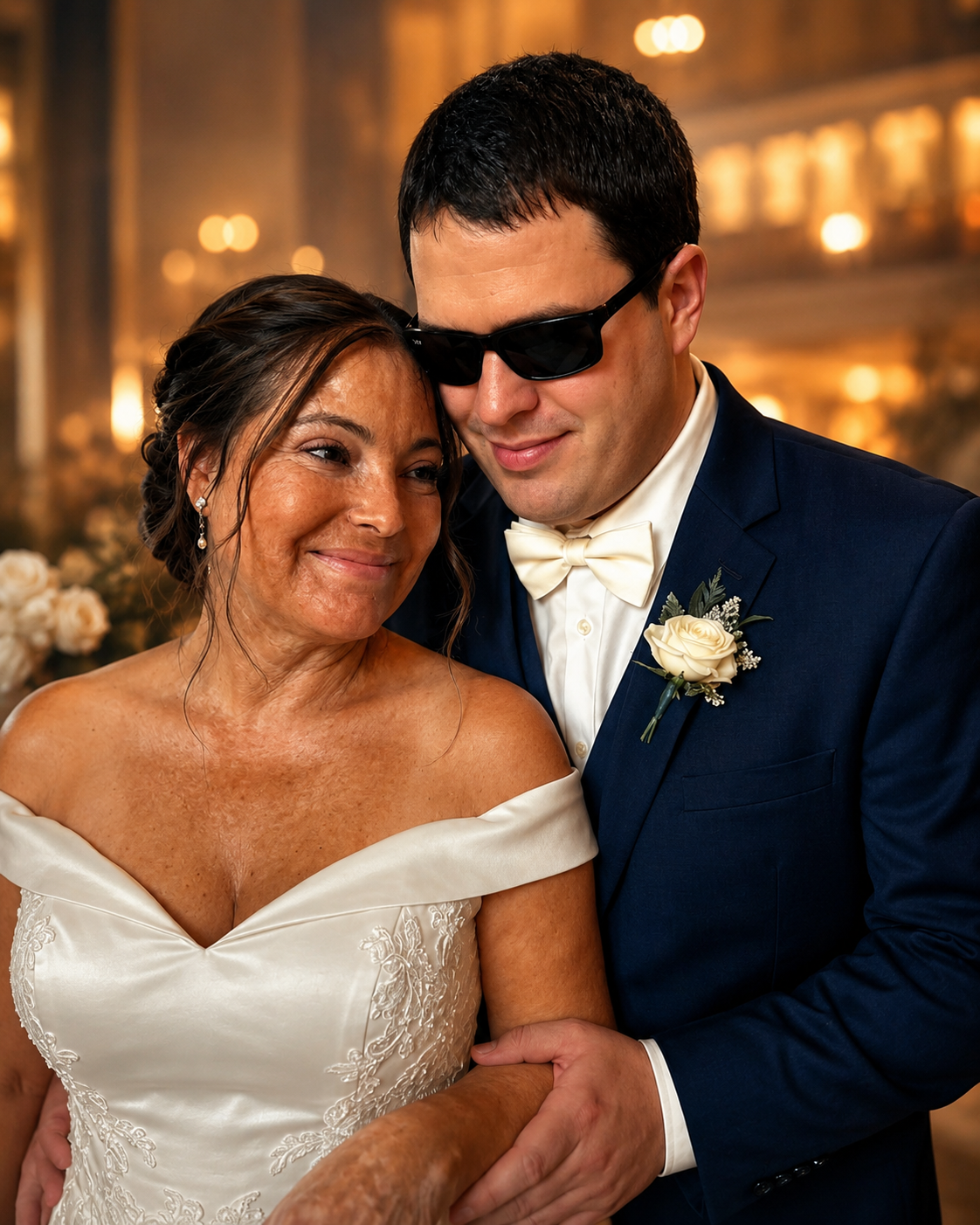
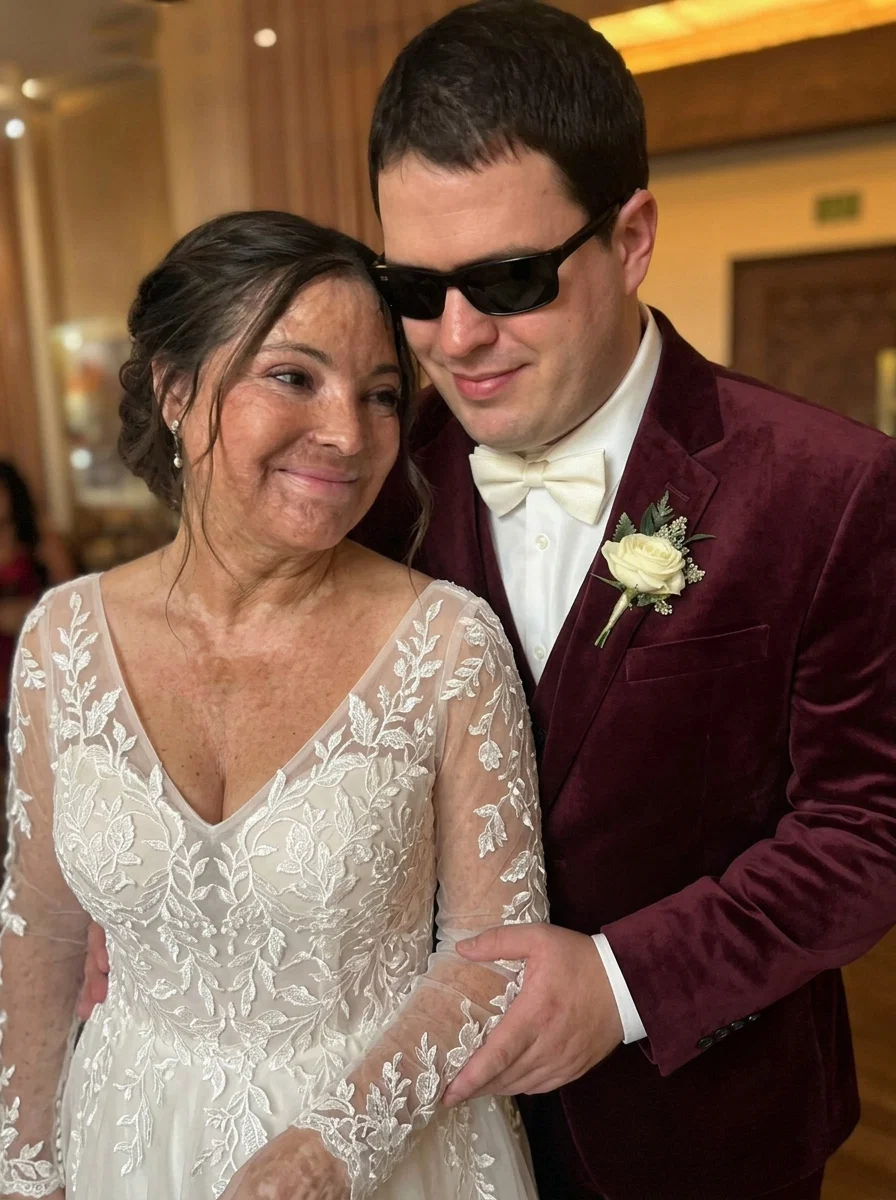
I married a blind man because I believed he would never be able to see the parts of me that the world had spent years examining, judging, and remembering. I thought his darkness would become my shelter. But on the night we became husband and wife, his fingertips traced every scar the fire had left behind, he called me beautiful without hesitation, and then revealed a truth so devastating that it shattered the fragile sense of security I had spent years trying to build.
On the morning of my wedding, it wasn’t me who cried first.
It was my sister.
Lorie stood behind me in the small dressing room at the church, her hands covering her mouth as she stared at my reflection in the mirror. Her eyes were filled with emotion, as though she could still see the frightened thirteen-year-old girl hidden beneath the elegant gown, makeup, and carefully styled hair.
My dress was a soft ivory shade, with long sleeves and a high neckline. I had chosen it partly because it was beautiful and partly because it concealed so much of my skin. Lorie had spent the entire morning telling me how stunning I looked, and eventually I stopped arguing with her long enough to let myself hear the compliment.
“You look absolutely beautiful, Merry,” she whispered as tears rolled down her cheeks.
Beautiful.
Even after all these years, that word still felt foreign.
When I was thirteen, lying in a hospital bed with severe burns covering half my body and face, I heard very different words.
A police officer stood beside my bed and explained that a gas leak in a neighboring apartment had caused an explosion. He told me I was fortunate to be alive.
Fortunate.
That word meant waking up inside a body that no longer felt like mine. It meant seeing fear, pity, curiosity, and discomfort in other people’s eyes. It meant hearing children whisper when they thought I couldn’t hear them and watching adults look away too quickly whenever our eyes met.
By then, our parents were already gone.
For a while, our aunt cared for us, but when she passed away as well, Lorie was only eighteen years old. Overnight, she became my guardian, my protector, my family, and my entire support system.
She was the one who ran beside the ambulance after the explosion.
She was the one who sat beside my hospital bed during endless surgeries and painful recoveries.
She was the one who quietly carried every burden I was too young and broken to carry myself.
And now, on my wedding day, she stood in front of me, squeezed my hands, and softly asked:
“Are you ready?”
I wiped away my tears and nodded.
Then I walked toward the man who changed everything.
I first met Callahan in the basement of the very church where we were now standing.
Three afternoons each week, he taught piano lessons to children who rarely kept proper rhythm and often sang louder than they played.
The first time I heard his voice, he was patiently correcting a young boy who kept rushing through a simple melody.
“Let’s try again,” Callahan said kindly. “This time slower, buddy. The song isn’t going anywhere.”
I smiled before I even saw him.
When I finally did, he was seated at an upright piano wearing dark glasses. One hand rested lightly on the keys while the other scratched behind the ears of a golden retriever lying peacefully beside him.
The dog’s name was Buddy.
He wore a service harness and carried the calm, wise expression of a creature who seemed to understand more about life than most humans ever would.
At that point, I was thirty years old.
I had never had many serious relationships.
Most men noticed my scars before they noticed anything else.
Their eyes always lingered a second too long.
Some tried not to stare.
Others stared openly.
Eventually, I grew tired of all of it.
People looked at my skin and decided they already knew my story.
Nobody seemed interested in looking deep enough to discover my heart.
But Callahan was different.
Despite his blindness, he somehow saw me more clearly than anyone else ever had.
On our first date, I nervously stared at the diner table and quietly said:
“There’s something you should know. I don’t really look like other women.”
He smiled immediately.
Then he reached across the table and took my hand.
“That’s good,” he said. “Ordinary has never interested me.”
I laughed so hard that tears filled my eyes.
Looking back, maybe that should have been my first warning.
By the time my sister placed my hand into his at the altar, every one of those memories was already making me emotional.
Callahan stood waiting with Buddy beside him.
The dog wore a tiny black bow tie chosen by one of Callahan’s students, who had insisted it was absolutely necessary for the occasion.
The same students had volunteered to perform a love song while I walked down the aisle.
The result was chaotic, off-key, and completely imperfect.
Notes were missed.
Rhythms were lost.
Voices cracked.
Yet somehow it was one of the sweetest things I had ever heard.
When the pastor asked whether I would take Callahan as my husband, I answered before he even finished asking the question.
The celebration afterward was simple but joyful.
There were hugs from friends.
Slices of inexpensive wedding cake.
Paper cups filled with fruit punch.
Children chasing one another beneath folding tables.
And Lorie repeatedly pretending she wasn’t crying every time she looked at me.
For one glorious evening, I wasn’t the woman with scars.
I wasn’t someone people pitied or politely ignored.
I was simply the bride.
After sunset, Lorie drove us to Callahan’s apartment.
Buddy entered first, exhausted from being the center of attention all day.
He wandered toward the bedroom and collapsed beside the doorway with a deep sigh that suggested he considered his responsibilities officially complete.
At the entrance, Lorie hugged me tightly.
“You deserve happiness, Merry,” she whispered. “I’m so happy for you.”
Then she left.
And suddenly, for the first time, it was just me and my husband.
The silence of marriage settled around us.
I gently guided Callahan toward the bedroom.
When we reached the bed, he turned toward me.
Unexpectedly, I felt more nervous than I had during the ceremony.
Not because he could see me.
Because he couldn’t.
A small part of me had always believed that Callahan’s blindness was the reason our relationship worked.
With him, I never had to worry about the moment someone’s expression changed after seeing my scars.
I never had to wonder whether love would survive the first real look.
Slowly, he raised a hand.
“Merritt,” he said softly. “May I?”
I nodded.
His fingertips brushed my cheek.
Then my jaw.
Then the raised scars along my throat and collarbone.
For a moment, instinct urged me to pull away.
Years of hiding do not disappear overnight.
But Callahan’s touch was so gentle, so careful, that I allowed him to continue.
Then he whispered the words that broke something open inside me.
“You’re beautiful.”
I collapsed into tears.
I buried my face against his shoulder and cried harder than I had in years.
Because for the first time since the accident, I felt truly seen without being judged.
I felt loved without being examined.
I felt safe.
Then Callahan suddenly grew tense.
After a long silence, he quietly said:
“There’s something I need to tell you. Something that will completely change the way you see me. You deserve to know the truth I’ve hidden for twenty years.”
I laughed through my tears.
“What is it?” I teased weakly. “Can you secretly see after all?”
He didn’t laugh.
Instead, he took both of my hands.
“Do you remember the explosion in your kitchen?” he asked quietly. “The one you barely survived?”
Everything inside me stopped.
I had never told him about the explosion.
I had only mentioned that my scars came from an accident when I was young.
Nothing more.
Never the details.
Never the fire.
Never the nightmare.
Those memories remained locked away in a place I rarely visited myself.
I pulled my hands away.
“How do you know about that?”
Callahan lowered his head.
“Because there’s something you don’t know.”
A cold feeling spread through my chest.
“What are you talking about?”
Slowly, he removed his glasses.
For one terrifying second, I thought he was about to confess that his blindness was fake.
That our entire relationship had been built on deception.
But then he turned toward my voice and slightly beyond it.
His eyes focused on nothing.
On darkness.
And I understood.
He truly could not see.
Then he spoke.
“I was there that day, Merry.”
My legs weakened beneath me.
I sat heavily on the edge of the bed.
“I was sixteen years old,” he continued. “A few friends and I were visiting Mike. He lived near your apartment.”
I recognized the name immediately.
Mike was our neighbor’s son.
The loud one.
The reckless one.
Callahan swallowed hard.
“We were stupid teenagers doing dangerous things we didn’t fully understand.”
Slowly, piece by piece, he told me what happened.
The boys had been fooling around with gasoline behind the building.
Showing off.
Taking risks.
Daring one another.
Trying to impress each other with the arrogance only teenage boys possess.
Then one careless mistake created a spark.
A leak became a disaster.
And everything changed.
When the fire erupted, they ran.
Every single one of them.
No one stayed.
No one helped.
Shortly afterward, Mike’s family moved away.
But Callahan remained.
Days later, he saw a newspaper article.
A young girl named Merritt had survived.
Barely.
The article described severe burns and permanent scarring.
He never forgot those words.
Then tragedy struck his own life.
Months later, a car accident killed his parents and brother.
The crash also took his eyesight.
From that point forward, he carried both grief and guilt completely alone.
I was crying before I even realized tears were falling.
The room suddenly felt crowded with ghosts from a past neither of us had escaped.
“Why didn’t you tell me?” I whispered.
Callahan gave a hollow, painful laugh.
“At first, I wasn’t sure it was really you. Then you told me your name, and I became terrified.”
Eventually, he confirmed the truth through a mutual acquaintance.
The woman he loved was the same girl injured in the explosion.
The same girl whose suffering had haunted him for two decades.
He considered walking away.
He couldn’t.
“I kept thinking that if I told you too soon, you’d leave before I had the chance to show you how much I loved you.”
I stared at him.
“You took that choice away from me.”
His head dropped lower.
“You let me marry you without knowing the truth,” I said. “Without knowing what happened.”
“I know.”
That was the worst part.
He wasn’t making excuses.
He wasn’t denying responsibility.
He understood exactly how deeply he had hurt me.
And still, he waited until after our vows to tell me.
Part of me wanted to scream.
Part of me wanted to run.
Yet another part remembered the man who had just called me beautiful and meant every word.
The contradiction tore me apart.
“I need some air,” I whispered.
I barely heard him offer to sleep in the guest room.
I grabbed my coat and left.
A bride wandering alone through the freezing night.
Wedding pins still in her hair.
Tears streaming down her face.
A future she no longer understood unraveling with every step.
Eventually, I found myself standing outside the house where I grew up.
It was empty now.
But it still held every memory.
I called Lorie.
Because sometimes only the person who knew you before the scars can help you survive what comes afterward.
She arrived within minutes.
One look at my face told her everything.
After I explained what happened, I whispered:
“Part of me wants to hate him. But another part remembers how he made me feel seen.”
Lorie wrapped her arms around me.
She said nothing.
Because there were no words large enough for what I was carrying.
She drove me back to her apartment.
I spent the night on her couch staring at the ceiling.
By morning, one truth had become clear.
Running from pain had already stolen too much of my life.
I wasn’t going to let fear make this decision for me too.
I borrowed a sweater from Lorie and pulled on an old pair of jeans.
She watched me tie my shoes.
“Are you sure about this?”
“No,” I admitted honestly. “But I have to go.”
She smiled through tears.
“I’m proud of you.”
I walked to Callahan’s apartment.
I needed time to think.
I needed the cold air.
I needed the silence.
Buddy heard me before anyone else.
The sound of his paws echoed across the floor before I even reached the stairs.
The moment I opened the door, he rushed toward me and nearly knocked me over with excitement and relief.
Callahan was standing in the kitchen.
The second I stepped inside, he turned his head.
“Merry,” he breathed. “You came back.”
“How did you know it was me?”
A sad smile appeared on his face.
“Buddy knew first,” he said softly. “My heart knew second.”
He stepped toward me carefully.
One hand reached out ahead of him.
He nearly caught his foot on the edge of a rug.
Without thinking, I grabbed his wrist.
He froze beneath my touch.
Then, gently, his fingers found my face once more.
“You are the most beautiful woman I have ever known, Merry.”
The sincerity in his voice struck harder than any apology.
Then, suddenly, I noticed a faint smell drifting through the room.
Something was burning.
And when I looked past him toward the stove, my heart skipped a beat.
“Callie! Are you seriously burning something over there?”
He tilted his head, genuinely confused.
“Burning something? No, I don’t think so.”
I looked toward the stove and immediately burst into laughter.
The omelet sitting in the frying pan had transformed into a blackened disaster. Smoke curled lazily toward the ceiling while the edges crackled beyond salvation.
I laughed so hard I had to grab the counter for support.
Buddy instantly sprang to his feet and began barking excitedly, as if happiness itself had suddenly become a language he understood perfectly.
A moment later, Callahan started laughing too.
Not a forced laugh.
Not a nervous one.
A real laugh.
The first genuine laugh I had heard from him since the confession that had shattered our wedding night.
Through tears and laughter, I pointed toward the stove.
“Well,” I managed to say between breaths, “I guess we’ve already settled one important issue.”
“What issue is that?” he asked.
I smiled.
“The kitchen officially belongs to me now.”
Callahan groaned dramatically.
“That’s unfair. I haven’t even had a chance to defend myself.”
“You set breakfast on fire.”
“It was only slightly overcooked.”
“It’s practically charcoal.”
“That seems a little harsh.”
Buddy barked again as if casting his vote in the argument.
I laughed even harder.
And for the first time since learning the truth, the crushing weight inside my chest eased.
That small, ridiculous moment became my very first official decision as a married woman.
Callahan was permanently banned from cooking unsupervised.
Buddy stretched out beneath the kitchen table like a mediator who had successfully negotiated peace between two exhausted nations. Every time either of us laughed, his tail thumped happily against the floor.
The apartment slowly filled with something that had been missing since the night before.
Hope.
Not the fragile kind built on secrets.
Not the temporary kind built on avoidance.
Real hope.
The kind that survives truth.
Over the weeks that followed, Callahan and I had difficult conversations. Some lasted for hours. Some ended in tears. Some ended in silence.
Forgiveness did not arrive all at once.
Trust did not magically repair itself overnight.
There were days when I felt angry.
Days when I felt confused.
Days when I looked at him and saw the frightened sixteen-year-old boy who ran away from a disaster.
And there were days when I looked at him and saw the man who spent years carrying guilt that slowly hollowed him out from the inside.
For the first time, we stopped hiding from the past.
He told me everything.
And I told him everything.
The fears.
The nightmares.
The loneliness.
The shame.
The years I spent believing that my scars were the first thing people saw and the only thing they remembered.
Callahan listened to every word.
He never interrupted.
He never tried to minimize my pain.
He simply held my hand and listened.
One evening, several months later, we were sitting on the porch while Buddy slept nearby.
The sun had already disappeared, and the world was wrapped in darkness.
For a long moment, neither of us spoke.
Then Callahan quietly asked:
“Do you ever wish you had never met me?”
I looked at him.
At the man who had broken my heart and helped heal it.
At the man who carried his own scars, invisible to everyone except himself.
And I answered honestly.
“No.”
He swallowed hard.
“Even after everything?”
“Yes.”
“Why?”
I reached for his hand.
Because finally, after all those years, I knew the answer.
“Because you never looked at me the way everyone else did.”
His fingers tightened around mine.
“But I couldn’t even see you.”
I smiled softly.
“That’s exactly why.”
For most of my life, people saw my scars before they saw me.
They saw damage.
They saw tragedy.
They saw something broken.
But Callahan never saw any of that.
He saw my voice.
My laughter.
My kindness.
My stubbornness.
My heart.
And somehow, despite carrying his own guilt and darkness, he loved all of it.
For years, I believed my scars were the worst thing about me.
Now I understand they were never the problem.
The problem was believing they defined me.
What happened that day was not my fault.
It never was.
And perhaps the greatest gift I received was realizing that the person who knew the darkest truth connected to my scars still found me worthy of love.
Not despite what happened.
Not because he pitied me.
But because he saw who I truly was beneath it all.
These days, when I catch my reflection in a mirror, I no longer search for the damage first.
I see a survivor.
I see a wife.
I see a woman who learned that healing does not come from hiding wounds.
It comes from allowing yourself to be loved with them.
And every morning, when Callahan reaches across the bed to find my hand before he says a single word, I remember something important.
Some people spend their entire lives being looked at.
Very few are ever truly seen.
I was fortunate enough to find someone who saw me through nothing but darkness.
And in the end, that changed everything.

