Light at the end of the blizzard: why that encounter on the winter road became my salvation
That night, the road seemed endless. The snow fell thick and heavy, as if someone had covered the world with a thick blanket from above, trying to muffle all sounds. The headlights illuminated only a narrow strip of asphalt, beyond which lay a cold, impenetrable void.
I drove slowly, gripping the steering wheel so tightly that my fingers hurt. My thoughts kept returning to my parents’ house, where my children were waiting for me. Emma and Jake had probably already pestered their grandmother with questions: ‘Where’s Mummy? Will she be back in time for the presents?’ This Christmas Eve was special for us — and painful. It was the first year since their father left. He just walked out the door, leaving me with two children and an empty silence that I had to learn to fill myself. I was coping. But on nights like this, the fatigue weighed so heavily that I wanted to stop in the middle of the forest and scream.

At the bend, I saw him.
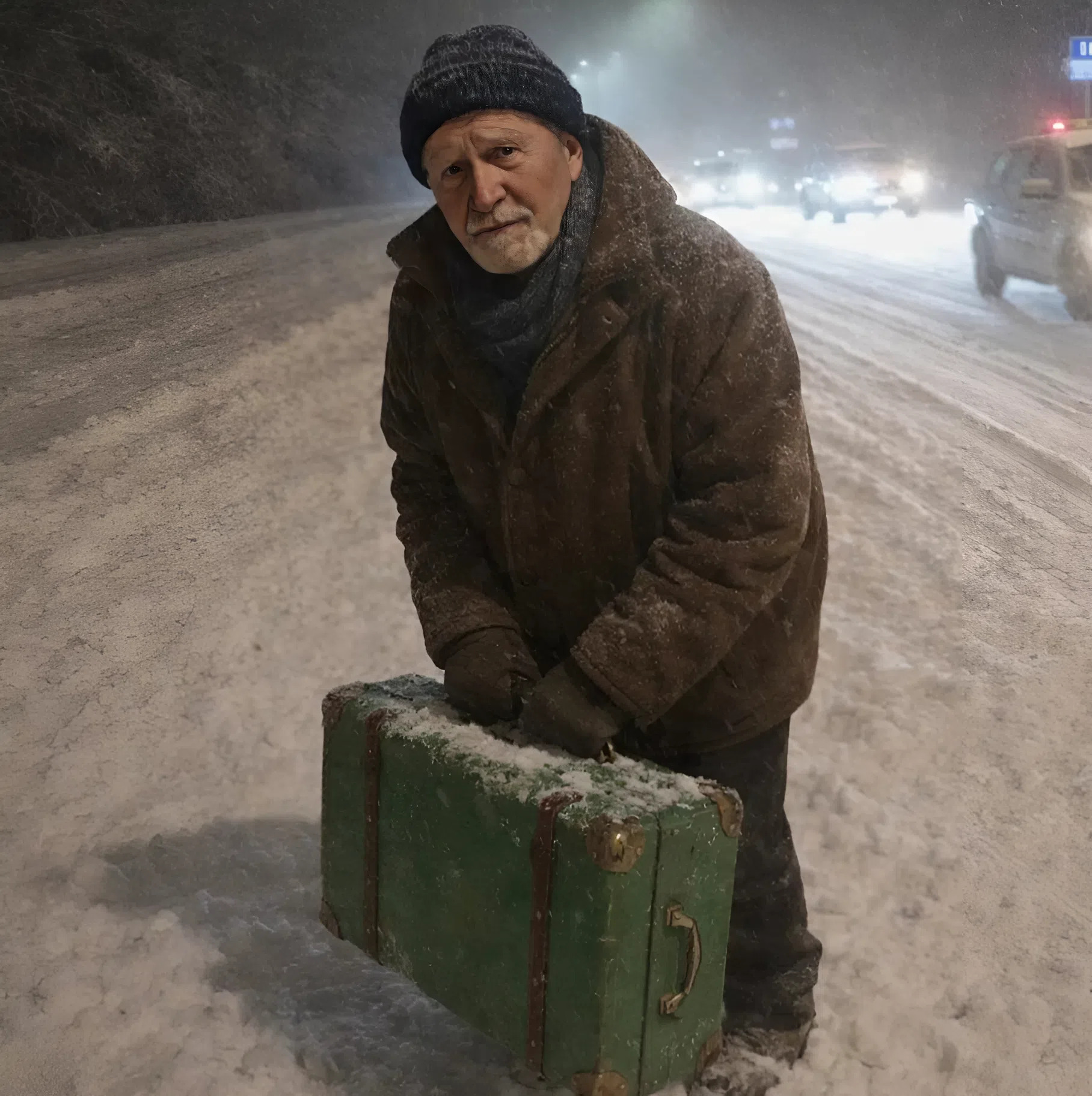
At first, it was just a shadow. Then the headlights caught a hunched figure. An old man in a worn coat was walking slowly along the side of the road. He was carrying an old leather suitcase with a cracked handle. He walked as if each step was a small victory over death.
My mind screamed, ‘Drive past! It’s dangerous!’ But I hit the brakes. The window rolled down with a heavy creak, and the icy air instantly filled the car.
‘Excuse me!’ I shouted. ‘Do you need help? It’s almost thirty degrees below zero outside!’
The man shuddered and slowly turned his head. His face was covered with wrinkles, his eyelashes with frost, but there was no aggression in his eyes—only bottomless, frozen confusion.
‘I need to get to Miltaun,’ he croaked. ‘My family is waiting for me there. They’re expecting me for dinner.’
I knew that town. It was at least five hours away on an icy mountain road.
‘You won’t make it there today,’ I said cautiously. ‘The roads are closed. Get in, I’ll take you to our place. It’s warm there.’
He stood motionless, staring at his snow-covered boots.
‘But today is Christmas…’ he whispered, and there was so much despair in that whisper that my heart sank. ‘They’re waiting…’
‘Get in,’ I opened the passenger door. ‘Please.’
He sat on the very edge of the seat, as if afraid of taking up too much space. He put his suitcase at his feet and held it by the handle the whole time.
‘My name is Frank,’ he said when the warmth began to slowly thaw his fingers.
‘Maria. Have some tea, there’s still some in the thermos.’
We drove in silence. I could see his hands — red and gnarled — trembling slightly. Sometimes silence is the safest conversation.
The truth in the kitchen
At home, my mother greeted him as if we had brought an old friend. She simply took his coat and pointed to the armchair by the fireplace.
‘No one should be alone on a night like this,’ she said.
In the morning, the house was filled with the smell of cinnamon and children’s laughter. Emma immediately brought Frank her drawings, and Jake began asking what was in the suitcase and whether he was Santa Claus’s helper. Frank smiled, but there was tension in his eyes. He sat upright, glancing at the door as if waiting for someone to come for him.
When the children ran off to play, he stared into his cup for a long time, then sighed deeply.
‘Maria… I have to tell you the truth. I lied to you on the road.’
‘What are you talking about?’ I asked.
‘I have no one in Miltaun,’ he said quietly, his voice breaking. ‘No one is waiting for me. I left the nursing home.’
He lowered his head, hiding his tears.
“It’s not because I’m a criminal. I just couldn’t stay there anymore. It was so cold there… not outside, but inside. Almost no one noticed us. I felt like I was disappearing, becoming an empty space, just a number in a report. I was afraid that if I told the truth, you would call the police and they would take me back to that emptiness.
‘Why did you decide to leave now?’ I asked, sitting down next to him.
‘At Christmas, loneliness becomes unbearable,’ he smiled bitterly. “At my age, asking for help is the scariest thing. I thought I’d go to the city, sit at the station, just watch people. To feel alive again.
He got up, reaching for his worn suitcase.
‘Forgive me. I’ll leave now. I don’t want to be a burden.’
I walked over and took his hand firmly.
‘Sit down, Frank. No one is left alone in this house. And you are not a burden. You are our guest. And the children seem to really need a grandfather.’
A gift from the suitcase
Frank stayed. First for the holidays, then longer. He became part of our lives. He repaired old things, read to the children before bed, taught them patience. He didn’t replace their father, but he became the support they so desperately needed.
One evening, he opened his suitcase.
‘I’ve kept this for forty years. It’s all that’s left of my wife.’
There was a sunrise — warm, vibrant, bathed in light.
‘This painting will help you,’ he said. ‘And it’s enough for me that I’m a person again, not a number.’
Frank lived with us for five years. He passed away quietly in his sleep. And now, when I drive through a snowstorm, I always look at the side of the road. Because I know that sometimes, behind an ordinary door or in the oldest suitcase, there is a whole world waiting for a chance to warm up.