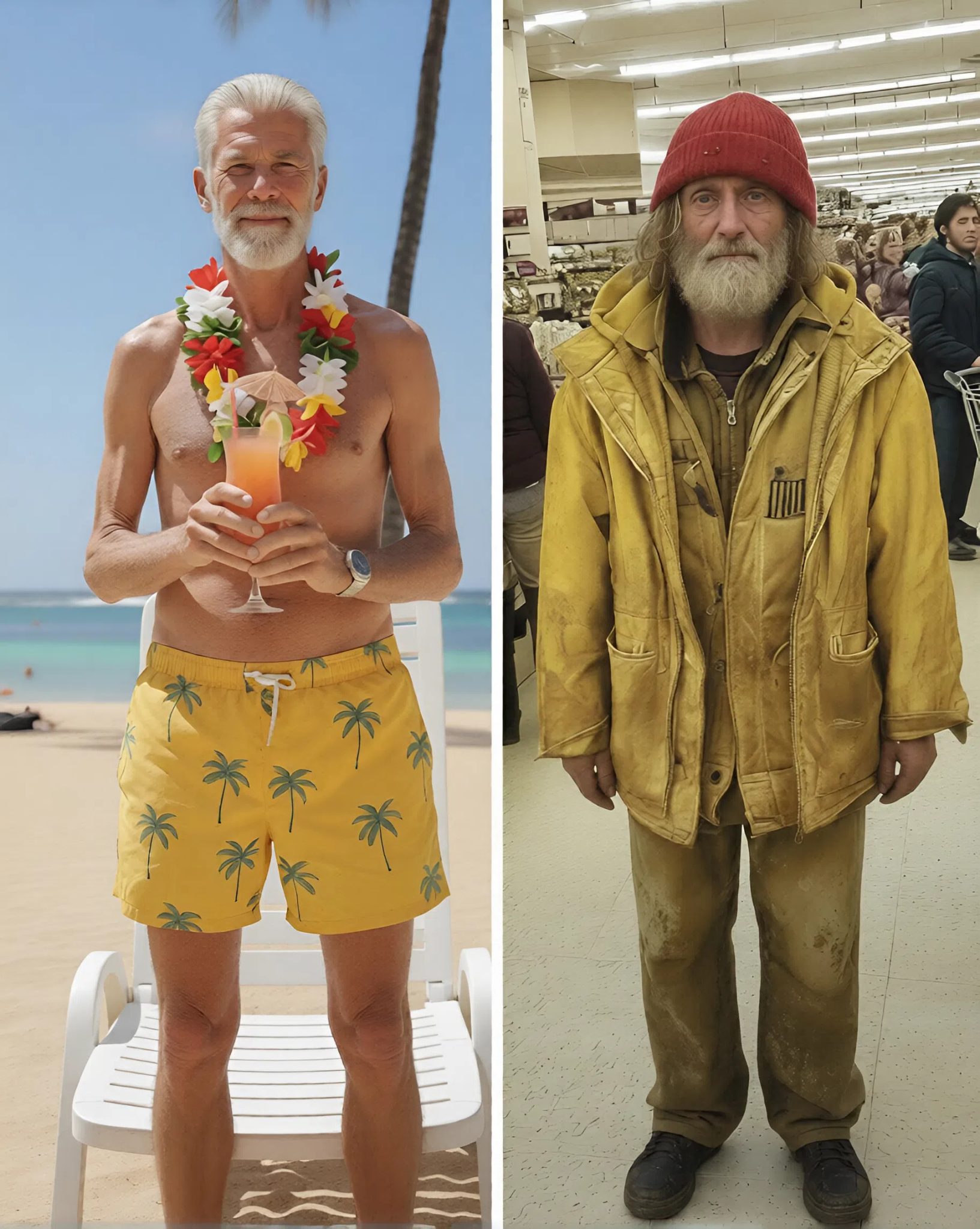
I am ninety years old. I dressed in rags and pretended to be homeless so I could go into one of my supermarkets and find out which of the people around me were truly human. What I saw shocked me and changed my whole life.
My name is Mr. Hutchins. For seventy years, I built and ran the largest grocery store chain in Texas. It all started with a single cramped shop after the war, when bread cost pennies and doors were rarely locked. By the time I was eighty, we had stores in five states, and my name was emblazoned on signs, contracts, and receipts. But wealth doesn’t keep you warm at night. When I became very lonely after my wife died in 1992, I realized that when I was gone, who would get all this? I didn’t want to leave my fortune in the hands of cunning lawyers or greedy directors. I wanted my heir to be someone who knew the value of money and treated others humanely — even when no one was watching.
So I decided to set up a test.

I put on some old clothes, didn’t shave for a few days, smudged my face a little, and walked into one of my supermarkets looking like I hadn’t eaten in a week. At that moment, the store I had spent years building became a foreign place to me. People stared and whispered. One young cashier snorted and whispered loudly to her colleague, “Ugh, he smells like meat.” Someone squeezed a child’s hand and pulled them away. The floor manager, Kyle Ransom—a man I had promoted a couple of years ago—came over and asked me to leave without further ado: “We’re getting complaints, please don’t interfere.” He didn’t recognize me and turned away as if I were trash, not the one who paid his salary and gave him bonuses.
I was about to leave when someone touched my arm. It was a young man in his thirties with a faded tie and tired eyes. His badge read, “Lewis, Junior Administrator.” He gently suggested, “Come on, I’ll get you something to eat.” In the break room, he poured me a hot cup of coffee, handed me a sandwich, and sat down across from me. “You remind me of my father,” he said quietly. He told me that his father, a Vietnam veteran, had recently passed away. “I don’t know your story, sir. But you are important. Don’t let these people decide your worth.”
I could barely contain my emotions. That day, I managed to keep up appearances, but my heart already knew that this young man was special. I returned home with tears in my eyes and rewrote my will that same night. Everything—the stores, the money—I am leaving to Lewis. Not because he was a relative, but because he showed the humanity that I so lacked in my old age.
A week later, I came to the same store without a mask: in an expensive suit, with a driver. I was treated like a king: smiles, assistance. Kyle and that cashier suddenly turned into well-groomed employees, apologizing. But Lewis, when our eyes met, just nodded quietly, and there were no flattering smiles or greed on his face. He didn’t say anything unnecessary, but in his voice on the phone, when he later confessed, the truth rang out: he realized it was me, but kept quiet because “kindness should not depend on status.”
I announced the dismissal of Kyle and the cashier. I led the ceremony and stood in front of the staff: “This man is your new boss and the heir to my chain.” People were shocked. But a few days later, a letter arrived in a plain white envelope with one short sentence: “Don’t trust Lewis. Check the prison records, Huntsville, 2012.” I had to check it out quietly.
It turned out that when he was 19, Lewis had been convicted of car theft and served about a year and a half in prison. I called him and asked him directly why he had hidden this. He didn’t try to justify himself: “I was young, I messed up. In prison, I saw who I didn’t want to be. I’m changing. I didn’t hide it because I knew that if you found out, you would close the door on me. I just wanted to show that I can act like a human being.” He admitted his guilt openly and honestly.
Looking at him, I realized that past mistakes do not negate inner change. But soon a barrage of calls and complaints began—relatives who hadn’t heard from me in decades showed up with complaints; one of them, Denise, my late brother’s niece, came to my house dressed to the nines and declared that such a decision was “absurd.” She even broke into my office, rummaged through my papers, and threatened, “We won’t let you do this; we’ll disgrace Lewis.” It became clear to me that Lewis would not only get the good stuff — he could be targeted.
I called Lewis back to my real office and told him everything: about the masks, the will, the letter, and the family threats. And then he did something that killed me: he said he didn’t want my money. “I don’t want to become a target, Mr. Hutchins. It was important for me to prove that humanity exists. Money will only bring me trouble.” He offered an alternative: to create a fund to help the homeless, ex-convicts, and poor families — to give a chance to those who, like him, had once made mistakes.
This decision turned out to be a true legacy—not to rule over money, but to take responsibility. I transferred my entire fortune to a new foundation—the Hutchins Foundation for Human Dignity—and opened shelters, scholarships for those leaving prison, and food banks in the states where my stores operated. And I appointed Lewis as the foundation’s director for life. Not because he needed the money, but because he knew how to treat people and bring out the best in them.
I am ninety years old, and I may only have a few months or days left to live. But I die with the feeling that I did the right thing: my “heir” is not just a person at the helm of companies, he is someone who understands the value of human dignity. And if you think that kindness doesn’t matter, remember Lewis’ words: “It doesn’t matter who is in front of you. What matters is who you are.”