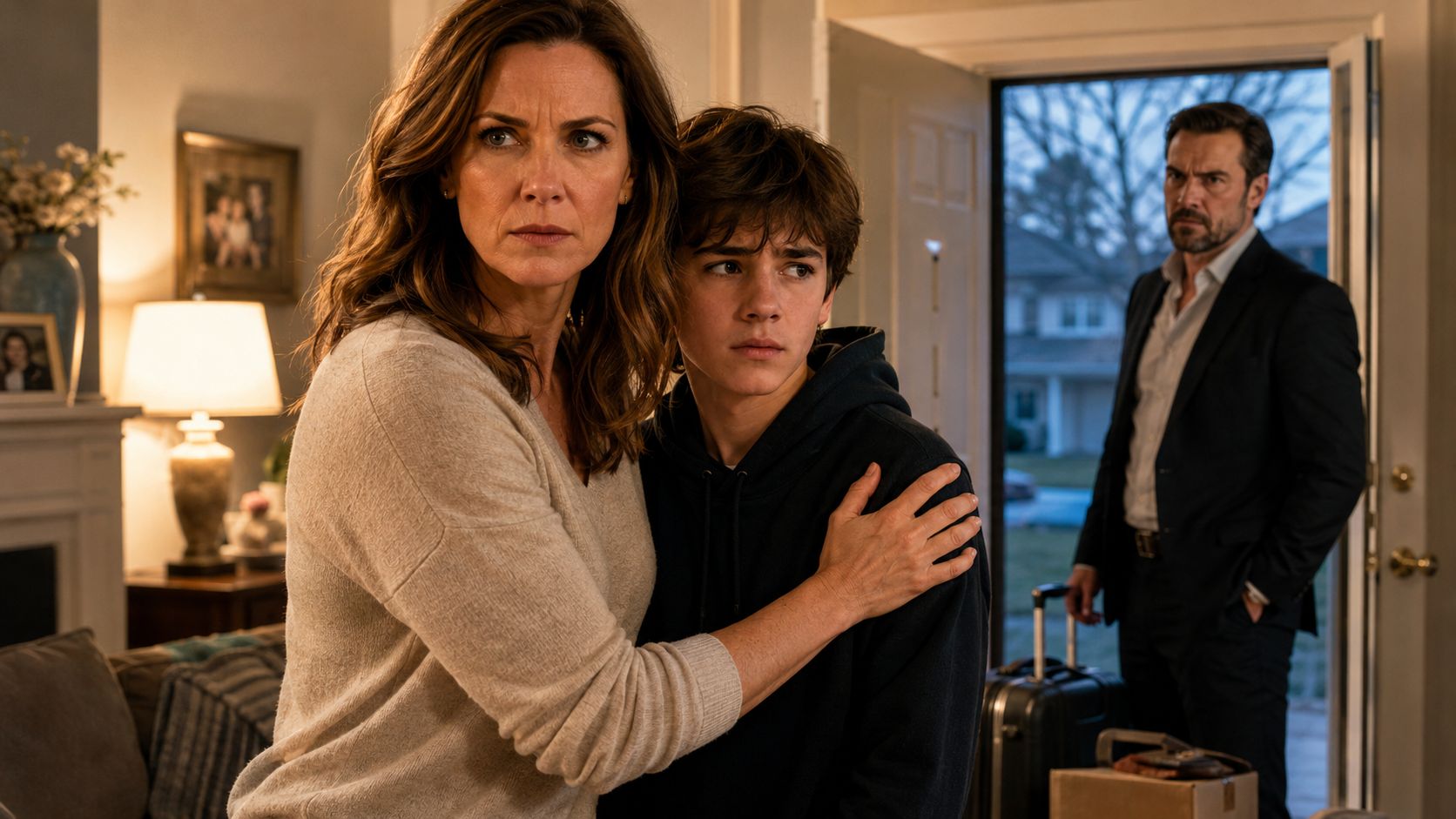
“Oh, sweetheart.”
“I did want him gone,” Caleb whispered. “But I didn’t want you sad.”
Olivia pulled him close.
“I was sad with him,” she said. “I was just calling it marriage.”
That was the moment Caleb finally cried.
Not quietly.
Not neatly.
He cried like a boy who had spent months folding himself smaller and smaller until there was nowhere left to fold.
Olivia held him and let him fall apart.
A week later, Caleb came home.
He paused in the doorway as if asking permission from the house itself.
The hallway looked different. Adrian’s framed city prints were gone. His steel umbrella stand was gone. His sharp black console table was gone.
In their place, there was space.
Caleb stepped inside carefully.
His shoes squeaked on the floor.
Olivia waited.
He looked toward the stairs. “Is my room still…”
“Your room is your room.”
He nodded.
Then, after a long moment, he dropped his backpack by the door.
Normally Olivia would have told him to put it away.
Instead, she let it sit there.
A backpack by the door had never been disrespect.
It had been proof that a child came home.
That night, Caleb played music in his room.
Not loudly.
Just enough for Olivia to hear the bass through the ceiling while she stood in the kitchen making pasta.
For months, the house had been managed like a hotel lobby. Quiet. Clean. Presentable. Dead.
Now there was music upstairs.
A spoon clattered in the sink.
The dryer buzzed.
Caleb shouted down, “Mom, do we still have parmesan?”
Olivia pressed both hands to the counter and cried.
Not because she was broken.
Because the house was breathing again.
The divorce turned ugly quickly.
Adrian hired an attorney who wrote emails like polished threats. He claimed Olivia had unlawfully removed him from the marital home. He requested temporary access to the property. He asked for reimbursement for household expenses. He accused Olivia of alienating him from the family and creating a hostile environment.
Then his attorney made the mistake of mentioning Caleb.
He suggested the court should consider whether Caleb’s “emotional volatility” had contributed to the breakdown of the marriage.
Marisol Keene smiled when she read that part.
It was not a warm smile.
It was the kind of smile a surgeon might give before picking up a scalpel.
“He should have left your son out of it,” Marisol said.
Olivia sat across from her in the office, hands folded in her lap.
“We have the recording,” Marisol continued. “We have the deed. We have the prenuptial agreement. We have the loan documents you found. We have the messages where he complained about Caleb. And now we have his attorney putting this theory in writing.”
She tapped the file.
“He thinks he is building a case against your son. He is building one against himself.”
The temporary hearing took place in a small courtroom that smelled faintly of paper, old carpet, and coffee.
Adrian arrived in a navy suit.
He looked tired, but carefully tired. The kind of tired meant to be seen. He had not shaved completely, leaving just enough shadow on his jaw to appear wounded rather than careless.
When he saw Olivia, his face softened.
It was almost impressive.
She remembered falling for that face once.
The tender eyes. The lowered voice. The way he made every apology sound like a confession and every confession sound like love.
Now she saw the performance beneath it.
His attorney argued first.
He described Adrian as a devoted husband pushed out of his home after a disagreement. He said Olivia acted impulsively. He said Adrian had contributed emotionally and financially to the household. He said no spouse should be locked out without due process.
Then Marisol stood.
She did not raise her voice.
She did not need to.
She played the recording.
The courtroom heard Adrian say foster care.
Adrian stared at the table.
His attorney shifted in his seat.
Then Marisol introduced the messages.
One read:
“You keep acting like Caleb is your partner. He is not. I am.”
Another:
“I did not marry a woman just to come second to a teenage boy.”
Another:
“You have three years until he leaves. I am your future, Olivia. Stop making me compete with your past.”
Olivia had cried the first time she reread those messages.
Now she listened without flinching.
The judge looked at Adrian over her glasses.
“Mr. Vale, did you suggest your wife place her minor child in foster care?”
Adrian cleared his throat.
“Your Honor, the statement was taken out of context.”
“What context makes that suggestion appropriate?”
Silence.
The judge continued. “Did you refer to the home as a financial asset in loan documents related to your private business?”
Adrian’s attorney stood. “Your Honor, those documents were preliminary and unsigned.”
“That was not my question.”
Adrian’s jaw tightened.