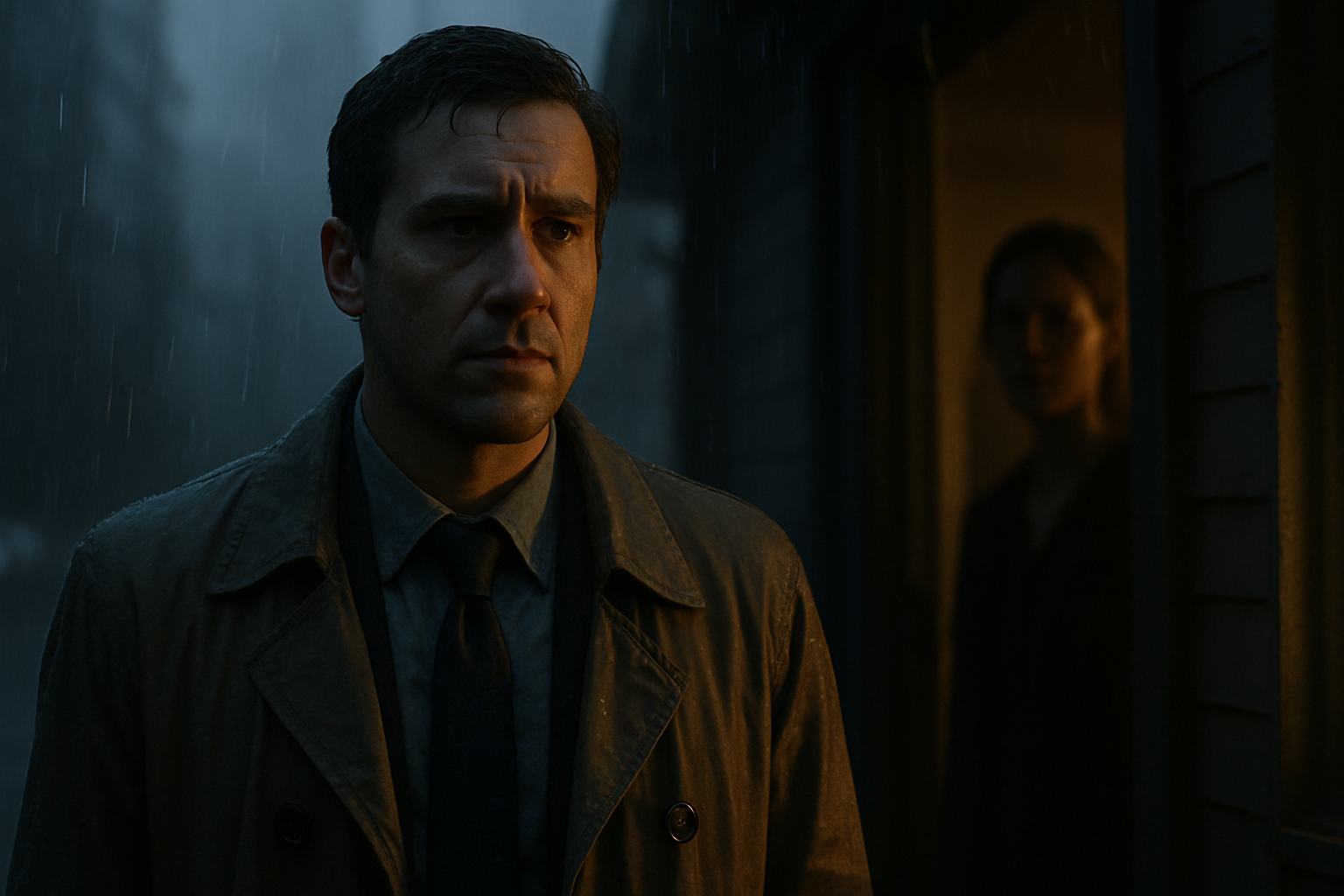
He Stopped in the Rain, and the Truth Followed Him to Court
“You’re really going to court Monday?” Elise asked from the garage office doorway.
Jonah Mercer looked up from the battery tester in his hand.
“Really.”
“Against Voss Urban?”
He paused. “You know them?”
Everybody in Millbridge knew the Voss name. It was on cranes, glass towers, newspaper smiles, and old buildings that somehow stopped belonging to ordinary people.
But Elise’s face changed in a way that made the question heavier.
“My father has handled cases connected to their projects,” she said.
Her sister Nora shot her a warning look. “Elise.”
Jonah pretended not to notice. “Your father’s a lawyer?”
“Sort of,” Elise said.
Nora sighed. “He’s Judge Adrian Whitcomb.”
The name did not strike Jonah at first. Then it landed hard.
Judge Adrian Whitcomb was not just a judge. He was a pillar of Carter County. Old money. Old discipline. Former corporate attorney. Widower. Strict. Careful. Famous for not being charmed by anyone.
Jonah had seen his name on courthouse records, but not on his own hearing notice. His case was supposed to be before Judge Ruth Bellamy.
Still, his stomach tightened.
“You should’ve told me last night,” he said.
“Would you have stopped?” Nora asked.
Jonah looked at her. “Yes.”
“Then it shouldn’t matter.”
“It matters,” he said quietly, “because people make stories out of things when money’s involved. And I’m already trapped in one I don’t control.”
Elise lowered her eyes. “We didn’t ask you to help because of him.”
“I know.”
Nora folded her arms. “And for the record, our father does not do favors. If we asked him to help someone because we liked him, he’d lecture us about ethics until Christmas.”
Jonah believed that.
He also believed Sterling Voss’s lawyers could turn a cup of water into a flood if it helped drown him.
He finished inspecting their Range Rover, wrote a fair estimate, and told the sisters he could replace the battery and cables by Monday afternoon. Elise insisted on paying a deposit. Nora asked if anyone was going to court with him.
“My lawyer,” Jonah said. “Walter Keane.”
He did not mention that Walter was semi-retired, half-deaf in one ear, and charging him almost nothing because Jonah had once fixed his wife’s car in a snowstorm and refused extra cash.
Pride was foolish.
Sometimes it was all a man had left.
Before the sisters left, Elise paused at the door.
“That thing you said last night,” she said. “About people in power needing to hear how regular people get ground down.”
Jonah tightened the coolant cap. “I was tired.”
“That doesn’t mean you were wrong.”
Nora took her sister’s arm. “Come on.”
Jonah watched them go, then turned back to the Range Rover.
For the next two hours, every tool felt a little out of place. The world had shifted by half an inch. Not enough to see clearly. Just enough to feel it in his bones.
On Monday morning, the courthouse smelled of floor polish, wet wool, and fear.
Jonah wore his only suit, navy blue from a thrift store, the sleeves just short enough to tell the truth about him. Walter Keane sat beside him at the defense table, gray hair combed back with water, thick glasses low on his nose.
Across the aisle, Voss Urban Holdings had not sent a lawyer.
They had sent a legal army.
Sterling Voss sat in the front row in a charcoal suit, calm as a man watching a building come down after he had already bought the land under it. His lead attorney, Celeste Arden, arranged her files with graceful cruelty. Walter had warned Jonah about her.
“She smiles,” he had said, “while she cuts.”
“Breathe,” Walter whispered.
“I am.”
“No. You’re holding air hostage. Breathe.”
Jonah exhaled.
Then the clerk stood.
“All rise. The Court of Common Pleas of Carter County is now in session, the Honorable Adrian Whitcomb presiding by reassignment.”
Jonah’s blood went cold.
Judge Whitcomb entered in a black robe, silver hair neat, face composed. He had Elise and Nora’s eyes, but where theirs still moved with feeling, his looked locked behind years of discipline.
He sat. Opened the file. Scanned the first page.
When his gaze reached Jonah’s name, one flicker of recognition crossed his face.
Then it vanished.
Walter stiffened.
Before anyone else spoke, Celeste Arden rose.
“Your Honor, before preliminary matters, the plaintiff must raise a serious concern regarding potential improper influence.”
Walter muttered, “Here we go.”
Judge Whitcomb looked at her. “State your concern.”
Celeste turned slightly, just enough for the gallery to see the clean line of her profile.
“It has come to our attention that the defendant, Mr. Mercer, had contact with members of Your Honor’s immediate family late Friday night. Specifically, he rendered roadside assistance to your daughters, discussed this lawsuit with them, and provided his business card. Given the timing, less than seventy-two hours before this hearing, we believe the contact may have been orchestrated to create sympathy or access.”
The room went so silent Jonah could hear his own pulse.
Walter stood. “Your Honor, that allegation is outrageous.”
Celeste did not look at him.
“We have surveillance showing Mr. Mercer stopped behind the Whitcomb vehicle, spoke with both young women, and followed them to a motel. He then serviced their vehicle at his shop Saturday morning. The plaintiff does not accuse Your Honor of bias, of course, but the defendant’s conduct raises serious questions.”
Jonah slowly turned toward Sterling Voss.
The billionaire’s face did not change, but satisfaction lived around his mouth.
The black SUV under the overpass.
The headlights off.
Someone had been watching.
Jonah had thought he was saving two strangers in a storm. Voss’s people had turned it into a trap.
Judge Whitcomb’s face stayed unreadable.
“Mr. Mercer,” he said, “did you know who my daughters were when you stopped?”
Jonah stood because sitting felt cowardly.
“No, Your Honor. I saw two women stranded in a storm. I stopped because nobody else did.”
“Did you discuss this case?”
“They asked why I looked half-dead. I told them I was working two jobs because I was being sued over my garage. I did not know they were your daughters.”
Celeste lifted one brow. “Convenient.”
Walter’s voice cracked across the room. “Counsel should be careful.”
Judge Whitcomb raised one hand, and both lawyers stopped.
For the first time, his eyes moved past Jonah and fixed on Sterling Voss.
“Ms. Arden, you said you have surveillance.”
“Yes, Your Honor.”
“Why was the defendant under surveillance Friday night?”
Celeste hesitated.
It was small. Half a second.
But it was the first crack.
“My client hired an investigator to document patterns relevant to the lease dispute.”
“At 11:42 p.m. during a storm?”
“Investigators work irregular hours.”
Judge Whitcomb leaned back.
“And this investigator observed two young women stranded on the side of a service road in dangerous weather?”
Celeste’s mouth tightened. “I cannot speak to everything the investigator observed.”
“I can,” said a voice from the back.
Every head turned.
Nora Whitcomb stood in the gallery beside Elise. Both sisters were pale, but steady.
Jonah’s stomach dropped again.
He had not known they were there.
Judge Whitcomb’s jaw tightened. Not with anger at Jonah. With a father’s alarm trying to survive inside a judge’s restraint.
“Ms. Whitcomb,” he said, “you will sit down unless called.”
Nora sat.
Elise stayed standing just long enough to say, “He was there before Jonah stopped, Dad.”
Dad.
The word landed in the courtroom like something too human for such a cold place.
Judge Whitcomb closed his eyes briefly.
When he opened them, he looked older.
“This court will take a recess. Counsel will remain available. When we return, I will address recusal and the handling of the record.”
The bailiff called the room to order. The judge left through the side door.
Jonah sat slowly.
He had imagined losing his garage in many ways. Bad evidence. Expensive lawyers. A judge believing the wrong man.
He had not imagined being accused of staging kindness like a con.
Walter leaned close.
“Do not speak to those girls. Do not speak to their father. Do not speak to anyone except me.”
“I didn’t do anything wrong.”
“I know,” Walter said. “That has never stopped rich men from making wrong look expensive.”
The recess lasted forty minutes.
When court resumed, Judge Whitcomb returned with a court reporter, an ethics attorney, and Judge Ruth Bellamy, the judge originally assigned to Jonah’s case.
Whitcomb did not sit in the center.
He sat to the side.
Judge Bellamy took the main seat.
Walter understood before Jonah did.
Judge Whitcomb was stepping out of power before anyone could claim he had used it.
Whitcomb spoke first.
“The court will place the following on the record. I became aware this morning that the defendant, Mr. Mercer, assisted my daughters during a roadside emergency Friday night. I was not present. I did not request, encourage, or know of that contact beforehand. Because my daughters may be witnesses to facts raised by the plaintiff, and because even the appearance of partiality must be avoided, I am recusing myself from any ruling on the merits of this case. Judge Bellamy will preside.”
Celeste stood. “Your Honor, the plaintiff appreciates—”
“I am not finished,” Whitcomb said.
She sat.
Whitcomb lifted a folder.
“Before recusal became necessary, the reassignment placed this matter before me for initial review. In reviewing the filings, I observed several discrepancies any court would be obligated to examine. Those observations have been provided to Judge Bellamy and to both parties. No ruling has been made. No finding has been entered. However, because the plaintiff has now introduced surveillance and allegations of improper influence, Judge Bellamy has agreed to conduct an evidentiary hearing today rather than proceed on unsupported representations.”
Judge Bellamy looked over her glasses at Celeste.
She was a compact woman with sharp eyes and no patience in her posture.
“Ms. Arden,” she said, “you opened this door. We are going to walk through it carefully.”
For the first time that morning, Sterling Voss shifted in his seat.
What followed did not feel like a hearing.
It felt like someone turning on the lights in a house where everyone had pretended not to smell smoke.
Celeste tried to begin with lease violations.
Judge Bellamy stopped her at the photographs.
Voss Urban had submitted eight images, allegedly showing oil spills, trash, blocked fire exits, and unauthorized equipment behind Mercer Auto & Body.
Jonah had told Walter for weeks that three of those photos were not his shop.
Nobody important had seemed to care.
Now Judge Bellamy projected them onto a screen and asked Celeste to identify the date, photographer, metadata, and exact location of each image.
Celeste answered smoothly at first.
“The photographs were provided by Voss Urban’s property management division.”
“That is not authentication,” Judge Bellamy said. “Who took them?”
“I would need to confirm.”
“You filed them as evidence. Confirm now.”
Celeste whispered to an associate.
The associate whispered back.
His face went red.
Walter rose with a folder in hand.
“Your Honor, if I may. The defense has photographs of Mr. Mercer’s property from the same week. Plaintiff’s Exhibit C shows a blue steel loading door with the number 14 painted beside it. Mercer Auto has a red rear door and no numbered loading bay. Exhibit E shows a chain-link enclosure. There is no chain-link enclosure on my client’s premises. Exhibit F appears to show a business called Harborline Glass reflected in a puddle. Harborline is four blocks away and is not owned, leased, or used by my client.”
Judge Bellamy looked at Celeste.
“Did your client submit photographs from another property?”
Celeste stood very still. “There may have been an internal file mix-up.”
Jonah looked at Sterling Voss.
The man no longer looked bored.
The rent records came next.
Voss Urban claimed Jonah was three months behind.
Jonah had bank statements showing all three payments withdrawn on time.
Celeste argued the management ledger did not reflect them.
Judge Bellamy asked if the money had been returned.
It had not.
She asked where it had gone.
Celeste had no answer.
Walter produced Jonah’s emails to the management office, each one asking why his account showed delinquent despite cleared payments.
The responses said the same empty thing.
“We are reviewing.”
Two days later, Voss Urban filed suit.
“So,” Judge Bellamy said, “the plaintiff received his money, failed to credit his account, ignored his inquiries, and sued to terminate the lease for nonpayment.”
“That is an unfair characterization,” Celeste said.
“It is a chronological characterization. Fairness will depend on your explanation.”
Then came the noise complaints.
Voss Urban had submitted statements from neighboring tenants claiming Jonah ran heavy machinery after midnight.
Walter called the former bakery owner, Mrs. Rosa Delgado, who testified by phone that she had never complained and that the signature on the statement was not hers.
Another complaint came from a bike shop that had moved out six months before the date on the document.
A third was signed by a warehouse manager who, according to state records, had died the previous winter.
The courtroom made a sound no judge could fully silence.
Judge Bellamy removed her glasses.
“Ms. Arden.”
Celeste’s voice had lost its polish.
“Your Honor, my client relied on information from third-party management and investigative services.”
Walter stood.
“Then perhaps we should hear from the investigator.”
Sterling Voss’s head snapped toward him.
Celeste objected at once, but Judge Bellamy had already seen enough.
The investigator, Miles Trent, was waiting in the hallway under subpoena. Walter, suspicious of the surveillance claim, had demanded his presence during the recess.
Miles Trent entered like a man realizing too late that expensive clients did not always protect hired help.
Under oath, he admitted he had been assigned to follow Jonah for three nights to “document after-hours activity.”
On Friday, he followed Jonah from the diner to the service road.
He saw the disabled Range Rover before Jonah arrived.
He recognized it because Voss Urban’s team had circulated photos of Judge Whitcomb’s family after learning Whitcomb might be reassigned to several redevelopment cases.
Judge Bellamy’s face hardened.
“Why would Voss Urban Holdings possess photographs of Judge Whitcomb’s family?”
Miles looked at Celeste.
Celeste did not look back.
“I was told to document any contact that could support a recusal motion if needed,” he said.
The words took the air out of the room.
Jonah stared at Sterling Voss and finally understood the shape of the trap.
They had not merely used his kindness after the fact.
They had been hunting for leverage.
Against judges.
Against tenants.
Against anyone standing between a billionaire and a blueprint.
Elise and Nora had been stranded in a storm while a paid investigator watched from the dry darkness. Helping them would not serve the project.
Jonah had stopped because he did not know their last name.
Miles Trent had not stopped because he did.
Elise covered her mouth.
Nora’s eyes filled, but she did not cry.
Judge Whitcomb sat to the side with both hands folded, his face carved from restraint. He could not rule. He could not thunder. He could not even simply be a father.
That was the cruelty of it.
A man trained to command a courtroom had to sit silently while strangers discussed how his daughters had been useful as evidence.
Judge Bellamy spoke slowly.
“Mr. Trent, did anyone instruct you not to assist the occupants of the disabled vehicle?”
“No.”
“Did you assist them?”
“No.”
“Why not?”
Miles swallowed.
“It was not my assignment.”
Nora stood again.
This time she did not address the bench.
She looked straight at Sterling Voss.
“Neither were we, right? We were just something you could use.”
Judge Bellamy warned her to sit.
Nora obeyed, shaking.
The hearing lasted two more hours.
Emails emerged from Voss Urban’s development director discussing “pressure points” for remaining tenants.
One message called Jonah “the mechanic holdout” and said, “litigation costs alone may solve the problem.”
Another advised creating “a record of nuisance behavior sufficient to justify early termination.”
No email openly ordered forgery.
By then, it did not need to.
The pattern smelled rotten enough.
Voss Urban had filed similar complaints against five small businesses in two years. Three had left. One had gone bankrupt. One had settled under seal.
Jonah had believed he was alone.
Now he understood.
Isolation had been part of the method.
At last, Judge Bellamy closed the file.
Her voice was not loud.
That made it worse.
“The plaintiff’s emergency request to terminate the lease is denied. The claims of nonpayment, nuisance, and material breach are unsupported by competent evidence. Several submissions raise serious questions regarding authenticity and candor to the tribunal. The court orders the plaintiff to reimburse the defendant’s reasonable attorney’s fees and costs related to this action. The matter will be referred for further review. A separate hearing on sanctions will be scheduled.”
Celeste rose, pale. “Your Honor, my client objects to—”
“Your client may preserve objections in writing,” Judge Bellamy said. “But your client will not use this courtroom as a crowbar against people who cannot afford a longer fight.”
The gavel came down.
Jonah did not move.
For weeks, he had imagined losing so clearly that winning had no place to land inside him.
Walter gripped his shoulder.
“You kept the shop.”
Jonah blinked.
“I kept the shop.”
“And they may have bought themselves an investigation.”
Across the room, Sterling Voss stood and buttoned his jacket with trembling fingers.
For one instant, his eyes met Jonah’s.
There was no regret there.
Only anger at being interrupted.
That frightened Jonah more than rage would have.
Men like Voss did not believe they lost.
They believed the world had temporarily malfunctioned.
Judge Whitcomb left through the side door without speaking to Jonah.
It was proper.
It was also painful in a way Jonah had not expected.
Elise and Nora waited near the exit, held back by Walter’s warning and by the knowledge that gratitude now had legal edges.
Elise mouthed, I’m sorry.
Jonah shook his head once.
Not because there was nothing to forgive.
Because they had survived the night, and the truth had survived the morning.
Outside, the rain had stopped.
Sunlight struck the courthouse steps in clean white sheets. For one brief moment, Millbridge looked washed, almost innocent, as if a city could choose to be better after all.
Jonah stood beneath the columns with Walter beside him.
His hands shook harder now than they had before the ruling.
He had braced so long for impact that relief felt like another kind of collapse.
His phone buzzed.
Unknown number.
He answered. “Jonah Mercer.”
A man’s voice said, “Mr. Mercer, this is Adrian Whitcomb. I am calling from my personal phone, after recusal and after the hearing has concluded. I will understand if you prefer not to speak with me.”
Jonah stared down at the courthouse steps.
“Your Honor, I don’t know what I’m allowed to say.”
“Neither do I, entirely,” Whitcomb admitted.
For the first time, he sounded less like a judge and more like a tired father.
“So I will keep it simple. Thank you for stopping for my daughters. And I am sorry someone tried to punish you for being decent.”
Jonah swallowed.
“I didn’t know who they were.”
“I know,” Whitcomb said. “That is precisely why it mattered.”
Silence passed between them, full of things neither man could safely discuss.
Fear.
Power.
Loneliness.
The strange grace of strangers doing what family sometimes fails to do.
Then Whitcomb said, “Elise and Nora would like to bring the Range Rover back when the legal dust settles. They also want to invite you to dinner. Not as a litigant. Not as a favor. As the man who helped them in the rain.”
Jonah almost said no.
Men like him did not eat in judges’ houses.
Men in thrift-store suits did not sit at tables built from old money and grief.
But he thought of Nora standing in court, wounded by the discovery that powerful people could see her as an object. He thought of Elise, quiet and shaken, as if the storm had opened something in her she had been trying to keep closed.
“After the sanctions hearing,” Jonah said. “When it’s clean.”
“That is wise.”
“And Judge?”
“Yes?”
“Go home for dinner before you invite anybody else.”
Whitcomb was quiet.
Then he gave a small, startled laugh that sounded like it had not been used in years.
“My daughters said almost the same thing.”
Three weeks later, after Judge Bellamy handled the sanctions hearing, Voss Urban withdrew all claims with prejudice and paid Jonah’s fees.
Then the Range Rover returned to Mercer Auto & Body.
Elise drove.
Nora arrived in a separate car because, as she said, she no longer trusted expensive vehicles with “dramatic personalities.”
Jonah replaced the battery cables, cleaned the electrical grounds, checked the alternator, and charged exactly what the work was worth.
Elise stared at the invoice.
“This is too low.”
“It’s the price.”
“My father said you would do that.”
“Your father is learning.”
Nora leaned against the counter. “Dad also said you told him to go home for dinner.”
Jonah kept his eyes on the receipt printer. “Did he?”
“Four nights last week,” Elise said softly. “He left his phone in a drawer. He burned chicken. It was terrible. We ate it anyway.”
“Sounds like progress.”
Nora studied him.
“Do you always fix things without making a speech about it?”
“Cars don’t listen to speeches.”
“People sometimes do.”
Jonah looked up.
Her sarcasm had thinned into sincerity.
The sisters were not fragile. But they had been neglected in the polished way wealthy families sometimes manage, surrounded by everything except attention.
Their mother had died five years earlier.
Their father had buried grief under work.
The girls had learned to treat disappointment as routine.
The storm had frightened them.
But the worst part had not been the dead car.
It had been standing in the rain, knowing their father might not answer.
Then watching a stranger do what they had stopped expecting from the man who loved them.
That Saturday, Jonah drove his battered Ford to the Whitcomb house, a brick place behind iron gates and maple trees old enough to make the street look inherited.
He almost turned around twice.
The driveway alone seemed to accuse his truck of lowering property values.
Elise opened the door before he knocked.
“He came!” she called over her shoulder.
Nora appeared behind her. “Good. Dad’s attempting pasta, and we need a mechanic in case the stove files for emergency relief.”
Jonah stepped inside and wiped his boots longer than necessary.
The house was large, but not warm. Beautiful furniture sat in careful rooms that looked rarely used. Family photographs lined the hall. Elise and Nora at twelve with braces. Their mother laughing on a sailboat. Whitcomb younger, less guarded, one arm around his wife and the other around daughters who still believed he could hold everything.
In the kitchen, Judge Whitcomb wore jeans, a blue sweater, and the expression of a man cross-examining a boiling pot.
“Mr. Mercer,” he said.
“Jonah, if we’re standing near pasta.”
“Adrian, then.”
Nora whispered, “Historic. He just voluntarily used a first name.”
Dinner was awkward for ten minutes and human after that.
Whitcomb overcooked the noodles. Elise made salad. Nora told a story about a charity board member who had mistaken her for Elise for three straight years, even though Nora had shorter hair and, in her words, “a more threatening aura.”
Jonah laughed before he could stop himself.
The house seemed to notice.
Sound moved differently after that. It rose to the high ceilings and came back softer.
When a cabinet hinge squeaked, Jonah fixed it with a screwdriver from the junk drawer.
Elise pointed at him like a game-show host.
“See? This is why we invited him.”
“I thought it was because he saved you from hypothermia,” Whitcomb said.
“That too.”
After dinner, Whitcomb asked Jonah to walk outside.
They stood on the back terrace, looking over a yard trimmed so perfectly it seemed untouched by weather.
For a while, neither man spoke.
Finally, Whitcomb said, “I have listened to thousands of people in court. I built a career on listening. Yet my daughters had to be stranded in a storm before I understood that hearing is not the same as being present.”
Jonah leaned against the stone railing.
“Work can trick you. Makes you think being needed is the same as being there.”
“That is generous.”
“It’s not an excuse.”
“No,” Whitcomb said.
He looked through the window, where Elise and Nora were arguing over dessert plates.
“After my wife died, I told myself the girls needed stability. I kept the house. The schools. The accounts. The schedule. I mistook provision for love because provision was easier to measure. Love required sitting at a table where grief might speak.”
Jonah took his time.
He was not a priest. Not a therapist. Not a man with elegant answers.
“My dad died when I was sixteen,” he said. “For a long time, I was angry about everything he didn’t get to teach me. Then one day I realized I still remembered how he stood in a room. How he listened when my mother talked. How he waved at neighbors he didn’t like because manners weren’t about mood. Kids remember presence more than speeches.”
Whitcomb’s eyes shone, though his voice stayed steady.
“Do you think it is too late?”
“For what?”
“To become the father they needed.”
Jonah looked through the window.
Elise was laughing now, head tipped back, one hand on Nora’s shoulder.
“Too late to be who you would’ve been? Maybe. Too late to be better than yesterday? No.”
Whitcomb nodded as if receiving a sentence he deserved.
“You speak plainly.”
“I fix broken things. Plain helps.”
Over the next months, the city changed around Jonah.
Voss Urban became a headline. Then an investigation. Then a warning whispered by small business owners who had once believed their losses were private failures.
Mrs. Delgado sued.
The bike shop owner came forward.
A former property manager leaked documents.
Sterling Voss announced through a spokesperson that he had full confidence in the redevelopment process, which Jonah understood to mean he had hired more lawyers.
The Harbor Row Commons project stalled.
For the first time, the empty storefronts on Jonah’s block did not look like missing teeth waiting for gold replacements.
They looked like evidence.
Mercer Auto & Body survived.
Then it steadied.
Customers came because they had read about the case. They returned because Jonah did good work.
Walter refused extra money beyond the court-awarded fees, so Jonah used part of the reimbursement to replace the dying compressor and hire a nineteen-year-old apprentice named Theo Price.
Theo had been turned away by three shops for lack of experience.
He showed up late twice in the first week, defensive and embarrassed.
Jonah pulled him aside.
“What’s really going on?”
Theo admitted he was sleeping on his aunt’s couch across town and depending on a bus route that treated punctuality like a rumor.
Jonah adjusted his schedule.
Then he taught him oil changes.
Then brakes.
Then diagnostics.
When Theo stripped his first bolt and looked ready to quit from shame, Jonah handed him a bolt extractor.
“Breaking something is tuition,” he said. “Hiding it is the mistake.”
Saturday dinners at the Whitcomb house became monthly.
Then almost weekly.
At first, Jonah suspected charity.
Then Nora insulted his truck with such creativity that he understood he had been accepted.
Elise brought friends with car trouble.
Whitcomb asked about the shop without offering solutions unless invited.
He still struggled.
Some nights his phone buzzed, and his hand moved toward it by habit.
Nora would stare.
He would stop, place the phone facedown, and say, “You’re right.”
Those two words, repeated often enough, repaired more than apologies could.
The most important dinner came in late November, when the first snow dusted the lawn and Whitcomb invited Jonah, Theo, Walter, Elise, Nora, and Mrs. Delgado.
The meal was crowded and imperfect.
Theo wore a tie too bright for the room. Walter argued with Whitcomb about baseball statistics. Mrs. Delgado cried when Elise asked if she might reopen her bakery one day. Nora burned the rolls and blamed “ancestral oven corruption.”
Near the end, Whitcomb stood with a glass of water.
“Speeches with wine,” he said, “become legally unreliable.”
Then his face grew serious.
“Months ago, my daughters stood in the rain while a man hired by powerful people watched and did nothing. Another man, who had every reason to keep driving, stopped. I have spent much of my life believing justice was a matter of rules correctly applied. Rules matter. Procedure matters. Ethics matter. But I have learned that justice also depends on whether ordinary decency survives long enough to reach the courthouse.”
Jonah looked down, uneasy with so many eyes on him.
Whitcomb continued.
“Jonah did not save my daughters because they were my daughters. He helped them because they were there. That distinction has changed my home, my work, and my understanding of what kind of man I still have time to become.”
Elise wiped her cheek.
Nora pretended not to.
Jonah raised his glass because words were crowding his throat and he needed to keep them simple.
“I didn’t think I was saving anybody. I thought I was cleaning battery terminals in the rain.”
“That’s because you’re emotionally defective,” Nora said, her voice thick.
Everyone laughed.
The room warmed.
Later that night, Jonah stood alone in the Whitcomb driveway while snow melted on the hood of his truck.
Whitcomb came outside with his coat unbuttoned.
“I resigned from two boards,” he said.
Jonah glanced at him. “Because of Voss?”
“Because my daughters knew my schedule better than they knew my thoughts. Because I knew the names of attorneys before me more readily than the names of Elise’s friends. Because Nora wrote an essay in college about grief and did not show me until last week because she assumed I would be too busy to read it.”
“That must’ve hurt.”
“It did. It should have.”
Whitcomb folded his arms.
“I cannot get the years back.”
“No.”
“But I can stop spending the ones left like spare change.”
Jonah smiled faintly.
“That sounds like something a judge would say.”
“I am trying to sound like a father.”
“You’re getting closer.”
In spring, Mercer Auto & Body received a city grant created for small businesses harmed by predatory redevelopment.
Jonah applied without asking Whitcomb for help, though Whitcomb had quietly sent him the public link and nothing more.
The grant let Jonah repaint the shop, replace the sign, and add two more bays in the vacant bakery space after Mrs. Delgado decided she did not want to reopen there.
She only wanted the building used by someone who would not turn it into a boutique candle store.
Jonah named the expanded space Delgado Bay without telling her.
When she saw the small plaque by the office, she cried so hard Theo panicked and offered her a tire rotation.
On the anniversary of the storm, it rained again.
Not as violently.
Just steady, with the patient rhythm of memory.
Jonah was closing the shop when a white Range Rover pulled up outside.
Elise and Nora stepped out under one umbrella, arguing because Elise held it too high and Nora accused her of “umbrella elitism.”
Behind them came Whitcomb carrying a paper bag from Mrs. Delgado’s new home kitchen business, which had become so popular she was considering a storefront after all.
“We brought dinner,” Elise said.
“And a complaint,” Nora added. “The Range Rover is making a noise.”
Jonah listened as the engine idled.
“That noise is your imagination.”
“Great. Fix that too.”
They ate in the shop office while Theo finished a brake job.
Rain tapped the windows.
The new sign outside glowed beneath the security light:
Mercer Auto & Body. Honest work. Fair price.
Under it, in smaller letters:
We stop when we can.
Nora had called the line sentimental.
Elise had called it perfect.
Jonah had pretended not to care and installed it anyway.
After dinner, Elise walked with Jonah into the bay while Whitcomb tried to help Theo sweep and did it so badly that Theo took the broom away.
Nora was on the phone with Mrs. Delgado, discussing pastry logistics.
For the first time since they met, Elise looked nervous.
“I never thanked you properly,” she said.
“You thanked me about forty times.”
“No. I thanked you for the car. For court. For Dad. But not for what you said before you left the motel that night.”
Jonah frowned. “What did I say?”
“You told us not to decide, in the worst hour of the night, what the rest of our life was going to feel like.”
She looked toward the rain-dark street.
“I was in a bad place then. Worse than Nora knew. Mom was gone. Dad was absent. School felt pointless. Every room in that house felt like a museum exhibit of a family. When the car died, I remember thinking, Of course. This is what happens. Things stop and nobody comes.”
Her voice shook, but she kept going.
“Then you came. You were exhausted. You were scared about your own life. And you still acted like we mattered. That did something to my brain. It made me think maybe the night wasn’t allowed to be the judge of everything.”
Jonah felt the words settle between them.
He had no memory of saying it.
Maybe exhaustion had spoken for him.
Maybe the sentence had been meant for himself and had reached her first.
“I’m glad,” he said softly. “I’m glad it helped.”
Across the shop, Whitcomb laughed at something Theo said.
It was a rusty laugh, still learning its way out.
Nora snapped a picture of him holding the confiscated broom like evidence.
Jonah watched them all and understood the final turn of that strange year.
He had thought the storm introduced him to people who could save him.
In truth, every person in that storm had needed saving from a different wreck.
His garage had been stranded by greed.
Elise and Nora had been stranded by loneliness.
Whitcomb had been stranded by grief disguised as duty.
Even Theo, who had not been there that night, had been stranded by a world demanding experience from people nobody trained.
None of them had fixed everything.
They had simply stopped for one another.
Then kept stopping.
Until motion became possible again.
When the others left, Jonah locked the office and stood beneath the awning.
The rain smelled like asphalt, oil, and spring dirt.
Across the street, the stalled Harbor Row lot sat fenced and empty, but weeds had begun pushing through the gravel.
He liked that.
It reminded him that even land marked for someone else’s vision could resist.
His phone buzzed.
A text from Nora appeared.
Movie night Saturday. Dad claims he won’t check email. We require a witness with mechanical integrity.
A second text followed from Whitcomb.
I saw that.
A third came from Elise.
Bring terrible coffee.
Jonah smiled and typed back.
I’ll be there.
Then he climbed into his truck and drove the long way home, past the service road where he had first seen two figures in the rain.
The shoulder was empty now.
Cars moved steadily through the wet night, each one carrying people with private emergencies, private hopes, private reasons to keep going.
Jonah slowed for a moment.
He remembered how close he had come to driving past.
Nobody would have blamed him.
He had been tired.
He had been broke.
He had been afraid.
But a life does not always change because someone makes a grand sacrifice.
Sometimes it changes because, at the lowest moment, a person still has enough decency left to pull over.
Jonah drove on.
Not rescued from hardship forever.
Not made rich.
Not made untouchable.
Just changed.
Because kindness is not a transaction. It is not a miracle either.
It is a seed thrown into weather.
Most days, you never see where it lands.
But somewhere, in some courtroom, some kitchen, some garage, some grieving house learning to laugh again, it breaks open.
It grows roots.
It pushes back against concrete.
And when the rain returns, as rain always does, it reminds the world that not every stranded thing stays stranded.

