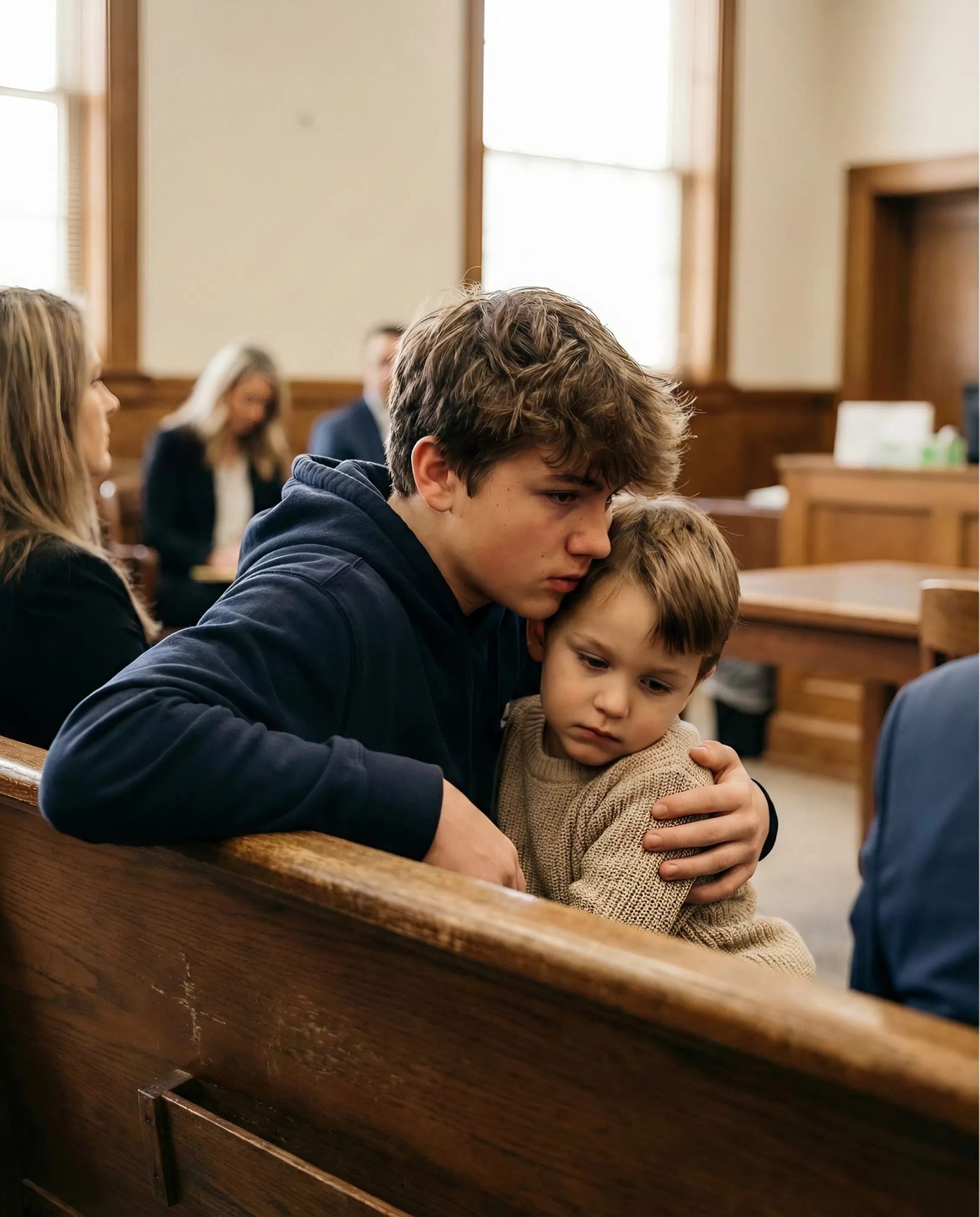
The day after I laid my parents to rest was the day my childhood ended. Not because I turned eighteen, but because someone tried to take away the only family I had left. Losing Mom and Dad had already gutted me. If anything happened to Max — my six-year-old little brother — I would’ve fallen apart completely.
The funeral was somber, suffocating, and wrong in every way a funeral can be. Max still thought Mom was off on “a long trip.” Every morning, he would ask when she’d be back, and every time, the words died in my throat. I kept telling myself I’d figure out how to tell him the truth gently. But life had no interest in giving us even a moment to breathe.

To make the day even more unbearable, the funeral landed on my birthday. People wished me “Happy 18th,” but the words meant nothing. I didn’t want candles or adulthood. I wanted my parents back — something I was never getting.
That afternoon, as everyone trickled out of the cemetery, I knelt beside my parents’ grave with Max clinging to my sleeve. I whispered a promise from the deepest part of me: “I won’t let anyone take you. Ever.” Back then, I thought life had already stolen enough from us. I was wrong.
A week later, Aunt Diane and Uncle Gary invited us over. They greeted us with forced warmth and strained smiles, pressing a mug of cocoa into my hands even though I hadn’t asked for it. They seated us at their pristine kitchen table like they were arranging a catalog photo shoot. Max quietly fiddled with his dinosaur stickers, completely unaware of the trap closing around us.
“A real home,” Gary echoed, clearly repeating a phrase they had rehearsed.

These were the same relatives who forgot Max’s birthdays three years in a row, the same ones who skipped holidays because their “cruise deal was too good.” Now, out of nowhere, they wanted to be our guardians? I left their house with a knot twisting in my stomach. Something was off.
The next morning proved just how off things were. They’d filed for custody.
This wasn’t compassion. It was calculated.
That same day, I marched into the college office and withdrew. The counselor asked if I was certain. I didn’t hesitate. School could wait. Max couldn’t. I took on two jobs — food delivery during the day, cleaning offices at night. We had to leave our family home because I couldn’t afford the mortgage, so we moved into a cramped studio that smelled like bleach and old takeout.
One night, Max wrapped himself in a blanket like a tiny burrito and said, grinning, “It smells like pizza… and home.” It nearly shattered me. But it also fueled me. I filed for guardianship, even knowing the odds weren’t great, hoping effort might count for something.
Then the accusations came.

Child Services showed up with a report that knocked the wind out of me. Diane claimed I yelled at Max, abandoned him, even hit him. The thought alone made me sick. But lies are fast movers, and doubt spreads like poison.
What Diane didn’t see coming was Ms. Harper — our neighbor, a retired teacher, the woman who cared for Max while I worked double shifts. She walked into court like a commander entering a battlefield, carrying a manila folder and a glare that could crack stone.
“That boy,” she told the judge, pointing straight at me, “is raising his brother with more love than most parents manage on their best days. Anyone who says otherwise is lying.”
Her testimony didn’t end the war, but it kept us afloat. The judge granted me temporary guardianship and required Diane’s visits to be supervised. Not a victory — but air.
Every Wednesday and Saturday, I had to drop Max off at Diane’s. My stomach knotted every time. One Wednesday, I arrived early, and when Max ran out, his tear-stained cheeks told me everything.
“She said if I don’t call her Mommy, I don’t get dessert,” he whispered.

I told him the only person he ever had to call “Mommy” was Mom. He nodded, but he held onto me like he was afraid I’d disappear.
That night, while taking out the trash, I walked past Diane’s kitchen window. Her voice carried — sharp, confident, full of greed. “We need to speed this up, Gary. Once we get custody, the state will release the trust fund.”
I stopped cold. Trust fund? As far as I knew, there wasn’t one.
I spent the whole night digging through old papers until I found it — a $200,000 fund my parents had set aside for Max. They probably never mentioned it because they expected to be around to manage it. Diane wanted the money. That was the motive. Not care. Not concern. Cash.
The next evening, I returned to the same spot and recorded their entire conversation. This time, Gary chimed in: “Once the money hits our account, we can send Max to boarding school. He’s a handful.”
Diane laughed. “I just want a new car. And maybe Hawaii.”
The next morning, I handed the recording to my lawyer.
At the final custody hearing, Diane walked in dressed like she was hosting a charity bake sale — pearls, perfect nails, a tin of cookies. The act collapsed the moment the audio played. Silence swallowed the courtroom. The judge’s expression went hard.
“You manipulated this court,” she said, “and attempted to exploit a child for financial gain.” Diane’s smile crumbled. Gary stared at the floor.
They lost everything — custody, visitation, their reputation. They were reported for attempted fraud before leaving the courtroom.
As for Max and me? I was granted full guardianship. The judge even recommended housing support, acknowledging the “remarkable effort” I’d put into keeping us together.
Outside, Max squeezed my hand. “Are we going home now?”

“Yeah,” I said. “We’re going home.”
It’s been two years. I work full time and take online classes. Max is thriving in school. We still live in a tiny apartment, still argue about movies, still laugh ourselves senseless before bed. It’s not flawless, but it’s ours.
Love isn’t measured by age, money, or documents. It’s measured by how hard you fight for it. And when Max hugged me tonight and said, “You never gave up on me,” I told him the only answer that’s ever mattered:
“I never will.”