“Thank you,” Celeste said.
Mara shook her head. “Don’t thank me. Testify.”
Celeste nodded. “I will.”
Helena refused until Conrad, suddenly old in a way no tailor could hide, whispered, “Sign it, Helena.”
She did.
The pen scraped across the page like a door closing.
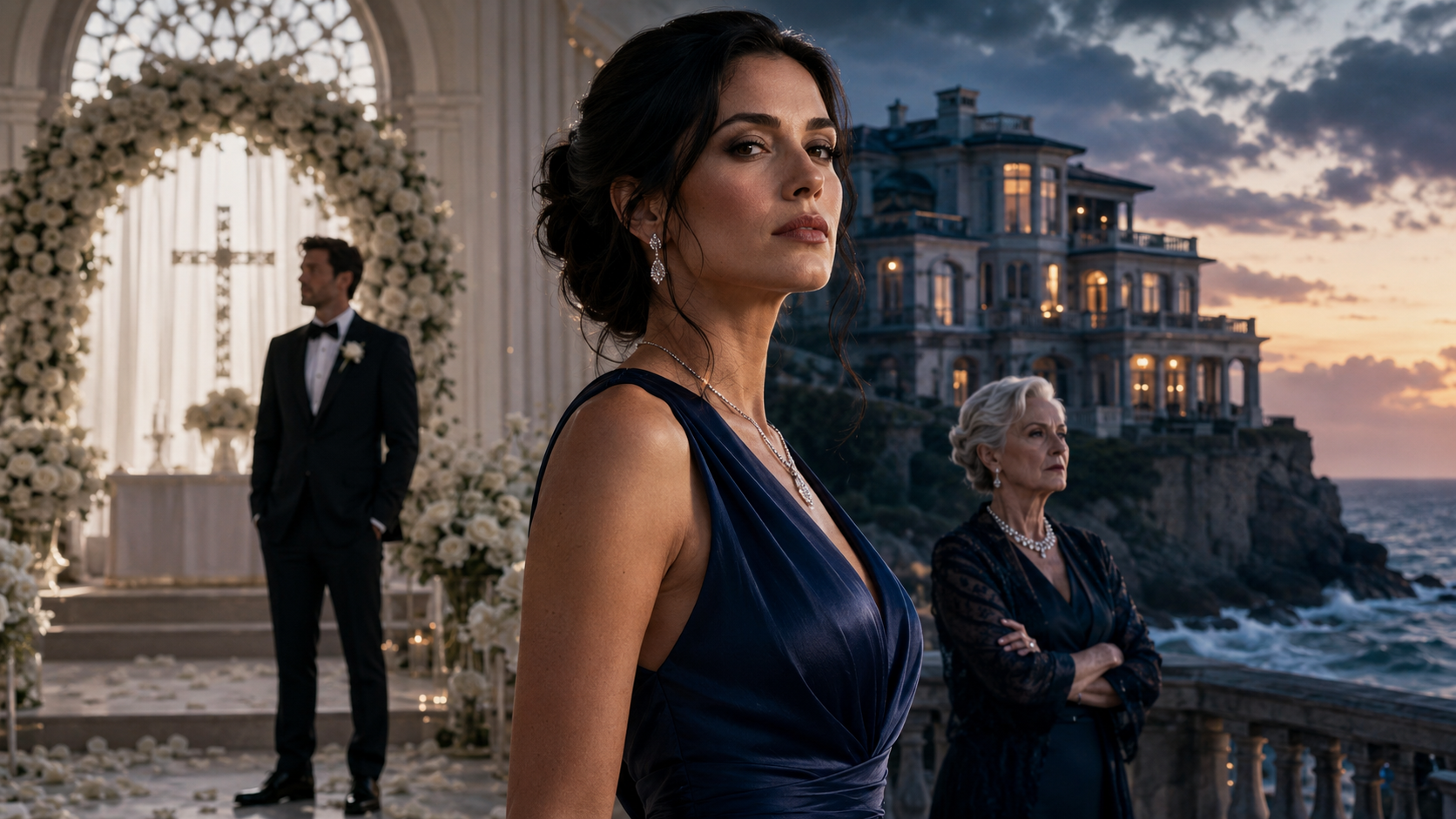
Two hours later, Iris married Daniel under a white arch facing the sea.
The ceremony was beautiful because it did not try to be perfect. Wind tugged at Iris’s veil. Daniel cried before his vows and laughed at himself while crying. Iris squeezed his hands and told him she had loved him since he brought soup to her office during flu season and pretended it was not a grand romantic gesture.
Mara watched from the third row beside Nicholas.
For the first time since the chapel, she saw an altar and did not feel abandoned by it.
She saw two people choosing each other without making the room pay for the choice.
At the reception that night, Adrian approached once more.
He looked emptied out, but not drunk.
That mattered.
“I’m going to cooperate,” he said.
“Good.”
“I don’t know what happens after.”
“You’re not supposed to. That’s what consequences are.”
He nodded.
Then, almost too softly, he asked, “Did you ever love me?”
Mara looked past him toward the dance floor, where Iris spun under Daniel’s arm, laughing as if the world had not tried hard enough to make her cynical.
“Yes,” Mara said. “I loved who I was trying to become with you.”
Adrian closed his eyes.
When he opened them, he looked almost peaceful.
“I hope he knows what he has.”
Mara glanced toward Nicholas, who stood near the terrace doors speaking with her senior counsel on the phone, probably about exposure timelines because romance had not made him less himself.
“He does,” she said. “But more importantly, so do I.”
Adrian gave a small nod and walked away.
Later, Celeste found Mara near the dessert table.
“I filed my statement,” she said.
“That was fast.”
“If I waited, I might become a coward again.”
Mara studied her. “What will you do now?”
Celeste looked toward the dark windows and the ocean beyond. “Lose a great deal of money. Gain a life, maybe.”
“That’s not a bad trade.”
“No,” Celeste said. “I’m beginning to think it may be the only good one I’ve ever made.”
They stood together in an unexpected peace.
They would never be friends. Some histories did not need that much decoration. But they were no longer enemies inside someone else’s story, and that was its own kind of freedom.
Near midnight, Mara stepped out onto the terrace.
The Newport air was cold and clean. Below the cliffs, waves struck rock with steady force. Behind her, music moved through glass and candlelight.
Nicholas joined her a minute later and handed her water.
“Not champagne?” she asked.
“You stop enjoying it after two glasses.”
She smiled. “Operational kindness again.”
“Always.”
They stood shoulder to shoulder.
For a while, neither spoke.
Then Nicholas asked, “Are you all right?”
Mara considered the question honestly.
She thought of white roses in a chapel. Adrian’s silence. Helena’s gloves. A suitcase in a hotel room. A one-way ticket purchased with shaking hands. Her father telling her not to disappear. Nights in Seattle when loneliness felt like weather. Tea in an office kitchen. Deeds, covenants, signatures, and numbers that eventually confessed. A company built from refusal. Helena’s face when Mara entered the library with authority Helena had once believed belonged only to people born behind gates.
“I’m not untouched,” Mara said.
Nicholas turned toward her.
“That’s what people get wrong,” she continued. “They see you survive something and succeed after it, and they call you untouchable. As if the goal was to become too hard to feel. But I was touched by all of it. Hurt by it. Changed by it. I just didn’t let it decide the final shape of me.”
Nicholas’s eyes softened.
“No,” he said. “You didn’t.”
She looked at him. “Thank you for not trying to save me today.”
“I wanted to.”
“I know.”
“I also knew you would hate it.”
“I would have.”
“I’m adaptable.”
She laughed, and he smiled.
Below them, the ocean kept striking stone.
“Nicholas?”
“Yes?”
“I don’t need an altar.”
“I know.”
“But someday,” she said, “if we choose one, I want roses.”
“White ones?”
“Stubborn ones.”
His smile deepened. “I’ll remember.”
She reached for his hand.
Not dramatically. Not to prove anything to the people inside. Not as a final scene for anyone else’s satisfaction.
She took his hand because she wanted to, because the choice was hers, because love had finally become a place where she did not have to disappear.
Inside the ballroom, the music rose. Somewhere, Iris shouted for everyone to come dance. Somewhere, Adrian Blackwell began the long work of telling the truth. Somewhere, Helena Blackwell sat in a room full of signed documents, discovering that legacy could be repossessed.
Mara looked out at the dark Atlantic and felt no hunger for their ruin.
Once, that would have surprised her.
It did not anymore.
Revenge had been a bridge.
Justice had been a door.
But peace was the country beyond both, and she had walked too far to stop at the border.
Three years earlier, Adrian had left her at the altar because he thought she was the easiest thing to lose.
He had been wrong.
Mara Ellison had not been lost.
She had been released.
And when she came back, she did not come back untouchable.
She came back touched by fire, shaped by work, steadied by love, and unwilling to bow before any room that mistook cruelty for power.
She had built her own name.
She had signed her own future.
And this time, when the doors opened, she walked through them by choice.