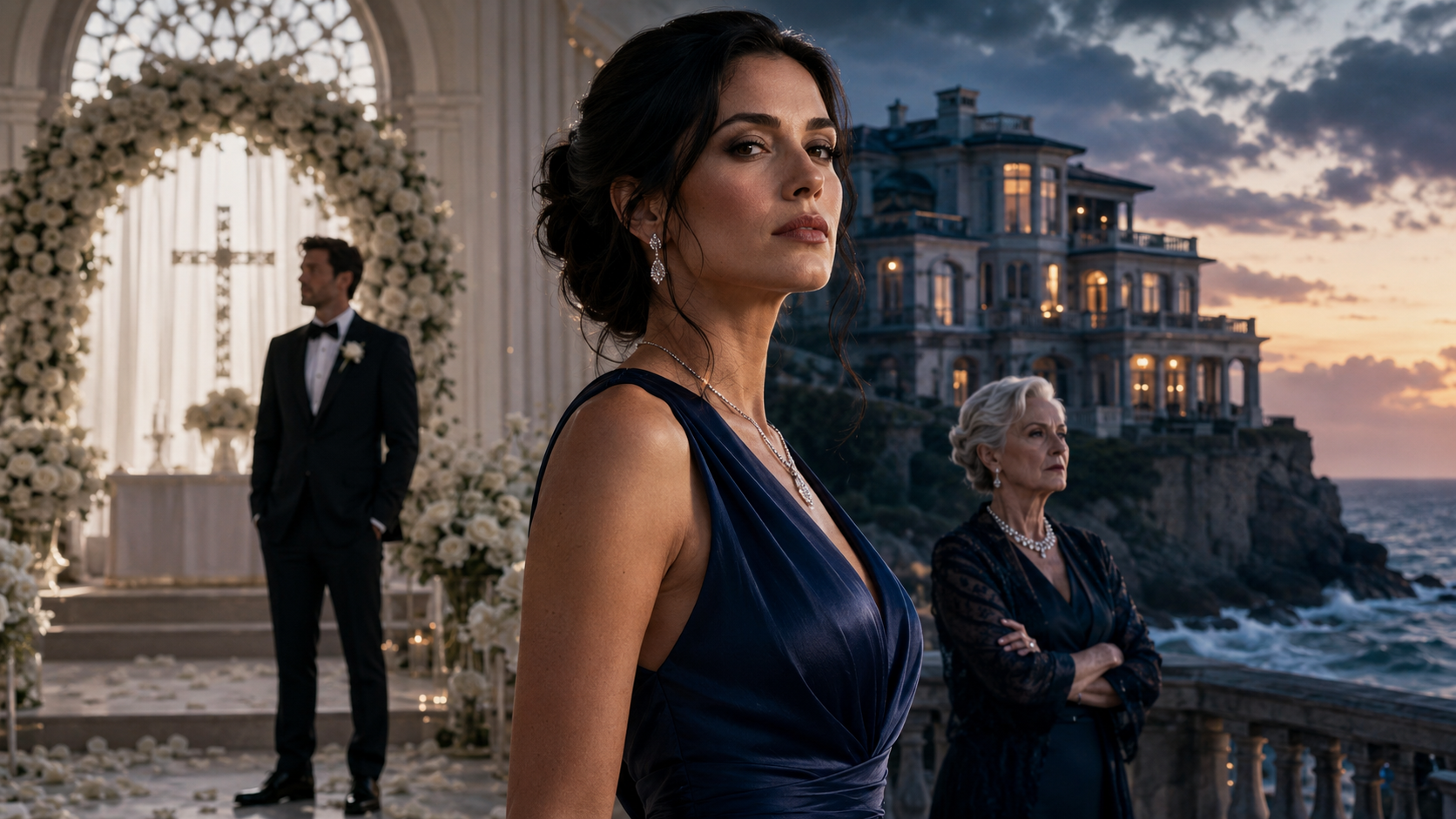
“No, I don’t miss Philadelphia.”
“Yes, I remember you.”
That last answer was her favorite. It made people briefly fear she remembered accurately.
She saw Adrian after forty minutes.
He stood near the terrace doors with a glass he had not touched. He looked older, though not destroyed. Life was rarely that generous. But his face carried the tired caution of a man who had spent years waiting for something buried to surface.
Celeste stood beside him in pale gray silk. Her beauty had changed. It was still there, but thinner now, worn at the edges. The triumph Mara remembered from the chapel was gone. In its place sat exhaustion.
Helena Blackwell stood a few feet away, pearls perfect, posture imperial, smile sharp enough to cut ribbon.
Nicholas leaned slightly toward Mara. “They’ve looked over seven times.”
“You counted?”
“I rounded down.”
“Very charitable.”
“I’m experimenting.”
Mara smiled into her glass.
For the first hour, Adrian did not approach.
That surprised her less than how little it mattered.
Then Helena did.
“Mara,” she said, extending both hands as if greeting a beloved niece instead of a woman she had publicly discarded.
Mara did not move into the embrace.
“Mrs. Blackwell.”
A small fracture appeared in Helena’s smile. “Please. Helena.”
“No, thank you.”
Nicholas looked down at his glass. Mara knew he was hiding amusement.
Helena recovered. “You look well. Success agrees with you.”
“Work agrees with me.”
“Of course. We have all heard about your firm.”
The pause before firm was polished enough to be deniable.
“How generous of my invoices to travel,” Mara said.
Helena’s smile tightened. “Still spirited.”
“Still literate.”
A silence opened between them.
Helena turned to Nicholas with visible relief. “Mr. Vale, Blackwell Holdings has long admired your civic portfolio. I believe there may be opportunities for alignment.”
Nicholas’s expression did not change. “Alignment is a demanding word.”
Helena blinked.
Before she could answer, Adrian appeared behind her.
“Mother,” he said.
Helena’s jaw tightened. “Adrian.”
“I’d like to speak with Mara.”
There it was.
Her name in his mouth.
Once, that sound had been home. Then it had been a wound. Now it was simply a sound.
Nicholas touched her elbow lightly. Not claiming. Asking.
Mara nodded.
He moved away, taking Helena with him into a conversation so smooth it looked accidental.
Adrian watched them go. “He’s impressive.”
“Yes.”
“Are you happy?”
Mara considered the question.
Once, she would have wanted to answer beautifully. She would have wanted to make happiness look like punishment. She would have wanted him to see every mile she had walked after he left her.
Now she wanted only accuracy.
“I’m whole,” she said. “Happiness visits. Whole stays.”
Adrian looked down.
The ocean wind pressed faintly at the terrace doors. Somewhere, people laughed too loudly.
“I’ve rehearsed an apology for almost three years,” he said.
“That sounds tiring.”
“It is.”
“You could stop rehearsing.”
He lifted his eyes. “I’m sorry.”
Mara waited.
His voice roughened. “Not because it ended. Maybe it would have ended someday. Maybe I loved the idea of courage more than I had courage. But the way I ended it—letting you walk down that aisle, letting everyone watch, letting my mother turn your humiliation into a family adjustment—there is no decent explanation.”
It was the first honest thing he had ever said about that day.
Mara felt it land.
Not as healing.
As placement.
A fact finally set where it belonged.
“Thank you for saying that,” she said.
“I don’t expect forgiveness.”
“No. You want it.”
He flinched.
She was not unkind when she said it. That somehow made it harder.
“Do you forgive me?” he asked.
Mara looked at him with the calm she had earned.
“No.”
His face changed.
Then she continued, “But I no longer carry the part of it that belongs to you. That is better than forgiveness.”
Adrian closed his eyes.
When he opened them, he looked smaller. Not humiliated. Human.
“I deserved that.”
“It wasn’t punishment. It was a boundary.”
Before dinner, Mara went to the restroom to breathe without an audience.
She was washing her hands when the door opened.
Celeste entered.
For a moment, both women stood still.
The room smelled of eucalyptus, perfume, and expensive flowers. Celeste kept one hand on the brass handle as if escape remained an option.
“You look beautiful,” Celeste said.
“So I’ve been told.”
“I suppose that gets old.”
“Not yet.”
A small, humorless smile touched Celeste’s mouth. “Fair.”
She stepped closer to the mirror but did not fix her makeup. Up close, Mara saw fatigue beneath the powder, worry lines around the mouth, the face of a woman who had won a prize and discovered it was a locked room.
“I owe you an apology,” Celeste said.