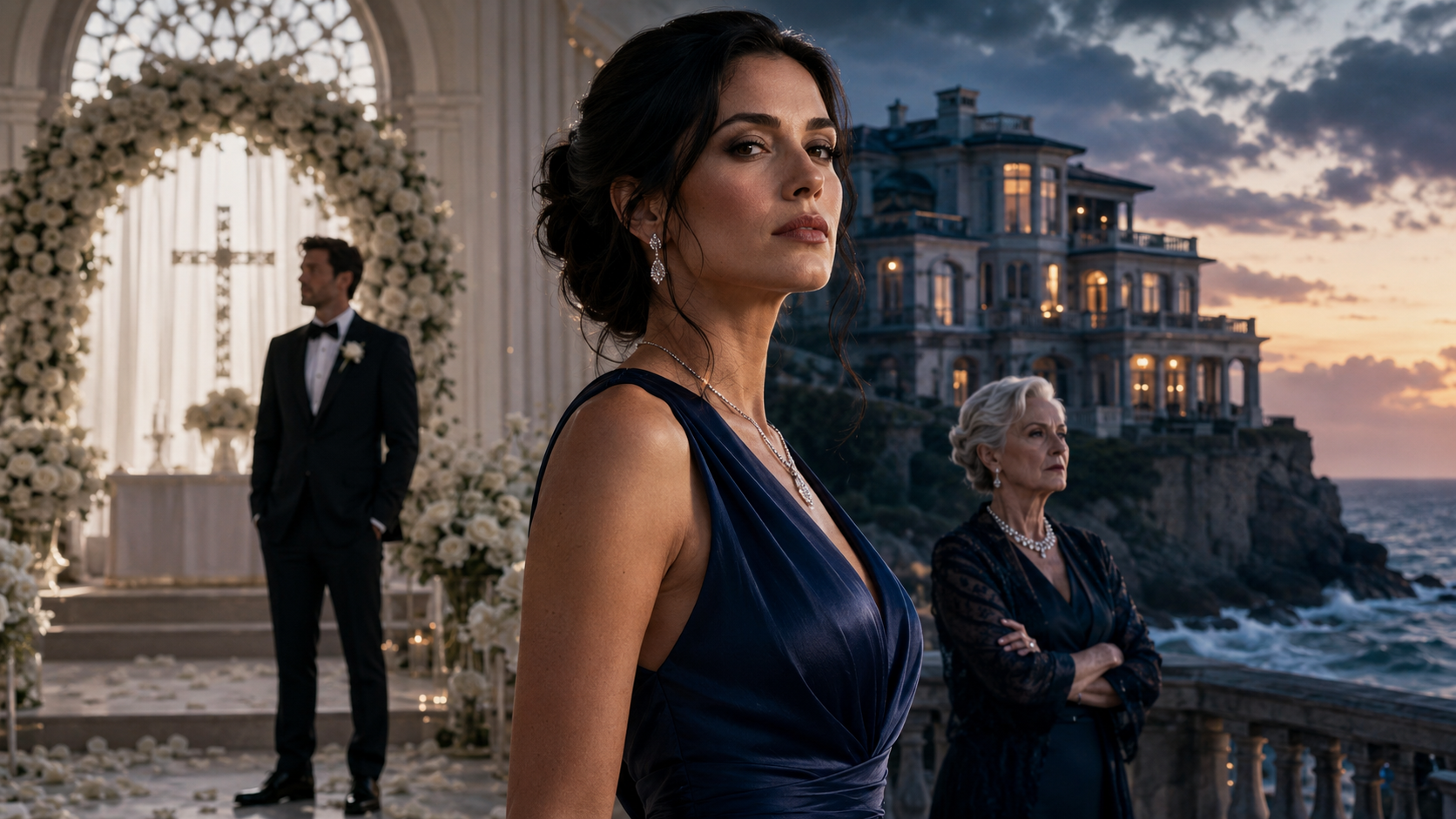
He Left Her at the Altar for His Mistress—Three Years Later, She Came Back Owning the Ground Beneath His Family’s Mansion

“Keep the Altar, Adrian,” the Millionaire Left Her There—Until She Returned With the Deed

By eleven in the morning, the chapel smelled like white roses, old money, and something Mara Ellison would later learn to recognize as warning.

The aisle had been covered in ivory silk. The pews were crowded with people who knew how to whisper without moving their lips. The Blackwell family crest had been woven into the programs, stamped on the napkins, carved into the doors, and somehow implied in the way everyone breathed—as if even oxygen had been granted permission by the family.

Mara stood in the bridal suite with her hands folded around a bouquet so tightly the rose stems bruised her palms.

“You look perfect,” her aunt Ruth said, though her voice shook on the last word.

Mara tried to smile. “Perfect is a dangerous thing to promise.”

Ruth adjusted the veil one more time, even though it needed no adjusting. “Adrian loves you.”

Mara looked at herself in the mirror.

She wanted to believe that.

Adrian Blackwell had loved her in the beginning. Or at least, he had loved the version of her who did not yet understand the price of being chosen by a man raised inside a dynasty. He had loved her in small restaurants, in borrowed apartments, in the back row of late-night movie theaters where no one cared about his last name. He had loved her when he could be only Adrian and not Adrian Blackwell, future chairman, only son, inheritance wrapped in a navy suit.

He had told her she made him feel real.

Mara, foolishly, had thought that was a compliment.

Outside the door, music began.

Ruth took both of Mara’s hands. “Whatever happens, walk slowly.”

Mara laughed. “That sounds like advice for a funeral.”

Her aunt’s face changed.

Just for a second.

Then the wedding coordinator knocked, breathless and too bright. “Miss Ellison? We’re ready.”

Mara stepped into the hallway.

At the far end, her father waited in his wheelchair, wearing the dark gray suit she had saved three months to buy. He had been a foreman once, the kind of man who could fix engines by sound and read lies in a handshake. Illness had taken his strength in pieces, but never his dignity.

When he saw her, his eyes filled.

“Oh, sweetheart,” he whispered.

Mara bent and kissed his cheek. “Don’t make me cry before the expensive photographer earns his money.”

He tried to laugh. “You sure about this?”

The question was soft. Not judgment. Not fear. Something older.

Mara glanced toward the chapel doors.

“I love him,” she said.

Her father nodded, but his hand tightened around hers.

The doors opened.

Everyone turned.

Mara walked.

She would remember every detail later with cruel clarity: the organ rising, the candles trembling, the pearls at Mrs. Blackwell’s throat, the way Adrian’s father, Conrad, looked down at his watch as if the ceremony were a meeting running late.

And Adrian.

Adrian stood at the altar in a black tuxedo, pale as paper.

For one shining, terrible moment, Mara thought he was nervous. She almost smiled wider for him. She almost sent him comfort across the aisle, across the flowers, across the crowd waiting for proof that she had been accepted into a world that had never wanted her.

Then she saw Celeste Rowan in the first pew.

Celeste was not wearing red. That would have been too honest. She wore champagne silk and a face composed into grief so delicate it looked rehearsed. Her hand rested low on her stomach, not dramatically, just enough for the right people to notice.

Mara’s steps slowed.

Her father felt it.

“What is it?” he whispered.

Mara did not answer.

Adrian’s eyes met hers.

He looked away.

The music continued because hired musicians are trained to survive disaster.

When Mara reached the altar, the priest smiled with professional confusion. “Dearly beloved—”

“Wait,” Adrian said.

One word.

The chapel shifted.

Mara turned to him slowly. “Adrian?”

He swallowed. Behind him, his mother Helena Blackwell sat very still, her gloved hands folded in her lap like two white birds trained not to fly.

“I can’t,” Adrian said.

Mara heard someone gasp. A woman in the back. Or maybe Ruth. Or maybe herself from a future she had not yet reached.

The priest lowered his book.

Mara’s bouquet suddenly felt obscene.

Adrian looked at her then, but not like a man looking at the woman he had promised to marry. He looked at her like a man hoping she would understand a contract clause.

“I’m sorry,” he said.

She waited.

He said nothing more.

Mara’s father tried to rise from his wheelchair. “What are you doing?”

Conrad Blackwell stood. “Let’s not make this uglier than it needs to be.”

Mara turned toward him. “Uglier?”

Helena rose next, graceful as a blade being drawn. “Mara, this is painful for everyone.”

“For everyone?” Mara repeated.

Her voice did not break. That surprised people. It surprised her most of all.

Celeste lowered her eyes.

Adrian closed his.

And then Helena said the sentence that would return to Mara for years, not as memory, but as a bruise with sound.

“Keep the altar ready,” Helena told the coordinator. “There is still a Blackwell commitment to be honored today.”

A silence fell so complete it seemed to erase the chapel walls.

Mara looked at Adrian.

“You’re marrying her?”

Adrian opened his mouth. Nothing came.

Helena answered for him. “Families have obligations, dear. Some people are born into them. Some only visit.”

Mara felt her father’s hand reaching for hers.

She did not take it yet.

She looked down at her wedding dress, at the lace sleeves Ruth had stitched in secret because Mara could not afford the alteration, at the satin shoes she had bought on sale and hidden from the Blackwell women because she knew they would recognize the discount.

Then she looked at Adrian one last time.

“Say it,” she told him.

His eyes reddened. “Mara.”

“No. Say it where everyone can hear you.”

Adrian’s jaw worked.

Celeste began to cry quietly.

Helena looked almost pleased.

Adrian whispered, “I’m choosing Celeste.”

Mara nodded.

Not because it made sense.

Not because she accepted it.

Because her body needed some instruction and a nod was all she had left.

Then she placed the bouquet on the altar.

Not threw it. Not dropped it. Placed it carefully, as if returning borrowed property.

“Then keep the altar,” she said. “I’m done paying for rooms where I’m not wanted.”

She turned.

Her father reached for her, and this time she took his hand.

No one stopped her as she walked back down the aisle. That was another insult. People make room very quickly when they are afraid dignity might touch them.

Outside, the sky was brutally blue.

Her aunt Ruth ran after her, crying. “Mara, sweetheart—”

“Take Dad home,” Mara said.

“You can’t be alone right now.”

“I’m not alone. I’m awake.”

Ruth covered her mouth.

Mara kissed her father’s forehead. “I’ll come by tonight.”

Her father gripped her wrist. “Don’t disappear because they were cruel.”

Mara crouched until their eyes were level.

“I’m not disappearing,” she said. “I’m leaving before they mistake silence for permission.”

She walked away from the chapel in a wedding dress that cost more than her first car and crossed three blocks to a small hotel where she had stayed the night before because Helena believed brides should not emerge from “unphotogenic” neighborhoods.

In the lobby, the clerk stared.

Mara lifted her chin. “I need my suitcase.”

He nodded too quickly.

In the room upstairs, she removed the veil first.

Then the shoes.

Then the dress.

She did not cry until she saw the tiny blue thread Ruth had sewn inside the bodice for luck.

After that, she cried without elegance.

By dusk, Adrian Blackwell had married Celeste Rowan in front of the same flowers.

By midnight, photographs had already begun circulating.

By dawn, Mara Ellison had sold her engagement ring to a jeweler who asked no questions and bought a one-way ticket to Seattle.

She did not choose Seattle because it was romantic. She chose it because Ruth’s cousin had a spare room above a bakery in Fremont and because the city was far enough from Philadelphia that church bells could not find her easily.

For the first month, Mara did not rebuild herself.

She survived.

She worked mornings at the bakery counter, afternoons doing bookkeeping for a marine supply warehouse, and nights studying municipal finance from used textbooks she bought for less than the price of one Blackwell cocktail napkin.

Pain did not make her brilliant. She had already been intelligent. Pain merely stripped away her willingness to waste intelligence on being acceptable.

Numbers became safer than people.

Numbers did not smile at you in private and abandon you in public. Numbers did not call cruelty tradition. Numbers did not ask you to understand why your humiliation was necessary for someone else’s legacy.

Numbers lied only when people forced them to.

And Mara became very good at finding the hands that did the forcing.

Eight months after the wedding that wasn’t, she took a temporary analyst position at a small advisory firm that specialized in distressed real estate. The office was above a dentist and smelled faintly of toner, rain, and burnt coffee. Mara loved it.

She learned tax liens, title transfers, debt covenants, bond indentures, zoning restrictions, environmental liabilities, and the secret emotional lives of balance sheets.

Her boss, a tired man named Paul Danner, once threw a file on her desk and said, “Tell me why this hotel portfolio is bleeding.”

Mara read for six hours.

Then she walked into his office and said, “It isn’t bleeding. It’s being drained.”

Paul looked up.

She placed three documents on his desk. “The maintenance vendors are owned by cousins of the borrower. The repair invoices are inflated by at least forty percent. The insurance reserves are being used to cover interest shortfalls. And the land under two of the hotels isn’t owned by the company. It’s leased from a trust that expires in eighteen months.”

Paul stared at her.

Mara braced for criticism.

Instead, he said, “Who taught you title work?”

“Nobody.”

“Good. Nobody taught you wrong.”

That was the beginning.

Within two years, Mara had become the person clients called when polite fraud needed an impolite diagnosis. She was not charming in meetings. She did not soften bad news. She wore simple suits, tied her hair back, and asked questions that made powerful men reach for water.

At thirty-one, she was recruited by Alderidge Capital, a private investment firm with a reputation for buying broken civic assets and either rescuing them or burying them, depending on who was telling the story.

That was where she met Nicholas Vale.

Nicholas did not look like a rescuer.

He looked like a man built out of quiet decisions. Early forties, dark hair touched with silver, gray eyes that made excuses feel childish. He owned enough companies to make newspapers speculate and enough silence to make them nervous.

Mara first saw him in a conference room overlooking Elliott Bay, where a team of analysts was presenting a plan to acquire a failing port redevelopment project.

The model was beautiful.

The assumptions were trash.

Mara sat at the end of the table, still new enough that no one expected her to speak.

The senior director clicked to a slide showing projected labor savings.

Mara lifted her hand.

The director frowned. “Yes?”

“You can’t cut labor expenses by eighteen percent in year one.”

He smiled thinly. “The contract allows operational restructuring.”

“It allows role consolidation after arbitration. Not before. Your savings arrive before your legal permission does.”

The room went quiet.

The director’s smile vanished.

Mara continued. “Also, your environmental remediation costs assume state reimbursement that has not been approved. If the grant fails, debt coverage collapses by the second quarter. And the land-use restriction on parcel six prevents resale to private developers for nine more years.”

Someone coughed.

Nicholas Vale, who had said nothing for the entire meeting, leaned back in his chair.

The director tried to recover. “Those are manageable risks.”

“No,” Mara said. “Those are hidden losses wearing lipstick.”

A dangerous silence followed.

Then Nicholas asked, “Your name?”

“Mara Ellison.”

“Who hired you?”

“Human Resources, technically.”

The corner of his mouth moved. Not quite a smile. “Technically, they finally did something right.”

After the meeting, he found her near the elevators.

“You embarrassed a senior director,” he said.

Mara pressed the button. “He brought a bad model to a room full of people who read numbers for a living. That was self-harm.”

This time Nicholas did smile.

The elevator opened.

He did not step in.

Instead, he said, “Tell me what else is wrong with the deal.”

“I’m off the clock.”

“You’re salaried.”

“I’m underpaid.”

His smile deepened. “Then consider this a negotiation.”

Mara looked at him carefully.

She knew powerful men. She knew the ones who liked sharp women until the sharpness turned toward them. She knew the ones who called honesty refreshing when it cost them nothing and disrespect when it did.

Nicholas Vale did not look amused.

He looked interested.

So Mara stepped out of the elevator.

For forty-five minutes, she explained everything the presentation had hidden. Nicholas listened without interrupting. When he disagreed, he asked for proof. When she provided it, he accepted it. He did not flatter her. He did not praise her shoes or her courage or her “unique perspective.”

He asked, “What would you do instead?”

Mara told him.

Three weeks later, she was moved to his civic assets division.

Six months later, she was leading due diligence on deals that made older men visibly resentful.

One year later, no one at Alderidge Capital said her name lightly.

Nicholas did not mentor her gently. He returned her memos covered in comments. He asked for precision so severe it felt almost cruel until Mara realized he demanded it from himself first. He did not protect her from hard rooms. He made sure she was prepared enough to own them.

Their trust grew without decoration.

Once, at 1:30 a.m., Mara found him alone in the office kitchen making tea.

“You’re still here?” she asked.

“So are you.”

“I’m trying to prove a bridge authority is hiding deferred maintenance.”

“I know.”

“You know?”

“You’ve been muttering about concrete fatigue for twenty minutes.”

She almost laughed. “That’s not embarrassing at all.”

He handed her a mug. “Tea.”

“I drink coffee.”

“Not tonight. You’re angry. Coffee will make you fast. Tea might keep you accurate.”

Mara took the mug. “Is that concern?”

“Risk management.”

“Of my heart rate?”

“Of my investment memo.”

She laughed then, unexpectedly, and the sound startled them both.

Years passed in the strange way hard-working years do: slowly while lived, quickly when remembered.

Mara became the person who saw the flaw before the room had agreed there was a structure. She found a buried land option in Tacoma that saved a public housing project. She uncovered a chain of shell vendors in a ferry terminal renovation. She forced a renegotiation that kept two hundred warehouse workers employed when a cleaner spreadsheet would have erased them.

Eventually, she left Alderidge.

Nicholas read her resignation letter twice.

“You’re starting your own firm,” he said.

It was not a question.

“Yes.”

“Name?”

“Ellison Civic Recovery.”

“Clients?”

“Three.”

“Capital?”

“Enough for eight months if I remember I’m not rich yet.”

“Office?”

“My dining table.”

“Good.”

Mara blinked. “Good?”

“If the idea cannot survive your dining table, it has no business asking the market for rent.”

She folded her arms. “That was almost encouraging.”

“It was fully encouraging. You’re just accustomed to applause being louder.”

“Will you invest?”

“No.”

The answer landed harder than she expected.

Nicholas saw it and continued, “Not now. If I fund you, they’ll call you my extension. If you build without me, they’ll have to learn your name.”

Mara looked away.

It was one of the kindest refusals she had ever received.

On her last day, he walked her to the elevator.

“I’ll send work when you’re the best,” he said.

“And when I’m not?”

“I’ll send it elsewhere.”

“Romantic.”

His gaze held hers. “Under different circumstances, I have range.”

The elevator doors opened.

Mara stepped inside with a cardboard box of files, two dying plants, and the strange sensation that a door could close without abandoning her.

Ellison Civic Recovery began with three clients, one laptop, and a dining table that developed a permanent lean from the weight of legal binders.

By the end of the first year, Mara had six employees and an office with windows that stuck in the rain.

By the end of the second, she had advised creditor committees, public agencies, pension trustees, and community boards on more than half a billion dollars in distressed assets. A trade magazine called her “the woman who makes bad books confess.” She hated the headline and framed it anyway.

Money came slowly, then suddenly.

Not Blackwell money. Not marble-staircase money. Not money with portraits of dead grandfathers attached.

Hers.

Earned in conference rooms, taxed without hiding, reinvested in people who worked too hard and lied too little.

She bought her father a medical bed that did not squeak. She paid off Ruth’s mortgage. She gave bonuses big enough to make junior analysts cry in the hallway. She learned that security was not healing, but it did take away fear’s favorite weapon.

Nicholas remained near without hovering.

He referred clients when she was right for them. He argued with her when she was wrong. He took her to dinner after her first impossible close and again after a conference in Portland where they both pretended the meal was convenient.

Nothing between them moved quickly.

Mara would not become a rumor attached to a billionaire. Nicholas would not insult her by turning opportunity into suspicion. They were careful because both of them understood cost.

When he finally kissed her, it was outside a noodle shop in the rain, beneath a broken awning and a flickering streetlight.

He touched her wrist first.

Not grabbed. Not claimed. Asked.

“Mara,” he said quietly, “tell me to stop if I’m wrong.”

She looked at him, this man who could buy buildings but still waited for permission to cross one inch of air, and felt something inside her unclench.

“You’re not wrong,” she said.

The kiss was calm.

That was what nearly broke her.

No spectacle. No witnesses. No aisle. No flowers. No room waiting to approve her value.

Just a choice.

Hers.

Two years and nine months after Adrian Blackwell left her at the altar, Mara received an invitation thick enough to qualify as architecture.

Iris Bellamy was getting married at Blackwell House.

Mara sat at her kitchen island and stared at the envelope.

Blackwell House was not merely a mansion. It was a coastal estate outside Newport, built on cliffs and entitlement, famous for weddings, political fundraisers, and photographs of people pretending inheritance was taste. The Blackwells did not own it outright, not technically. Old coastal families rarely owned things simply when they could complicate ownership across trusts, leases, foundations, and holding companies.

Mara knew that now.

She knew many things now.

Iris had been one of the few people from Philadelphia who called after the failed wedding and did not ask questions she could later retell. She had simply said, “I love you. I’m angry. I will follow your lead, including if your lead involves arson, though I prefer legal options.”

Now Iris was marrying a pediatric surgeon named Daniel Price, and because Daniel’s mother was a Blackwell cousin, the wedding would be held at Blackwell House.

At the bottom of the note, written by hand, Iris had added:

I need to warn you because I love you. Adrian and Celeste will be there. Helena too. I understand if you say no.

Mara read the note three times.

Nicholas sat across from her, reviewing a report with reading glasses he claimed were “for poor lighting.”

“I’m going,” Mara said.

He looked up. “To Iris’s wedding?”

“Yes.”

“At Blackwell House.”

“Yes.”

He removed the glasses. “Adrian will be there.”

“I know.”

“Helena?”

“I hope so.”

Nicholas studied her face. “That sounded specific.”

Mara slid another folder across the island.

He opened it.

For ten seconds, he said nothing.

Then his eyes sharpened. “Where did you get this?”

“Public records, receivership filings, trust documents, and one very annoyed retired title clerk named Maureen.”

Nicholas read faster.

Mara waited.

Finally, he looked up. “You acquired the ground deed.”

“Not personally. Ellison Civic Recovery acquired the enforcement rights on behalf of the creditor trust. The charitable foundation that originally held the land had a reversion clause. Blackwell Holdings violated it when they used restricted property as collateral for private debt. The deed reverted. They never cleaned the title.”

Nicholas leaned back.

For Nicholas, that was applause.

Mara continued. “Blackwell House is still hosting events because no one wants to admit the family lost control of the land under its own ballroom.”

“And the wedding?”

“Iris doesn’t know. Daniel doesn’t know. This will not touch them.”

“Helena knows?”

“She suspects. Which is why she’s trying to secure emergency refinancing this weekend from anyone rich enough to be flattered.”

Nicholas closed the folder.

His voice was careful. “Do you want me beside you?”

Mara looked toward the rain-dark window.

Once, she had imagined returning to Adrian’s world in a dress so beautiful it would punish him. She had imagined Helena’s face collapsing, Celeste ashamed, Adrian ruined by regret. In the early months, revenge had kept her warm when dignity felt too expensive.

Now revenge seemed small.

But truth did not.

“Yes,” Mara said. “Not because I need protection. Because I want to walk in with someone who never confused love with ownership.”

Nicholas’s face softened.

“Then I’ll come.”

Blackwell House stood above the Atlantic like a building that believed weather was beneath it.

Stone terraces stepped down toward cliffs. White tents bloomed across the lawn. Valets moved luxury cars as if arranging chess pieces. Inside, chandeliers poured light over marble floors, gilded mirrors, and portraits of men who had mistaken property for virtue.

Mara had been there once before, when Adrian took her to a charity gala and told her which forks to use as if kindness and instruction were the same thing.

This time she arrived in a deep blue dress with a clean neckline, sharp shoulders, and no apology in the fabric.

Nicholas walked beside her in a black suit, no tie. He did not place a hand on her back to steer her. He did not present her like an acquisition. He simply entered with her, as if her pace was the only reasonable pace in the room.

The room noticed.

Of course it did.

Rooms like that never gasp. They thin. Conversations weaken. Glasses pause near lips. Names travel without voices.

Mara Ellison.

The bride from the chapel.

The girl Adrian left.

No—wait.

The founder.

The one from the federal port recovery.

The one standing with Nicholas Vale.

Iris saw her from across the foyer and nearly knocked over a florist to reach her.

“You came,” Iris said, hugging her hard.

“I said I would.”

“Yes, but people say brave things in writing.”

“I try not to.”

Iris pulled back, eyes shining. “You look like closure hired a stylist.”

Mara laughed.

The sound came easily.

Iris hugged Nicholas too because Iris had never met a boundary she didn’t first test with affection. “Thank you for coming with her.”

Nicholas glanced at Mara. “I’m honored to be allowed.”

Iris mouthed, Oh, dangerous, then disappeared toward a crisis involving peonies and a groomsman who had lost cufflinks.

The welcome reception began beneath chandeliers and old portraits. Mara spoke with people who had once looked past her and now leaned forward too eagerly.

“Yes, Ellison Civic Recovery is based in Seattle.”

“Yes, we advise creditor trusts and public agencies.”

“No, I don’t miss Philadelphia.”

“Yes, I remember you.”

That last answer was her favorite. It made people briefly fear she remembered accurately.

She saw Adrian after forty minutes.

He stood near the terrace doors with a glass he had not touched. He looked older, though not destroyed. Life was rarely that generous. But his face carried the tired caution of a man who had spent years waiting for something buried to surface.

Celeste stood beside him in pale gray silk. Her beauty had changed. It was still there, but thinner now, worn at the edges. The triumph Mara remembered from the chapel was gone. In its place sat exhaustion.

Helena Blackwell stood a few feet away, pearls perfect, posture imperial, smile sharp enough to cut ribbon.

Nicholas leaned slightly toward Mara. “They’ve looked over seven times.”

“You counted?”

“I rounded down.”

“Very charitable.”

“I’m experimenting.”

Mara smiled into her glass.

For the first hour, Adrian did not approach.

That surprised her less than how little it mattered.

Then Helena did.

“Mara,” she said, extending both hands as if greeting a beloved niece instead of a woman she had publicly discarded.

Mara did not move into the embrace.

“Mrs. Blackwell.”

A small fracture appeared in Helena’s smile. “Please. Helena.”

“No, thank you.”

Nicholas looked down at his glass. Mara knew he was hiding amusement.

Helena recovered. “You look well. Success agrees with you.”

“Work agrees with me.”

“Of course. We have all heard about your firm.”

The pause before firm was polished enough to be deniable.

“How generous of my invoices to travel,” Mara said.

Helena’s smile tightened. “Still spirited.”

“Still literate.”

A silence opened between them.

Helena turned to Nicholas with visible relief. “Mr. Vale, Blackwell Holdings has long admired your civic portfolio. I believe there may be opportunities for alignment.”

Nicholas’s expression did not change. “Alignment is a demanding word.”

Helena blinked.

Before she could answer, Adrian appeared behind her.

“Mother,” he said.

Helena’s jaw tightened. “Adrian.”

“I’d like to speak with Mara.”

There it was.

Her name in his mouth.

Once, that sound had been home. Then it had been a wound. Now it was simply a sound.

Nicholas touched her elbow lightly. Not claiming. Asking.

Mara nodded.

He moved away, taking Helena with him into a conversation so smooth it looked accidental.

Adrian watched them go. “He’s impressive.”

“Yes.”

“Are you happy?”

Mara considered the question.

Once, she would have wanted to answer beautifully. She would have wanted to make happiness look like punishment. She would have wanted him to see every mile she had walked after he left her.

Now she wanted only accuracy.

“I’m whole,” she said. “Happiness visits. Whole stays.”

Adrian looked down.

The ocean wind pressed faintly at the terrace doors. Somewhere, people laughed too loudly.

“I’ve rehearsed an apology for almost three years,” he said.

“That sounds tiring.”

“It is.”

“You could stop rehearsing.”

He lifted his eyes. “I’m sorry.”

Mara waited.

His voice roughened. “Not because it ended. Maybe it would have ended someday. Maybe I loved the idea of courage more than I had courage. But the way I ended it—letting you walk down that aisle, letting everyone watch, letting my mother turn your humiliation into a family adjustment—there is no decent explanation.”

It was the first honest thing he had ever said about that day.

Mara felt it land.

Not as healing.

As placement.

A fact finally set where it belonged.

“Thank you for saying that,” she said.

“I don’t expect forgiveness.”

“No. You want it.”

He flinched.

She was not unkind when she said it. That somehow made it harder.

“Do you forgive me?” he asked.

Mara looked at him with the calm she had earned.

“No.”

His face changed.

Then she continued, “But I no longer carry the part of it that belongs to you. That is better than forgiveness.”

Adrian closed his eyes.

When he opened them, he looked smaller. Not humiliated. Human.

“I deserved that.”

“It wasn’t punishment. It was a boundary.”

Before dinner, Mara went to the restroom to breathe without an audience.

She was washing her hands when the door opened.

Celeste entered.

For a moment, both women stood still.

The room smelled of eucalyptus, perfume, and expensive flowers. Celeste kept one hand on the brass handle as if escape remained an option.

“You look beautiful,” Celeste said.

“So I’ve been told.”

“I suppose that gets old.”

“Not yet.”

A small, humorless smile touched Celeste’s mouth. “Fair.”

She stepped closer to the mirror but did not fix her makeup. Up close, Mara saw fatigue beneath the powder, worry lines around the mouth, the face of a woman who had won a prize and discovered it was a locked room.

“I owe you an apology,” Celeste said.

“You weren’t engaged to me.”

“No. But I stood in that chapel and let you think I came to steal him.”

“Didn’t you?”

Celeste looked at her reflection.

“No,” she said quietly. “I came because our families had already sold all of us.”

Mara turned off the faucet.

Celeste opened her clutch and removed a small envelope.

“I should have told you years ago. I told myself you were better off gone. That was true, but it was also convenient.”

Mara did not take the envelope.

“What are you talking about?”

“Blackwell Holdings used restricted charitable land and pension-backed redevelopment funds to cover private losses. My father’s company helped move the money through shell contractors. Adrian found out two days before the wedding. Helena told him if he married you, the Rowans would expose everything and his father would go to prison. My father demanded the marriage as proof that both families were locked together.”

Mara’s pulse slowed.

Danger always did that to her. It made the world clean.

“Why tell me now?”

Celeste’s laugh broke at the edge. “Because Helena is going to ask Nicholas Vale for refinancing tomorrow morning. She thinks he’s the answer. She doesn’t know your firm controls the deed enforcement through the creditor trust.”

Mara said nothing.

Celeste finally looked at her directly.

“She doesn’t know you own the floor she’s standing on.”

The envelope remained between them.

Mara took it.

Inside was a flash drive and a note written in tight, careful handwriting.

I was cruel because I was afraid. You did not deserve either.

—Celeste

Mara closed her hand around it.

“Why not take this to regulators?”

“I already did, through counsel. This is not the only copy.”

“Then why give it to me?”

“Because tomorrow Helena will try to make you feel like the girl at the altar. I wanted you to know the truth before she performs it.”

The restroom door opened. Two bridesmaids entered laughing, saw their faces, and immediately became fascinated by the soap.

Celeste stepped back.

“Mara,” she said softly, “I didn’t take your place. Helena converted me into a signature and called it a marriage.”

Then she left.

Mara stood with the envelope in her hand and understood, with cold clarity, that the worst day of her life had not been a romantic betrayal.

It had been a business decision.

Nicholas did not ask questions when she returned to the terrace. He saw her face and led her down the stone steps toward the lower garden where the ocean wind could cover their voices.

She handed him the drive.

“Source?” he asked.

“Celeste.”

His eyebrows rose.

For Nicholas, that was thunder.

“She says Blackwell and Rowan moved restricted funds through redevelopment shells. Adrian signed documents. Helena is courting you tomorrow.”

Nicholas’s jaw tightened. “She invited me to a private briefing at ten.”

“You didn’t tell me.”

“I was going to decline.”

“Don’t.”

He studied her.

Mara looked back at the house blazing with light.

For years, she had believed the altar was where she had been rejected. She had measured herself against Celeste’s silk dress, Helena’s pearls, Adrian’s silence. She had wondered what she lacked.

Now she knew.

She had lacked usefulness to a cover-up.

She had lost because she was clean.

Then she had won for the same reason.

Nicholas said, “We can leave.”

“No.”

“We can send this to counsel tonight and avoid the room.”

“No.”

“Mara.”

She turned to him. “That chapel was never about love. It was a boardroom decision staged in front of flowers. Tomorrow, I want the correct room.”

For a long moment, Nicholas said nothing.

Then he nodded once.

“Then we prepare.”

They worked until three in the morning in Nicholas’s suite with encrypted calls, coffee gone cold, and Mara’s senior counsel appearing on video in a sweatshirt, furious at being awakened and more furious at what Celeste’s documents confirmed.

By morning, the shape of it was clear.

Blackwell Holdings had been hollowed out for years. Restricted land tied to Blackwell House had been pledged improperly. Pension-backed redevelopment funds meant for coastal housing and transit improvements had been routed through friendly vendors, inflated invoices, and private loss accounts. Rowan Development had assisted. Celeste had been forced into the marriage to bind the families. Adrian had not started the scheme, but he had signed enough to become responsible.

At 10:00 a.m., while florists prepared Iris’s wedding arch on the lawn, Helena Blackwell hosted her private investor briefing in the old library.

The room smelled of leather, salt air, and money pretending it had never been dirty.

Conrad Blackwell sat at the head of the table, gray and rigid. Helena stood beside him in cream silk. Adrian sat to his father’s right, eyes shadowed. Celeste sat beside Adrian, calm in a way Mara had not seen before. Attorneys, investors, cousins, and advisors filled the rest of the room.

Nicholas entered first.

Helena brightened. “Mr. Vale. We’re delighted.”

Then Mara entered behind him.

Helena’s smile froze.

Adrian stood so quickly his chair struck the wall.

Conrad’s face drained of color.

Mara wore a charcoal suit, not a dress. Her hair was pinned back. In her hand was a black folder and a certified copy of the deed transfer.

“Good morning,” she said. “I’m Mara Ellison, managing founder of Ellison Civic Recovery. We represent the creditor trust now holding enforcement rights to the Blackwell House ground deed and related redevelopment assets.”

No one spoke.

Nicholas took a seat against the wall.

He was not there to rescue her.

He was there to witness.

Helena recovered first. “This is inappropriate.”

Mara placed the folder on the table. “No. Leaving a woman at the altar to conceal financial misconduct was inappropriate. This is a title and restructuring briefing.”

One of the attorneys dropped his pen.

Conrad leaned forward. “Miss Ellison, whatever you believe you have been told—”

“The time for managing what I believe ended when your company pledged restricted land it did not fully control and routed public redevelopment money through shell vendors to hide private losses.”

The room changed.

Power rarely screams when it starts to bleed.

It goes quiet first.

Helena’s eyes cut to Celeste.

Celeste looked back.

Adrian whispered, “Celeste.”

She did not answer.

Mara opened the folder and distributed copies. “The deed reversion was triggered eighteen months ago. The creditor trust has standing. Blackwell Holdings has three options. One, contest title and invite immediate regulatory escalation. Two, enter receivership and lose operational control entirely. Three, accept a supervised restructuring that preserves legitimate employment, protects the wedding events already contracted, and prioritizes restitution over family equity.”

Helena’s voice turned cold. “And I suppose you decide who keeps what?”

“No,” Mara said. “The documents do.”

She nodded to counsel, who activated the screen. Transaction chains appeared: dates, transfers, signatures, shell vendors, deed restrictions, board approvals.

Numbers moved across the wall like ghosts given bodies.

Adrian stared at one page.

His signature appeared three times.

Mara looked at him.

“You had choices,” she said. “Not simple ones. Not painless ones. But choices.”

His face tightened.

“I know,” he said.

Helena snapped, “Adrian, do not indulge this.”

He turned to his mother, and something in him looked exhausted enough to become honest.

“No,” he said. “I did it your way once.”

Helena went still.

Adrian faced Mara. “I found out before the wedding. Mother said if I married you, Rowan would expose everything and my father would go to prison. Celeste’s father demanded the marriage. Celeste was trapped too. I told myself I was protecting everyone.”

Mara’s voice was quiet. “Except me.”

His eyes shone. “Except you.”

The admission did not heal the chapel.

Nothing could.

But it changed the room.

It made the lie stop breathing.

Helena stepped forward. “This sentimental display is irrelevant. Miss Ellison, you may be enjoying your little return, but do not mistake paperwork for power. Everyone has a number.”

Mara closed the folder.

The sound was soft.

“No,” she said. “That was your mistake from the beginning.”

Helena’s mouth tightened.

“You thought everyone had a number because everyone around you did. Adrian had one. Celeste’s father had one. Your vendors had one. Your lawyers probably billed by one. But some of us learned money differently. To us, money meant medicine, rent, repairs, second chances. We know exactly what it can buy. We also know what it cannot.”

She looked at Conrad, then Adrian, then Celeste, and finally Helena.

“You cannot buy back the altar. You cannot buy silence from me. And you cannot buy dignity after spending yours so carelessly.”

For the first time since Mara had known her, Helena Blackwell had no answer.

The conditions were precise and merciless.

Conrad would resign from all executive authority. Helena would be removed from management and board control. Adrian would cooperate with investigators and surrender his voting interest into a restitution trust. Rowan Development would do the same. The pension-backed funds would be made whole before any family shareholder received a dollar. Blackwell House events already contracted would be protected under supervision. Employees would be paid. Community projects with legitimate public purpose would continue under independent oversight.

No one applauded.

Real justice rarely feels theatrical while it is happening. It feels like clauses, signatures, deadlines, and powerful people discovering that consequences have calendars.

Adrian signed first.

His hand shook.

When he passed the pen to Celeste, she looked at Mara.

“Thank you,” Celeste said.

Mara shook her head. “Don’t thank me. Testify.”

Celeste nodded. “I will.”

Helena refused until Conrad, suddenly old in a way no tailor could hide, whispered, “Sign it, Helena.”

She did.

The pen scraped across the page like a door closing.

Two hours later, Iris married Daniel under a white arch facing the sea.

The ceremony was beautiful because it did not try to be perfect. Wind tugged at Iris’s veil. Daniel cried before his vows and laughed at himself while crying. Iris squeezed his hands and told him she had loved him since he brought soup to her office during flu season and pretended it was not a grand romantic gesture.

Mara watched from the third row beside Nicholas.

For the first time since the chapel, she saw an altar and did not feel abandoned by it.

She saw two people choosing each other without making the room pay for the choice.

At the reception that night, Adrian approached once more.

He looked emptied out, but not drunk.

That mattered.

“I’m going to cooperate,” he said.

“Good.”

“I don’t know what happens after.”

“You’re not supposed to. That’s what consequences are.”

He nodded.

Then, almost too softly, he asked, “Did you ever love me?”

Mara looked past him toward the dance floor, where Iris spun under Daniel’s arm, laughing as if the world had not tried hard enough to make her cynical.

“Yes,” Mara said. “I loved who I was trying to become with you.”

Adrian closed his eyes.

When he opened them, he looked almost peaceful.

“I hope he knows what he has.”

Mara glanced toward Nicholas, who stood near the terrace doors speaking with her senior counsel on the phone, probably about exposure timelines because romance had not made him less himself.

“He does,” she said. “But more importantly, so do I.”

Adrian gave a small nod and walked away.

Later, Celeste found Mara near the dessert table.

“I filed my statement,” she said.

“That was fast.”

“If I waited, I might become a coward again.”

Mara studied her. “What will you do now?”

Celeste looked toward the dark windows and the ocean beyond. “Lose a great deal of money. Gain a life, maybe.”

“That’s not a bad trade.”

“No,” Celeste said. “I’m beginning to think it may be the only good one I’ve ever made.”

They stood together in an unexpected peace.

They would never be friends. Some histories did not need that much decoration. But they were no longer enemies inside someone else’s story, and that was its own kind of freedom.

Near midnight, Mara stepped out onto the terrace.

The Newport air was cold and clean. Below the cliffs, waves struck rock with steady force. Behind her, music moved through glass and candlelight.

Nicholas joined her a minute later and handed her water.

“Not champagne?” she asked.

“You stop enjoying it after two glasses.”

She smiled. “Operational kindness again.”

“Always.”

They stood shoulder to shoulder.

For a while, neither spoke.

Then Nicholas asked, “Are you all right?”

Mara considered the question honestly.

She thought of white roses in a chapel. Adrian’s silence. Helena’s gloves. A suitcase in a hotel room. A one-way ticket purchased with shaking hands. Her father telling her not to disappear. Nights in Seattle when loneliness felt like weather. Tea in an office kitchen. Deeds, covenants, signatures, and numbers that eventually confessed. A company built from refusal. Helena’s face when Mara entered the library with authority Helena had once believed belonged only to people born behind gates.

“I’m not untouched,” Mara said.

Nicholas turned toward her.

“That’s what people get wrong,” she continued. “They see you survive something and succeed after it, and they call you untouchable. As if the goal was to become too hard to feel. But I was touched by all of it. Hurt by it. Changed by it. I just didn’t let it decide the final shape of me.”

Nicholas’s eyes softened.

“No,” he said. “You didn’t.”

She looked at him. “Thank you for not trying to save me today.”

“I wanted to.”

“I know.”

“I also knew you would hate it.”

“I would have.”

“I’m adaptable.”

She laughed, and he smiled.

Below them, the ocean kept striking stone.

“Nicholas?”

“Yes?”

“I don’t need an altar.”

“I know.”

“But someday,” she said, “if we choose one, I want roses.”

“White ones?”

“Stubborn ones.”

His smile deepened. “I’ll remember.”

She reached for his hand.

Not dramatically. Not to prove anything to the people inside. Not as a final scene for anyone else’s satisfaction.

She took his hand because she wanted to, because the choice was hers, because love had finally become a place where she did not have to disappear.

Inside the ballroom, the music rose. Somewhere, Iris shouted for everyone to come dance. Somewhere, Adrian Blackwell began the long work of telling the truth. Somewhere, Helena Blackwell sat in a room full of signed documents, discovering that legacy could be repossessed.

Mara looked out at the dark Atlantic and felt no hunger for their ruin.

Once, that would have surprised her.

It did not anymore.

Revenge had been a bridge.

Justice had been a door.

But peace was the country beyond both, and she had walked too far to stop at the border.

Three years earlier, Adrian had left her at the altar because he thought she was the easiest thing to lose.

He had been wrong.

Mara Ellison had not been lost.

She had been released.

And when she came back, she did not come back untouchable.

She came back touched by fire, shaped by work, steadied by love, and unwilling to bow before any room that mistook cruelty for power.

She had built her own name.

She had signed her own future.

And this time, when the doors opened, she walked through them by choice.

He Left Her at the Altar for His Mistress—Three Years Later, She Came Back Owning the Ground Beneath His Family’s Mansion
How cats perceive the world around them