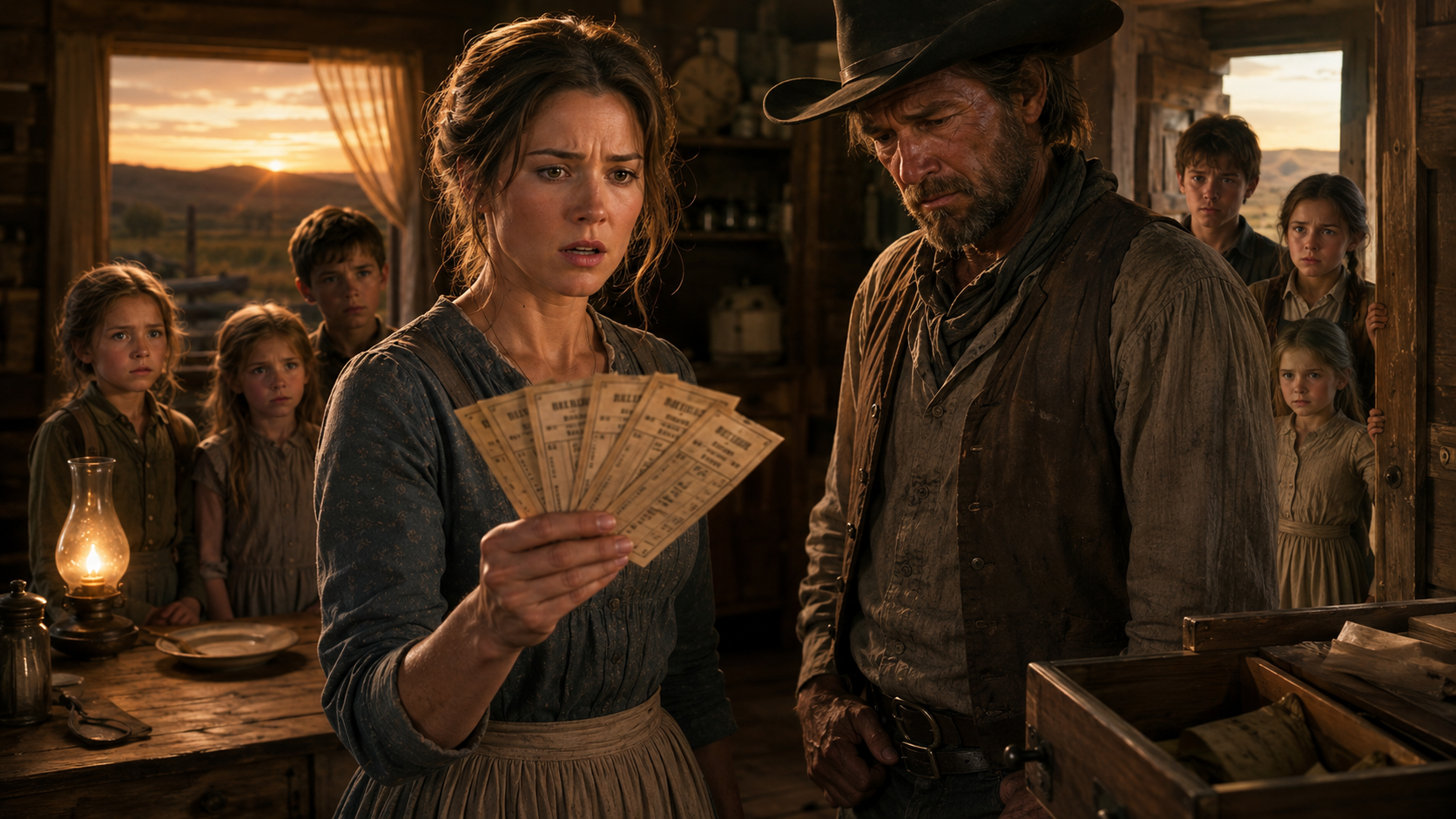
The tickets were gone. Wyatt burned them himself in the stove while the children watched. The envelopes followed. The guardianship papers curled black in the flames.
“I was wrong,” Wyatt said.
No one spoke.
He turned to them, face raw. “I thought carrying fear alone made me your father. It didn’t. It made me a coward with good intentions. I am sorry.”
Elsie cried first.
Then Sam.
Then the twins.
Nate tried not to, failed, and looked furious about it.
Molly crossed the kitchen and placed one hand against Wyatt’s sleeve.
It was the smallest forgiveness.
It was enough to break him.
He knelt and pulled them in, all of them, even Nate, who resisted for one second before collapsing against him like the boy he still was.
Clara turned away to give them privacy.
But Elsie reached for her.
“You too,” she said.
Clara shook her head. “This is family.”
Elsie’s chin lifted. “Then come here.”
Clara stood very still.
Then Benji, pale and small in Wyatt’s arms, whispered, “Miss Clara stays.”
So she did.
The next weeks became a battle fought with paperwork, pride, and pie.
Sheriff Pike took the bank records to the county judge.
Hiram Voss discovered that a town happy to gossip about a falling man was even happier to gossip about a cheating banker.
Wyatt sold two horses, not seven children.
Clara wrote letters to three doctors and one hospital in St. Louis. Elsie copied them in her neat hand. Nate rode messages into town. Sam collected coins in a jar labeled Benji’s Breath, because he said lungs sounded too ugly.
The twins charged visitors one penny to see the blue chicken coop.
Molly drew pictures of trains going away empty.
The town, ashamed of itself in the manner of towns that had known exactly enough to be guilty, began showing up.
Mrs. Bellamy brought quilts.
The blacksmith refused payment for wagon repairs.
The church ladies brought preserves, though Clara had to stop one of them from reorganizing her pantry and nearly started a war over peaches.
Even Sheriff Pike came by with an envelope of money and his hat in his hands.
“I should have read closer,” he told Wyatt.
Wyatt looked at him for a long time. “Yes.”
The sheriff nodded. “I’ll spend a while making that right.”
Benji had good days and frightening days.
On good days he sat in the sun and laughed when Ruby and Ruth pretended to be bank robbers stealing biscuits.
On frightening days his lips went pale and Wyatt carried him for hours, whispering stories against his hair.
Clara saw the fear in Wyatt every time.
But he no longer hid it.
That was something.
One night, after the children slept, Wyatt found Clara in the kitchen kneading dough. The lamp turned the windows black. Outside, the prairie wind moved softly around the house.
“I wrote to the hospital,” he said. “They answered.”
Clara stopped kneading.
“They’ll see him. It will cost less than Mercer feared. Still more than I have, but less.”
“That’s good.”
Wyatt nodded.
He stood there, hat in both hands though he was indoors.
Clara narrowed her eyes. “Why do you look like a man about to confess to stealing my rolling pin?”
“I’m going to St. Louis with Benji.”
“Of course you are.”
“I want Elsie to come.”
“She should.”
“And Nate, if he’ll agree.”
“He will pretend not to want to and then pack first.”
Wyatt almost smiled.
Then the smile faded.
“I want you to come too.”
Clara looked down at the dough.
“Benji trusts you,” Wyatt said. “The children trust you. I trust you.”
“That is not a reason to drag a cook across three states.”
“No,” he said quietly. “It’s not the only reason.”
The room changed.
Clara hated that her hands trembled.
“Wyatt.”
“I know.” He stepped back immediately, as if afraid of frightening her. “I know you came for work. I know grief makes fools of lonely people. I know this house is chaos and debt and children and trouble.”
“That is a very romantic list.”
He laughed softly, then sobered. “I’m not asking for anything tonight. I have no right. I just needed to say that somewhere between the first supper you forced me to attend and the morning you stood on my porch ready to fight a banker, I stopped thinking of you as someone passing through.”
Clara swallowed.
She wanted to say something sharp. Sharpness was safer.
Instead, she said, “I do not make promises when a child is sick.”
“I’m not asking for a promise.”
“Good.”
“I’m asking you not to run just because staying might matter.”
That was worse.
Far worse.
Clara turned back to the dough. “You should go to bed.”
“Clara.”
She closed her eyes.
He did not move closer. That was why she trusted him.
Finally, she said, “I will go to St. Louis for Benji.”
“And after?”
She looked at him then.
“After,” she said, “we will see what is still standing.”
They left for St. Louis two weeks later.
Not with six one-way tickets.