“You don’t have to fix everything,” Clara told her one evening.
Elsie’s hands tightened around a towel. “Someone does.”
“No. Some things get fixed by everyone carrying one corner.”
Elsie looked toward the yard, where Wyatt was showing Benji how to hold a brush for the old mare.
“He used to laugh,” she said.
“He may again.”
Elsie’s mouth trembled. “What if he doesn’t?”
“Then we teach him badly until he learns from embarrassment.”
That earned Clara the girl’s first real smile.
Wyatt changed slower.
But he changed.
He started coming to breakfast.
Then supper.
Then both.
He repaired the broken chair in Molly’s room. He took Sam riding. He let the twins paint the chicken coop blue, though the result was so ugly even the chickens seemed offended. He listened when Elsie spoke instead of staring through her.
At night, he sometimes remained on the porch after the children went to bed.
Clara would come out with coffee. At first they spoke of beans, fences, feed prices, and weather. Safe subjects. Practical subjects. The kind of things people discussed when they were afraid of what silence might reveal.
Then, little by little, the dead entered the conversation.
Marian, who had sung off-key.
Peter, who had danced badly and never admitted it.
Marian, who had hidden coins in flour jars.
Peter, who had once tried to fix a roof and fallen through it into a laundry basket.
Grief became less like a locked room and more like a door they sometimes opened together.
One night Wyatt said, “Marian would have liked you.”
Clara leaned against the porch rail. “Are you sure? I’ve been told I’m difficult.”
“She was difficult too.”
“Then perhaps we would have respected each other from opposite corners.”
He smiled.
It was brief.
It was tired.
But it was real.
And Clara, who had promised herself never to become foolish over a lonely man with wounded eyes, felt something dangerous shift inside her.
The first warning came from town.
Clara had gone into Briar Creek with Elsie and Nate for flour, salt, lamp oil, and thread. The general store was crowded with women pretending not to stare and men pretending not to gossip.
Clara had barely ordered sugar before she heard Wyatt’s name.
“Banker’s been out there twice this month.”
“Land note is past due.”
“Caldwell should have sold after Marian died.”
“He won’t last the summer.”
“Seven children and no wife. Mercy, what did he expect?”
Clara kept her face still.
Elsie heard too. Her chin lifted, but Clara saw her fingers tremble around the cloth bag.
Outside, near the bank, Wyatt stood with Hiram Voss, the town banker. Hiram was short, round, and polished, with hands too soft for honest work. Beside him stood Sheriff Alden Pike, looking uncomfortable beneath his hat.
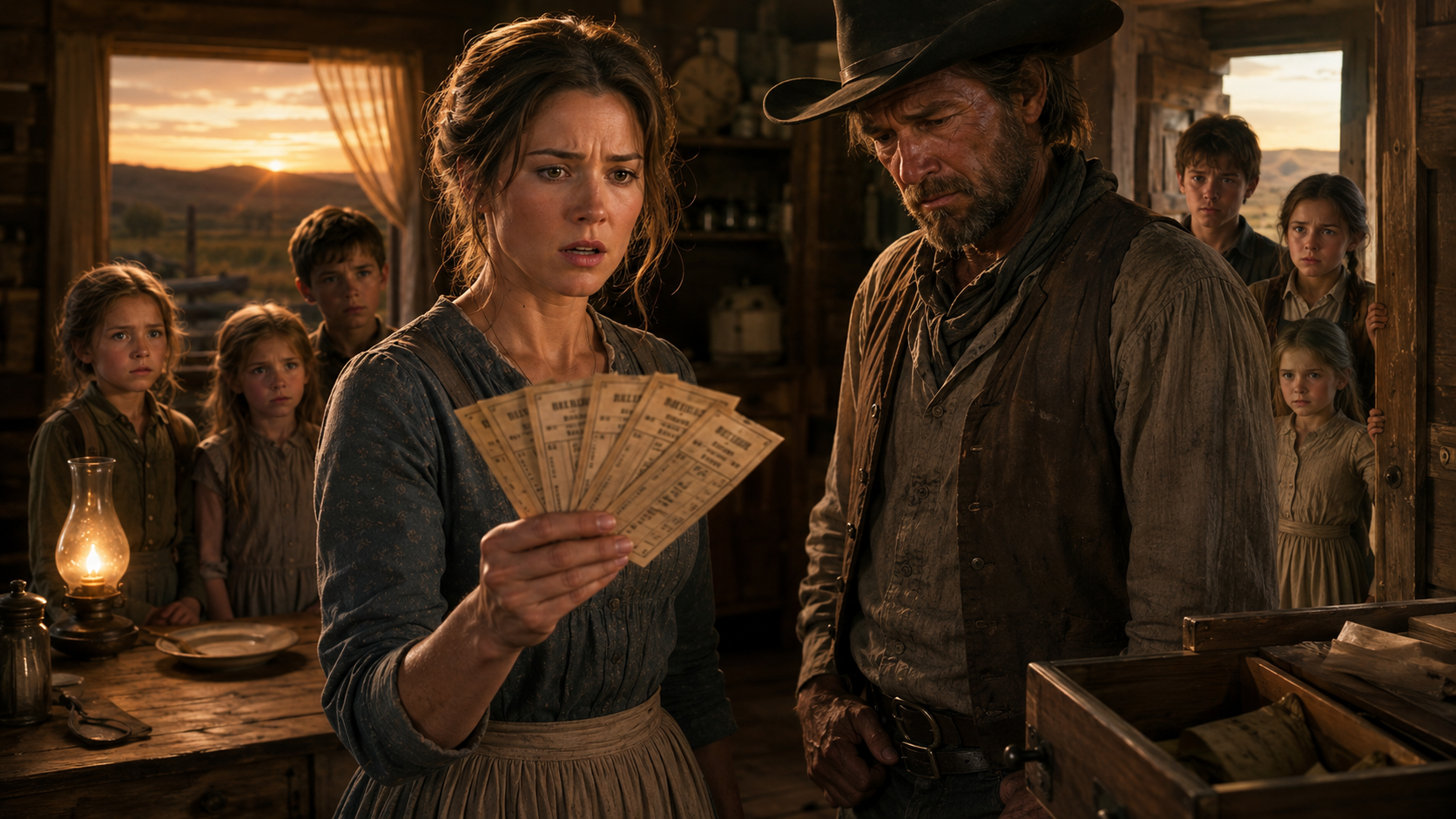
Hiram held papers.
Wyatt looked as if every word being spoken cost him blood.
When Hiram tapped the papers against Wyatt’s chest, Wyatt snatched them from him and shoved them into his coat.
Then he saw Clara across the street.
His face closed.
That night, she asked him plainly.
“What does Hiram Voss want from you?”
Wyatt was in the barn, rubbing oil into a cracked harness. “Money.”
“That much I guessed.”
“It’s ranch business.”
“Ranch business does not make a sheriff avoid looking at your daughter in the street.”
His hands stilled.
For a moment Clara thought he might tell her.
Then he said, “It’s nothing you need to carry.”
Clara laughed once, without humor. “Men are always very generous when deciding what women need not carry.”
He looked up sharply.
She held his gaze.
But he said nothing more.
After that, things began to disappear.
Not large things.
Small things.
A silver-backed hairbrush that had belonged to Marian. A pair of good candlesticks. A saddle Wyatt had once said belonged to his father. Three calves from the lower pasture. Then four.
When Clara asked, Elsie pressed her lips together.
Nate avoided her eyes.
Wyatt spent more time in his office and locked the door whenever he left.
The house had been warming.
Now a cold thread ran through it.
Clara felt it most at night, when she passed the office and saw lamplight under the door. Sometimes she heard paper sliding. Sometimes she heard Wyatt cough like a man choking on words he would not speak.
Then came the fever.
Benji woke before dawn burning hot, his small body rigid and shaking. Clara knew fever. She knew the smell of it, the speed of it, the way it could turn a child from restless to limp in the space of an hour.
“Elsie,” she said, calm because panic was useless, “cool water. Nate, saddle the mare in case we need the doctor. Sam, wake your father.”
“Pa’s not here,” Nate said.
Clara turned.
“He rode out before dawn,” Elsie said. “Said he had business at the west line.”
Clara swallowed a curse.