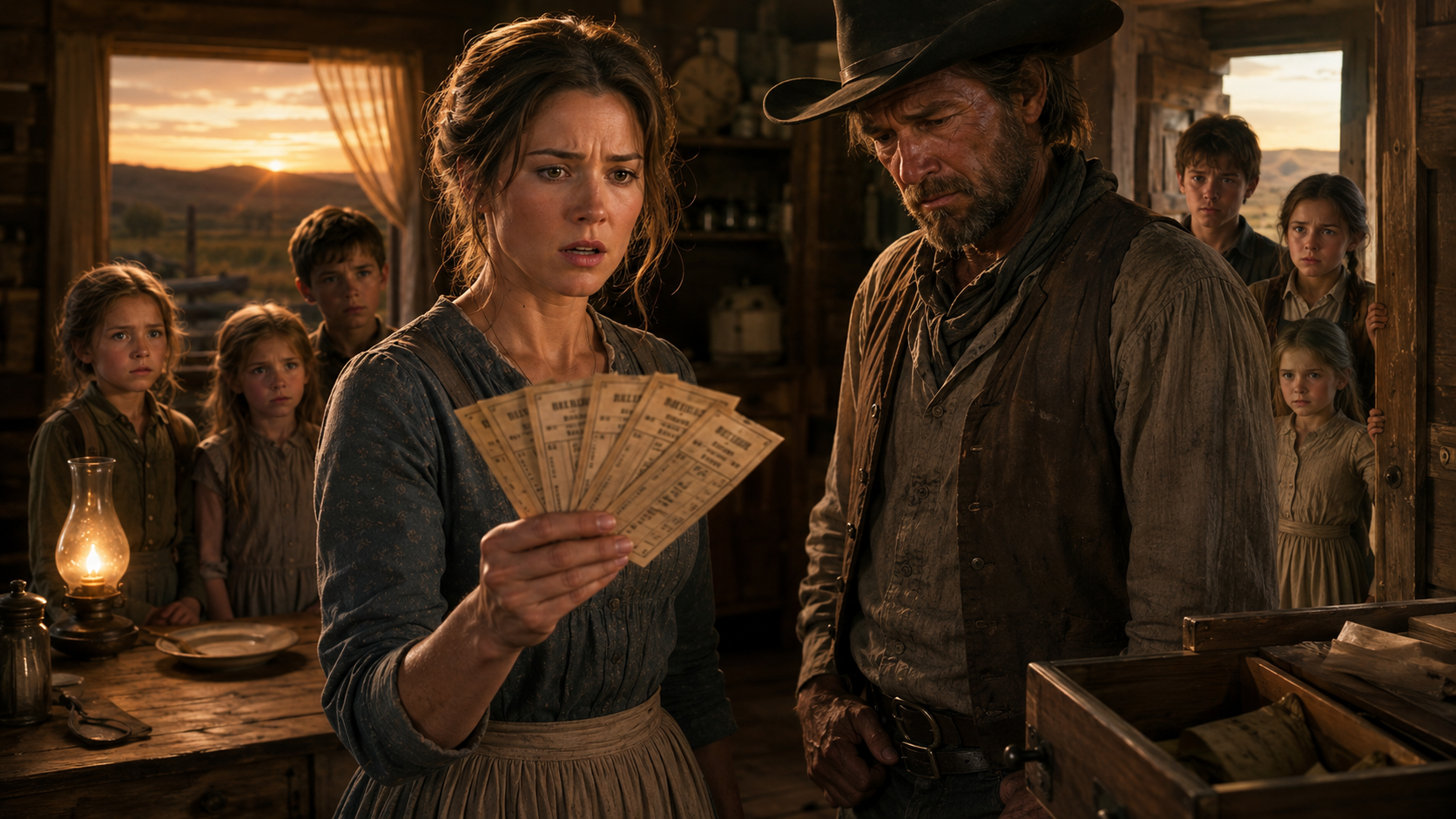
When Clara Whitmore stepped off the mail wagon at the edge of Briar Creek Ranch, the first thing she noticed was not the size of the house, though it was large enough to swallow three ordinary homes. It was not the wide stretch of dry pasture, nor the weathered barn leaning into the wind like an old man with secrets.
It was the silence.
A house with seven children should have been loud.
There should have been shrieking, laughter, boots on stairs, someone crying over a stolen toy, someone else begging for biscuits before supper. Clara had worked in enough homes, boarding houses, church kitchens, and widow’s parlors to know the sounds of children. They filled walls the way smoke filled a room.
But the Caldwell house sat quiet beneath the afternoon sun.
Too quiet.
The front porch boards creaked under her boots. Her carpetbag bumped against her knee. A yellow dog lying in the shade lifted its head, studied her, then dropped it again as if deciding she was not worth the effort.
Clara raised her hand to knock.
Before she could, the door opened.
A girl stood there, thin as a candle and nearly as pale. She could not have been more than fourteen, but her tired eyes belonged to someone much older. Her dress was clean, but patched at both elbows. Her hair had been braided in a hurry.
“You’re the cook?” the girl asked.
“I am,” Clara said. “Clara Whitmore.”
The girl looked past her toward the empty road. “You came alone?”
“I usually do.”
“You got references?”
“I got hands, recipes, and patience. References are in my bag if your father wants them.”
At the mention of father, something flickered across the girl’s face.
Not fear exactly.
Exhaustion.
“I’m Elsie Caldwell,” she said. “Pa is out by the south fence. He said to show you the kitchen and tell you supper is at six.”
Clara glanced over the girl’s shoulder into the dim hallway. Somewhere inside the house, a baby coughed. A chair scraped. A boy whispered, “Is she old?”
Clara lifted one eyebrow.
Elsie flushed. “That’s Nate. He doesn’t mean anything.”
“I’m thirty-two,” Clara said, stepping inside. “Old enough to know when a child is hiding behind a door.”
A small boy’s face vanished from the crack of a room to the left.
For the first time, Elsie almost smiled.
Almost.
The kitchen told Clara more than any letter could have.
There were dishes stacked in a basin, bread gone hard beneath a cloth, a stew pot scorched black at the bottom, three jars of peaches open and attracting flies, and a flour sack left untied beside the table. Someone had tried to keep the place running. Someone young. Someone tired. Someone who knew how to work but not how to breathe.
Seven tin plates waited on the shelf.
Only seven.
Clara turned slowly. “Where does your father eat?”
Elsie looked at the floor. “Mostly in his office.”
“Mostly?”
“When he remembers.”
A little girl stood in the doorway holding a wooden horse missing one leg. She had enormous brown eyes and a solemn mouth.
“That’s Molly,” Elsie said. “She doesn’t talk much.”
Molly stared at Clara as if deciding whether she was another person who would leave.
Clara crouched, keeping her hands folded. “Hello, Molly.”
Molly said nothing.
Behind her came two boys, one about eleven, one maybe eight. The older had sunburned cheeks and a defiant chin. The younger had jam on his shirt and guilt in his eyes.
“I’m Nate,” said the older one before Elsie could introduce him. “I can shoot, ride, and mend a gate.”
“You can also burn eggs,” Elsie muttered.
Nate scowled. “Only once.”
“Three times.”
The younger boy raised his sticky hand. “I’m Sam. I can eat six biscuits.”
“That may be your finest talent,” Clara said.
Two red-haired twins appeared next, both barefoot, both grinning as if trouble had personally invited them to dinner.
“Ruby and Ruth,” Elsie said. “Don’t ask which is which. They lie.”
“We don’t lie,” one twin said.
“We improve the truth,” said the other.
A small child, no more than four, shuffled in last, dragging a blanket behind him. His curls stuck to his forehead. He looked at Clara, then hid behind Elsie’s skirt.
“That’s Benji,” Elsie said softly.
Clara counted them.
Elsie. Nate. Sam. Molly. Ruby. Ruth. Benji.
Seven children.
No mother.
No laughter.
No father at the table.
Clara set down her bag.
“Well,” she said, rolling up her sleeves. “First thing, we wash every dish in this kitchen. Second, someone opens those windows before I faint from the smell of old stew. Third, if there’s a hen on this ranch willing to part with eggs, I intend to meet her.”
Sam brightened. “Does that mean biscuits?”
“It means supper,” Clara said. “And supper means everyone sits down.”
Elsie went still. “Pa won’t.”
Clara looked at the girl.
“Then your father and I will have our first disagreement.”