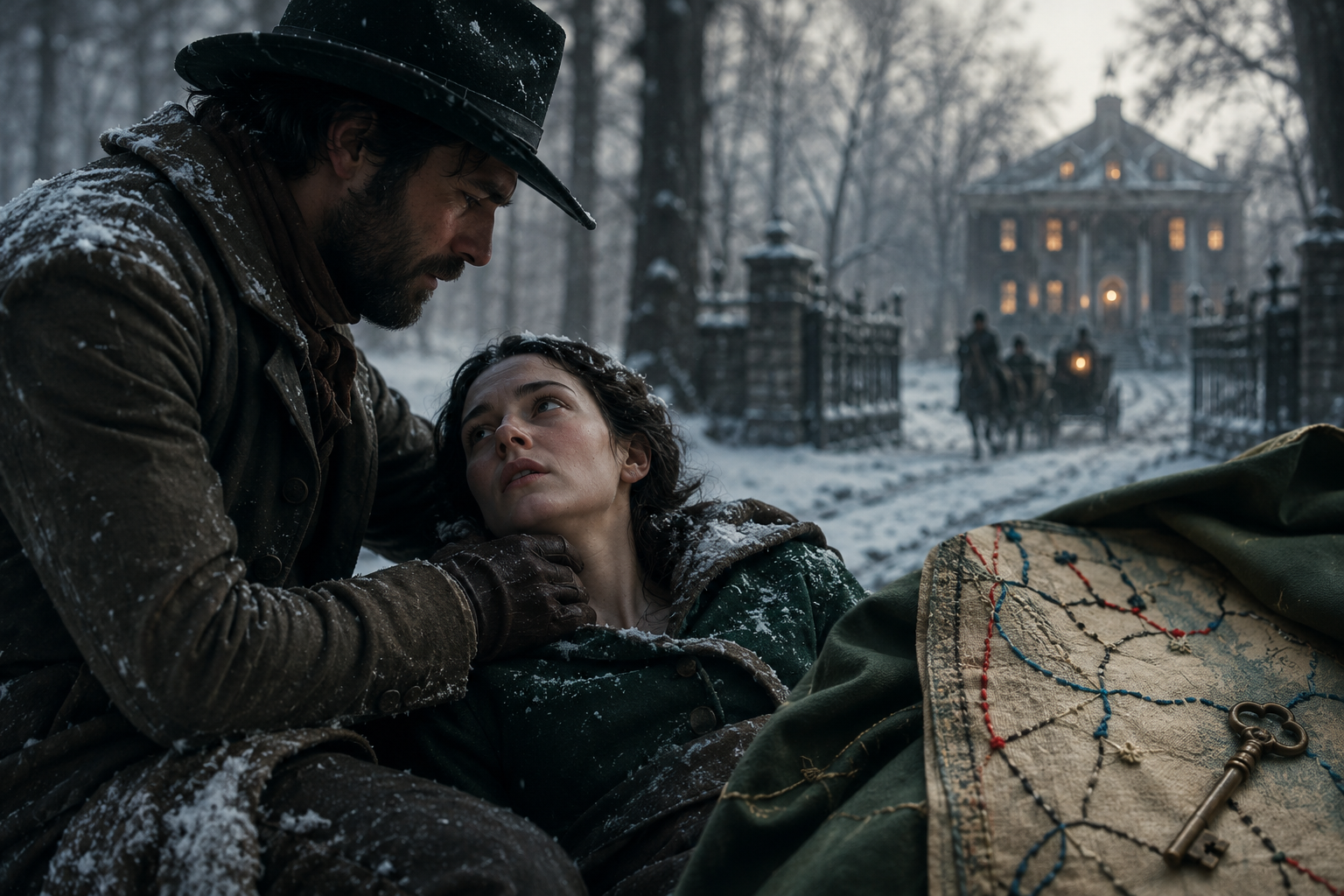
Elara hesitated at the opening.
“I cannot be locked underground again.”
Gideon stepped away from the trapdoor.
“Then you may leave through the back window. I won’t force you.”
The hoofbeats grew louder.
Elara looked from the window to the cellar.
Finally, she lowered herself inside.
Gideon left the trapdoor slightly open.
“You control it from below,” he told her. “No one locks it but you.”
A moment later, someone struck the front door.
Gideon opened it.
Bram Cutter stood on the porch with snow melting across his shoulders. Two riders waited behind him.
“You are Gideon Marsh?”
“You already know my name.”
Cutter smiled without warmth.
“A woman belonging to Mr. Wycliffe became confused during the storm.”
“Belonging to him?”
“His wife.”
“That is not the same thing.”
Cutter’s smile disappeared.
“She is ill. She left Briarwood without proper clothing and may harm herself. We followed her tracks north.”
“The snow covered every track before midnight.”
“We found blood near the road.”
Gideon leaned against the doorframe.
“Then perhaps you should look for an injured deer.”
Cutter glanced past him into the cabin.
“You mind if we search?”
“Yes.”
“This is a serious matter.”
“So is entering another man’s home without permission.”
One of the riders moved his hand toward his coat, but Cutter raised a finger and stopped him.
“We are trying to protect Mrs. Wycliffe.”
Gideon looked directly at him.
“Then why is she running from you?”
For several seconds, no one spoke.
Cutter stepped closer.
“If you see her, tell her that her husband forgives her. Tell her that Briarwood is her home.”
Gideon’s voice remained calm.
“A home does not require guards to keep someone inside.”
The two men stared at each other until Cutter finally turned away.
The riders disappeared into the trees, but Gideon knew they had not gone far.
He shut the door.
Elara emerged from the cellar a few moments later.
“They will watch the cabin.”
“Yes.”
“They will return with the sheriff.”
“Probably.”
“You should send me away.”
“You would freeze before reaching Cedar Hollow.”
“Then they will destroy you too.”
Gideon returned to the stove.
“They tried once.”
Elara studied him.
“What did Cassian Wycliffe take from you?”
Gideon’s hand stopped above the firewood.
“My sister.”
Seven years earlier, June Marsh had accepted work at Briarwood Hall. The wages were good, and she planned to remain there only until she had saved enough money to open a dress shop.
Three months later, Gideon received a letter saying she had left for New Orleans.
He never believed it.
June had taken nothing with her. Her clothes remained in the servants’ quarters, along with the silver locket their mother had given her.
Cassian insisted she had run away.
Bram Cutter claimed no one knew where she had gone.
Gideon searched river ports, towns, churches, and burial grounds. He found no trace of her.
Finally, people began telling him to accept the truth.
He never did.
Elara slowly reached for her coat.
Her fingers moved along the newly stitched hem.
“There are names in here.”
Gideon looked at her.
“What names?”
“People who disappeared from Briarwood. Families whose property was taken. Workers blamed for thefts they did not commit. Boat captains who refused Cassian’s private cargo.”
She found a small pair of scissors on Gideon’s table and carefully opened the lining.
A folded sheet of thin cloth slipped into her hand.
It was covered in lines sewn with blue, black, and red thread.
At first, it resembled decorative embroidery. Then Gideon recognized the curves of rivers, roads, and property boundaries.
“A map,” he said.
Elara nodded.
“My father taught me surveying before he died. Cassian believed it was an unsuitable interest for a woman, so I allowed him to think I had forgotten everything.”
Gideon examined the stitched lines.
One red thread followed the Natchez Trace. Several black knots marked estates and abandoned buildings. A blue line led from Briarwood to an old chapel near Willow Crossing.
“What is hidden at the chapel?”
“The original land records.”
Gideon looked up.
Elara sat straighter, although exhaustion remained visible in her face.
“Cassian’s fortune was not built through wise investments,” she said. “It was built through false debts. His clerks altered contracts after they were signed. When families could not pay amounts they had never agreed to, he took their farms, mills, and businesses.”
“Why hide the real records in a chapel?”
“Because his father started the scheme. Before he died, he became frightened that Cassian would kill anyone who knew too much. He moved the original deeds and account books into a crypt beneath the abandoned chapel.”
“How do you know?”
“I found a letter inside his desk.”