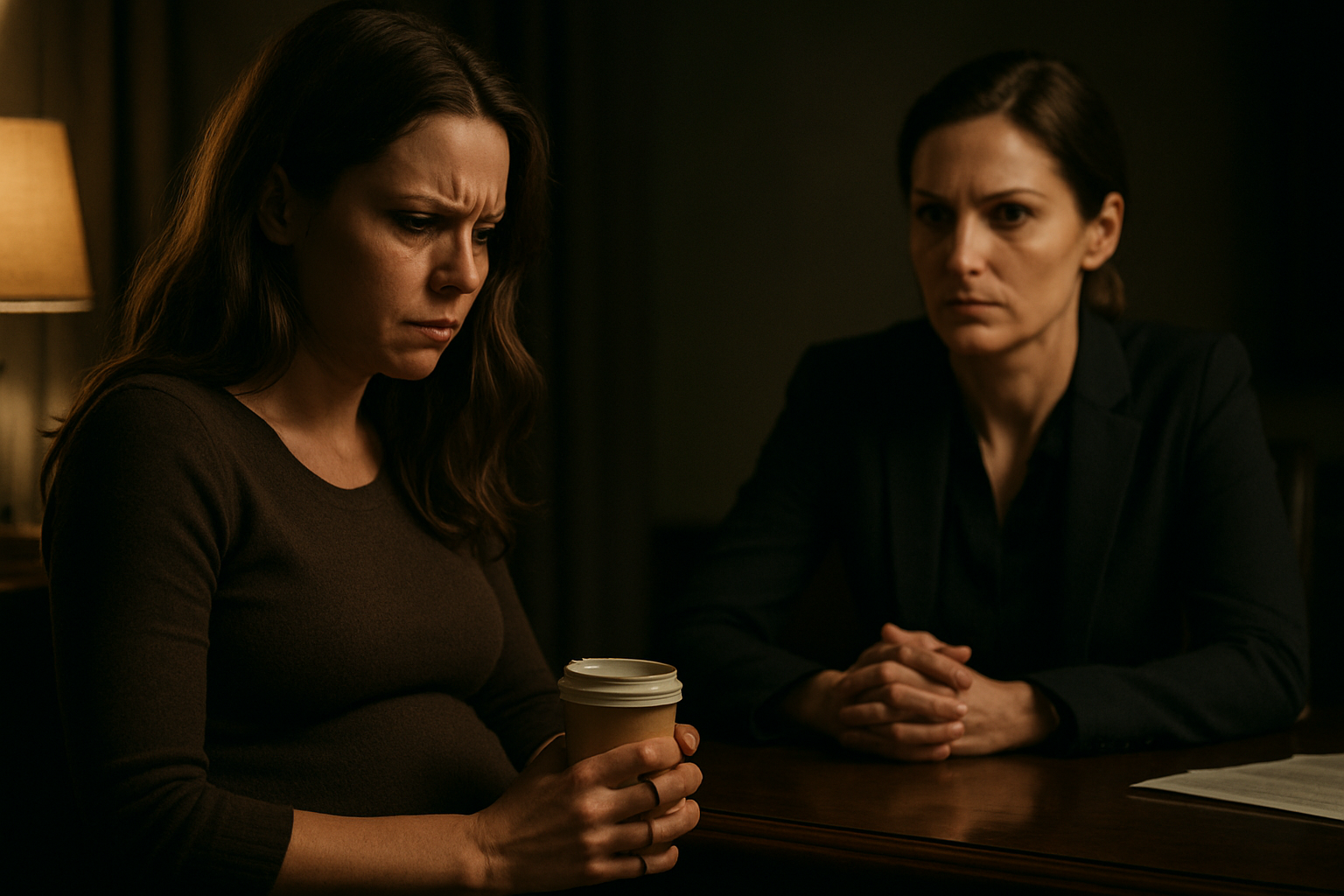
“I mean it,” Livia said quickly. “I’ll tell Rowena everything. The invoices, the hotels, what Julian said about the trust. I’ll cooperate. I just need you to tell them I helped.”
There it was.
Not redemption.
Negotiation.
Vivienne felt something inside her finally detach.
The friendship did not shatter in that moment. It had shattered long before, in hotel rooms and wire transfers and whispered strategies.
This was only the sound of Vivienne setting down the pieces.
She closed the door, removed the chain, and opened it wider.
Livia’s eyes brightened with hope.
Vivienne reached into the small table drawer beside the entrance and took out a velvet pouch. Inside was the bracelet Livia had given her before the wedding, engraved with Sisters by choice.
She placed it in Livia’s palm.
“You left this long before I returned it,” Vivienne said.
Livia broke into a fresh sob.
“Vivienne, please.”
“You can tell Rowena the truth because it is right, or you can tell her because you want a deal. That’s between you and whatever conscience you have left. But do not come to my home again asking me to turn your panic into forgiveness.”
Livia’s hand closed around the bracelet.
“Do you hate me?”
Vivienne thought about it.
Hate seemed too heavy to carry with a baby pressing beneath her ribs and an entire life waiting to be rebuilt.
“No,” she said. “I’m done making space for you.”
Then she closed the door.
Livia testified three days later.
Not out of nobility, Rowena said, but because Julian had already begun blaming her for everything. Once the company’s internal auditors called, he claimed Livia had fabricated invoices and manipulated him emotionally during a difficult time in his marriage.
Livia, realizing she had been promoted from mistress to scapegoat, arrived at Rowena’s office carrying emails, texts, hotel receipts, and one recording.
On it, Julian’s voice was clear.
“Once Vivienne is declared unstable, nobody will question what I sign.”
That sentence changed everything.
The temporary protective order became permanent. Julian was removed from his position at Vale & Ashbourne Capital pending investigation. The board froze his access, then referred the matter to federal authorities because some of the funds had crossed regional lines.
By breakfast the next morning, business papers and gossip columns alike had devoured the scandal.
BELLHAVEN FINANCE STAR SUSPENDED AMID TRUST FRAUD PROBE.
Reporters called Vivienne’s hospital. Old acquaintances texted with carefully disguised curiosity. Women who had once envied her penthouse whispered that she had always seemed too quiet, as if quietness were proof of hidden drama rather than the armor of a woman who had learned young that spectacle never protected anyone.
Vivienne ignored almost all of it.
The one call she answered came from Gideon.
“I’m outside,” he said.
Vivienne opened the door to find him standing on the townhouse steps in a navy coat, holding two paper bags from a bakery and looking older than he had at her mother’s funeral.
Gideon Price had been her mother’s closest friend, occasional advisor, and the only man from that glittering old world Vivienne had never distrusted. He had known Cordelia Ashbourne before the illness, before the legal battles, before grief sharpened her into something formidable and remote.
He did not ask for details.
He did not tell Vivienne she should have seen it coming.
He simply set the bakery bags on the kitchen counter and said, “Your mother would have burned down half of Bellhaven.”
Vivienne laughed before she could stop herself.
The sound cracked open into tears.
Gideon crossed the kitchen and held her while she cried into his coat.
It was not a graceful cry. It was not cinematic. It was ugly, breathless, and full of months of swallowed humiliation. Gideon said nothing. He only kept one hand on her back and the other steady at her shoulder, as if grief were a storm he could help her stand inside.
When she finally pulled away, embarrassed, he handed her a napkin.
“I’m sorry,” she whispered.
“Don’t apologize for telling the truth with your body.”
That sounded so much like her mother that Vivienne cried again, softer this time.
Over coffee and cinnamon rolls, Gideon told her what Cordelia had never managed to say before illness stole her strength: the trust had not been built to make Vivienne powerful.
It had been built to keep powerful people from owning her.
“Your mother knew you hated that world,” Gideon said. “But she also knew money doesn’t vanish because you dislike it. It only waits for someone less decent to use it.”
Vivienne looked toward the empty nursery.
“Julian thought I was weak because I didn’t want the empire.”
“No,” Gideon said. “He thought wanting it made him stronger than you. That was his mistake.”
The settlement hearing took place the following week in a Merrow County courtroom that smelled faintly of coffee, wool coats, and old paper.
Julian arrived with a new attorney, a bruised reputation, and the hollow-eyed look of a man who had discovered consequences were not reserved for poorer people.