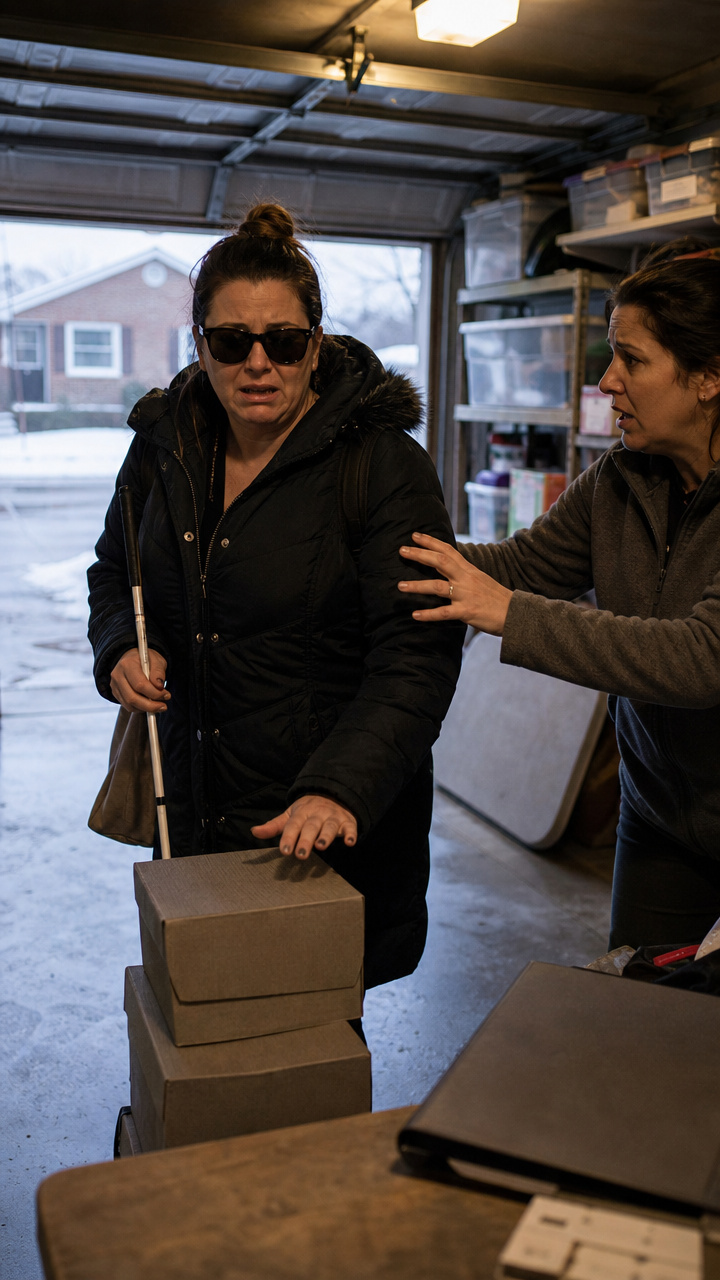
When my husband Michael came home from a business trip, I greeted him wearing dark glasses, one hand wrapped around a white cane.
We had been married for eleven years, and he was certain the surgery had failed.
Certain I was still unable to see.
What he didn’t know was that, by then, I had already looked with my own eyes at everything he had hidden inside our garage for years.
And I had decided not to tell him that my sight had returned.
I was twenty-eight when I married Michael. Back then, my vision was perfectly healthy. I drove myself everywhere, worked at the public library, and could spend entire evenings reading without the slightest discomfort.
Then, about a year later, something strange began happening.
People’s faces blurred whenever they stood more than a few feet away.
Soon, the words on printed pages began running together.
Not long after that, I could barely make out the steps on the staircase whenever the lights were off.
After a series of examinations, the doctors diagnosed me with a rare eye disorder.
Over the next few years, my vision deteriorated until I was almost completely blind.
At first, the change shattered me.
I was terrified to leave the house alone.
I could no longer keep my job.
Sometimes even placing a mug on the kitchen table ended with coffee splashing across the floor.
Michael stayed beside me through all of it.
He drove me to appointments, bought the groceries, handled the bills, and reminded me almost every day that I would never become a burden to him.
People around me often said:
“Claire, you’re incredibly lucky to have such a devoted husband.”
And I believed them. Every word.
The garage had always been Michael’s private territory.
He kept his tools there, along with car supplies, old boxes, and all the belongings that had no room inside the house.
I almost never went in.
There were too many sharp corners, heavy metal shelves, and objects scattered across the floor.
Whenever I needed something stored there, Michael brought it to me himself.
For years, I saw nothing suspicious in that arrangement.
Not until the previous month.
One afternoon, the specialist who had treated me years earlier called unexpectedly.
He told me that an experimental laser procedure had become available, and a place had suddenly opened in a clinical trial.
No one promised that it would work.
The doctor was completely honest: the treatment might change nothing at all.
Still, I decided to take the chance.
When I told Michael, his reaction unsettled me.
He didn’t look pleased.
For several seconds, he said nothing. Then he quietly replied:
“Claire, maybe you shouldn’t put yourself through this again. We’ve tried so many things already, and none of them helped. I don’t want you getting your hopes up only to be hurt all over again.”
That same evening, he casually announced that he would be leaving for a weeklong business trip two days later.
The procedure took place while he was away.
On the first day afterward, I could see only brilliant patches of light.
By the second, I began to recognize the outline of a window.
And on the third morning…
I saw the doctor’s face.
I cried so hard that a nurse had to hold me and reassure me for a long time.
I returned home two days before Michael was due back.
Everything looked unfamiliar, almost magical.
For the first time in years, I saw the true color of the walls in our living room.
I saw the sofa where I had spent countless hours.
Then I stood in front of the mirror and studied my own face.
Even seeing my eyes again felt impossible.
That was when I remembered the Christmas lights.
Michael always stored them in the garage.
I wanted to hang them around the living room and spend the evening watching their soft glow.
So I walked to the garage.
I opened the door.
For several seconds, I couldn’t understand what I was looking at.
There were hardly any tools inside.
The familiar oil containers were gone.
So was the clutter Michael had described to me countless times.
Nearly half the room was filled with neatly stacked boxes.
Every single box had my name written across it.
I stepped closer.
Then I noticed a large blue container.
A label had been placed on its lid:
“Willow Creek Care Center.”
My hands began to tremble.
On one of the shelves lay my personal documents.
My passport.
My birth certificate.
The jewelry that had belonged to my mother and passed to me after her death.
Beside them sat a thick pile of papers.
I lifted the top page.
Across the upper section, in large printed letters, was one word:
“Power of Attorney.”
Below it was my signature.
Or rather, a signature that was supposed to be mine.
But I had never signed anything like that.
I kept reading.
Page after page.
Line after line.
When I reached the final section, a cry escaped me:
“Oh God… Is this what you’ve been hiding from me?”
According to the document, Michael had been given complete authority over my bank accounts.
He could sell the house that belonged to me.