Yes, Daddy loved Mommy before.
Yes, Uncle Victor did something very wrong.
No, Mommy did not lie to you.
No, Daddy did not leave you on purpose.
Yes, families can be broken and still become real.
Six months after the trial began, Mara asked to see the old house.
Elias almost said no because every room inside it was haunted.
But he had promised not to make choices for her.
So he drove Mara and Sophie to the home he had locked up after the funeral.
The nursery door was the hardest.
Mara turned the knob herself.
The room was empty except for dust and sunlight.
The green walls were still there.
So was the pale outline where the wooden moon had once hung above the crib.
Mara walked into the center of the room and closed her eyes. Sophie held her hand. Elias stood in the doorway, afraid to step into a memory that belonged to all three of them in different ways.
Then Mara looked back.
“Where is the moon?”
“In the attic.”
Sophie gasped.
“There’s an attic?”
For the first time that day, Mara laughed.
A real laugh.
Small, but real.
They found the wooden moon wrapped in an old blanket. Elias had put it away because looking at it hurt too much. Sophie insisted on carrying it herself, though it was nearly half her size.
Together, the three of them hung it back on the nursery wall.
Not because Sophie would sleep there.
Not because the past could be rebuilt exactly.
Because some symbols deserved to return to the places they had been stolen from.
One year after the day on Briar Lane, they went back to the bakery.
It had new windows now.
Agnes no longer owned it. A young couple had bought the place and kept the blue shutters. Sophie insisted on wearing her yellow raincoat even though it barely fit anymore because she called it “the discovery coat.”
Mara rolled her eyes.
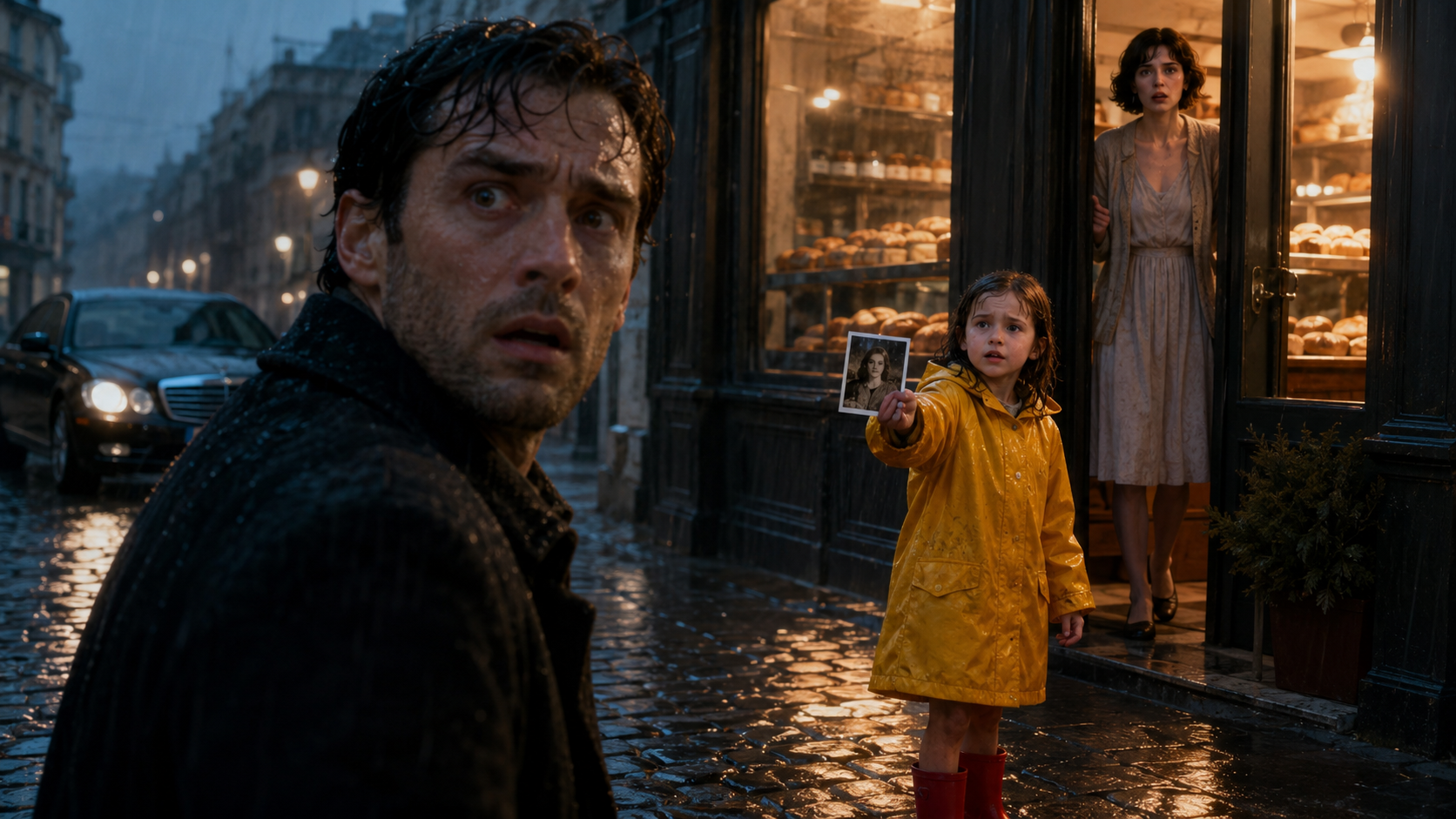
Elias bought three hot chocolates, and they sat on the stone step where Sophie had found the photograph.
The city moved around them.
People passed.
Shoes clicked over cobblestones.
A bell rang above the bakery door.
Mara sat beside Elias, her shoulder touching his. She was not fully the woman from the photograph. She was not fully Nora either. She was Mara with scars, memory gaps, sharper edges, and strength no old picture could have captured.
Elias loved all of her.
But he had learned to say it carefully.
Without demand.
Without expectation.
“Mara,” he said.
She looked at him.
“I’m glad the photo fell.”
Her eyes softened.
“So am I.”
Sophie leaned across her mother’s lap.
“Show me again.”
Elias pulled out the photograph.
The old one.
The one that started everything.
Mara laughing in the wind.
Sophie studied it like she always did.
“You look happy,” she told her mother.
Mara smiled.
“I was.”
Sophie looked at Elias.
“Were you happy too?”
He nodded.
“I was.”
The little girl considered this with six-year-old seriousness.
“Are you happy now?”
Elias looked at Mara.
Mara looked back at him.
There were too many answers.
Yes, because they were alive.
No, because so much had been stolen.
Yes, because Sophie’s hand was in his.
No, because justice could not return first steps, first words, first birthdays, five years of mornings he never knew existed.
Mara answered first.
“We are learning how to be.”
Sophie seemed satisfied.
She slipped the photograph back into Elias’s hand.
“Don’t drop it again.”
Elias laughed, and the sound surprised him.
It had been years since laughter had come out without cutting him on the way.
“I won’t.”
Mara reached over and closed his fingers around the picture.
“Maybe you should,” she said softly.
He looked at her.
She looked toward the street where strangers walked beneath the afternoon sun, never knowing that one small fallen photograph had once broken open a grave and returned a life.
“Some things need to fall,” she said. “So the truth can be picked up by the right person.”
Years later, people would tell the story in softer ways.
They would say a little girl found a picture.
They would say a widower found his wife alive.
They would say a powerful family was destroyed by one impossible question on a rainy street.
But Elias would know the truth was not soft at all.
The truth came with shattered glass, forged records, stolen years, a child raised under a false name, and a woman brave enough to reclaim herself piece by piece.
He would know something else too.
Mara was not returned to him like lost property.
Sophie was not a prize for suffering.
Their family was not restored in one dramatic moment.
It was rebuilt slowly, carefully, honestly, with apologies that did not demand forgiveness and love that finally understood freedom.
And whenever Sophie asked to hear the story, Mara always began the same way.
“Your father was walking like the saddest man in the world.”
Sophie would grin.
“And he dropped the picture.”
Elias would pretend to be offended.
Mara would smile.
And for a moment, sunlight would touch all three of them.