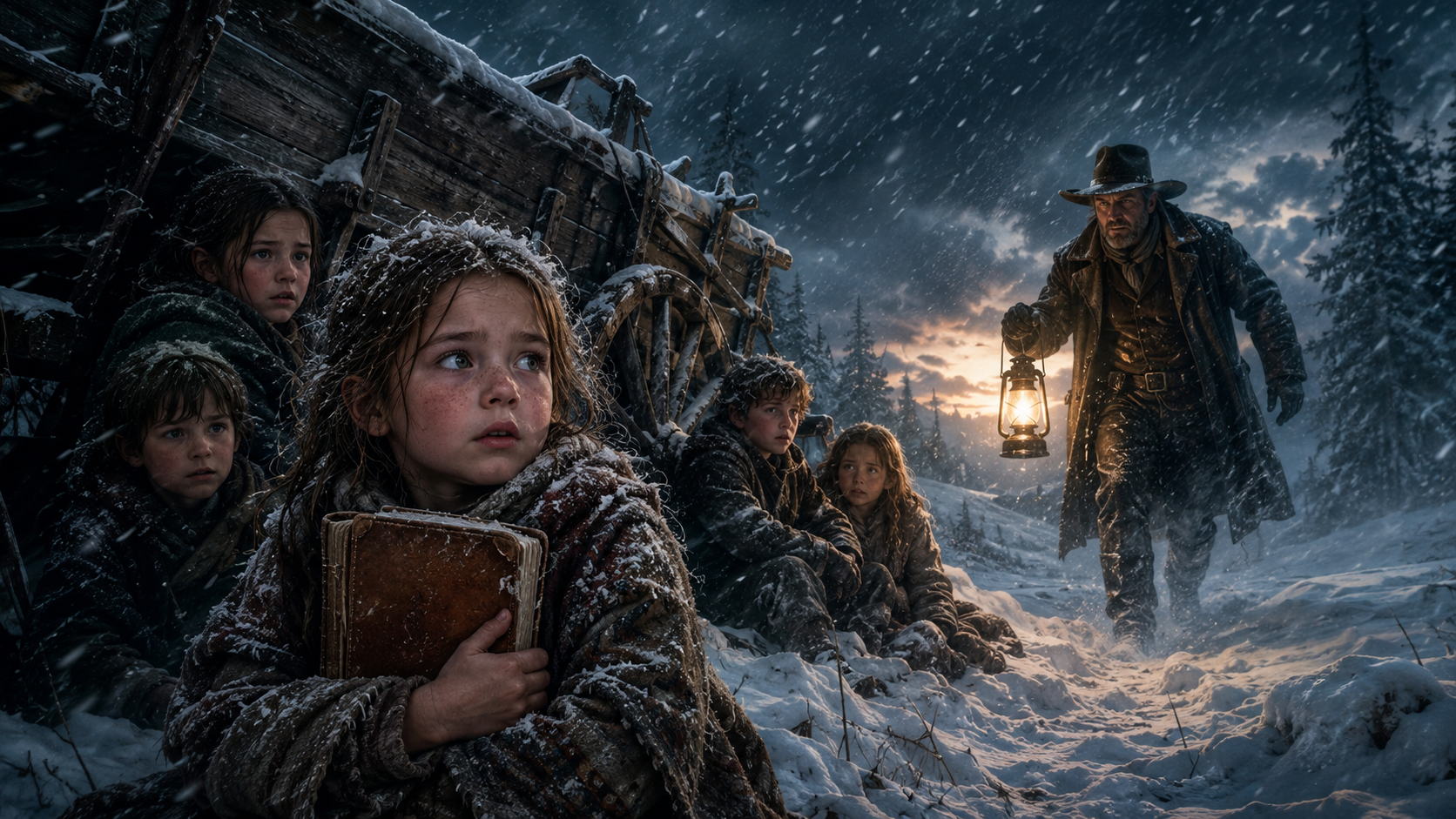
“I can make soup,” the smallest child whispered.
No one laughed.
Not in that storm. Not with the wind clawing at the broken wagon like a living thing. Not with five children huddled beneath a canvas stiff with ice while their mother lay wrapped in a quilt that no longer rose and fell with breath.
The man who heard the whisper was Jonah Vale, a widower who had come down from the north ridge only because his horse had refused the lower trail. Jonah had learned long ago to trust animals before men. Men lied. Horses only stopped when the world ahead was trying to kill them.
He had expected a fallen tree. Maybe a wolf pack. Maybe a washed-out bridge under the snow.
He had not expected children.
The oldest boy stood in front of them with a hatchet in both hands. He could not have been more than thirteen, but his eyes had the hard, sleepless look of someone who had already made promises too large for his bones.
“Don’t come closer,” the boy said.
Jonah stopped. He raised both hands slowly.
“My name is Jonah Vale. I’m not here to hurt you.”
“That’s what men say before they do.”
The boy’s voice trembled only at the edges. Jonah respected him for that.
Behind him, two girls clung to each other beneath a torn blanket. A younger boy sat motionless beside the wagon wheel, his lips blue. The smallest child, a girl with tangled dark hair and cheeks raw from cold, held a little leather book against her chest as if it were warmer than fire.
Jonah looked past them.
The woman lay near the wagon bed.
He removed his hat.
The oldest boy noticed. His grip on the hatchet weakened.
“She was our mother,” he said.
“I figured.”
“She walked until she couldn’t.”
The wind slammed a sheet of snow between them.
Jonah took one step closer, careful and slow. “What’s your name?”
The boy hesitated.
“Caleb.”
“And the others?”
Caleb swallowed. “Nora, Beth, Isaac, and Ruth.”
The smallest girl lifted her chin when her name was spoken.
Jonah nodded once. “I have a cabin two miles west if the trail hasn’t vanished. Food, firewood, blankets.”
“We were going east,” Caleb said. “To Braddock Crossing.”
“You won’t reach it tonight.”
“My father went for help.”
“When?”
Caleb looked away.
The girl named Nora answered. “Yesterday morning.”
Jonah did not say what all of them already knew. In a Wyoming blizzard, yesterday was not time. It was a death sentence.
But Ruth, the smallest one, opened her book.
“Mama said if Papa didn’t come back, we had to keep the recipes.”
Caleb spun toward her. “Ruth, hush.”
“But she said—”
“Hush.”
The sharpness in his voice made the little girl flinch.
Jonah watched that closely. The boy was not angry. He was afraid.
“What recipes?” Jonah asked.
Ruth hugged the book tighter. “Soup. Bread. Dumplings. Things like that.”
“I can cook,” she whispered again.
Jonah looked at the dead woman, then at the five children she had dragged through snow, hunger, terror, and whatever else had chased them into the storm.
“Then we’ll need your help,” he said. “Because cold children don’t argue well on empty stomachs.”
Caleb stared at him as if kindness were more dangerous than a gun.
Jonah did not blame him.
He had seen what hunger did. He had seen what powerful men did when winter gave them a convenient way to erase people.
He wrapped the dead woman more carefully in the quilt, then turned to the children.
“We can’t carry her far in this wind.”
Caleb’s face changed.
“No.”
“Son—”
“No. We’re not leaving her.”
Jonah crouched so they were eye to eye.
“I did not say leave. I said we cannot carry her far. There’s a stand of pines south of the creek. The ground will be softer there. We’ll lay her where the storm can’t take her.”
Caleb’s mouth twisted, fighting tears he considered betrayal.
“She hated the cold.”
“I know.”
“You don’t.”
Jonah looked at the snow, and for a moment he saw another winter, another grave, another woman’s hand slipping from his.
Then he said, “No. Not yours. But I know enough.”
They buried Miriam Cole beneath three leaning pines while the sky turned black behind the mountains.
Caleb dug first. He would not let Jonah take the shovel until his arms shook too badly to lift it. Nora tied a red thread from her sleeve around her mother’s wrist. Beth placed a button in the grave because, she said, Mama was always losing buttons and might need one in heaven. Isaac stood silent, staring at nothing.
Ruth opened the leather recipe book.
“Does Mama need this?” she asked.
Caleb reached for it quickly. “It was hers.”
Ruth stepped back. “She said I keep it.”
“Ruth.”
“She said recipes remember what people try to forget.”
Jonah’s hand tightened around the shovel.
That was no ordinary thing for a dying woman to say.
Caleb saw the question in Jonah’s face and spoke fast.
“She had fever. She didn’t know.”