Part One: The Child the City Refused to See
Westbridge never truly became quiet.
Even before sunrise, delivery trucks groaned through narrow streets, traffic lights changed for empty intersections, and commuters hurried toward the glass towers downtown. By afternoon, the sidewalks were crowded with office workers, students, tourists, and impatient drivers searching for somewhere to park.
Everyone seemed to be going somewhere important.
That was why almost no one stopped for the little girl sitting beside a closed flower shop.
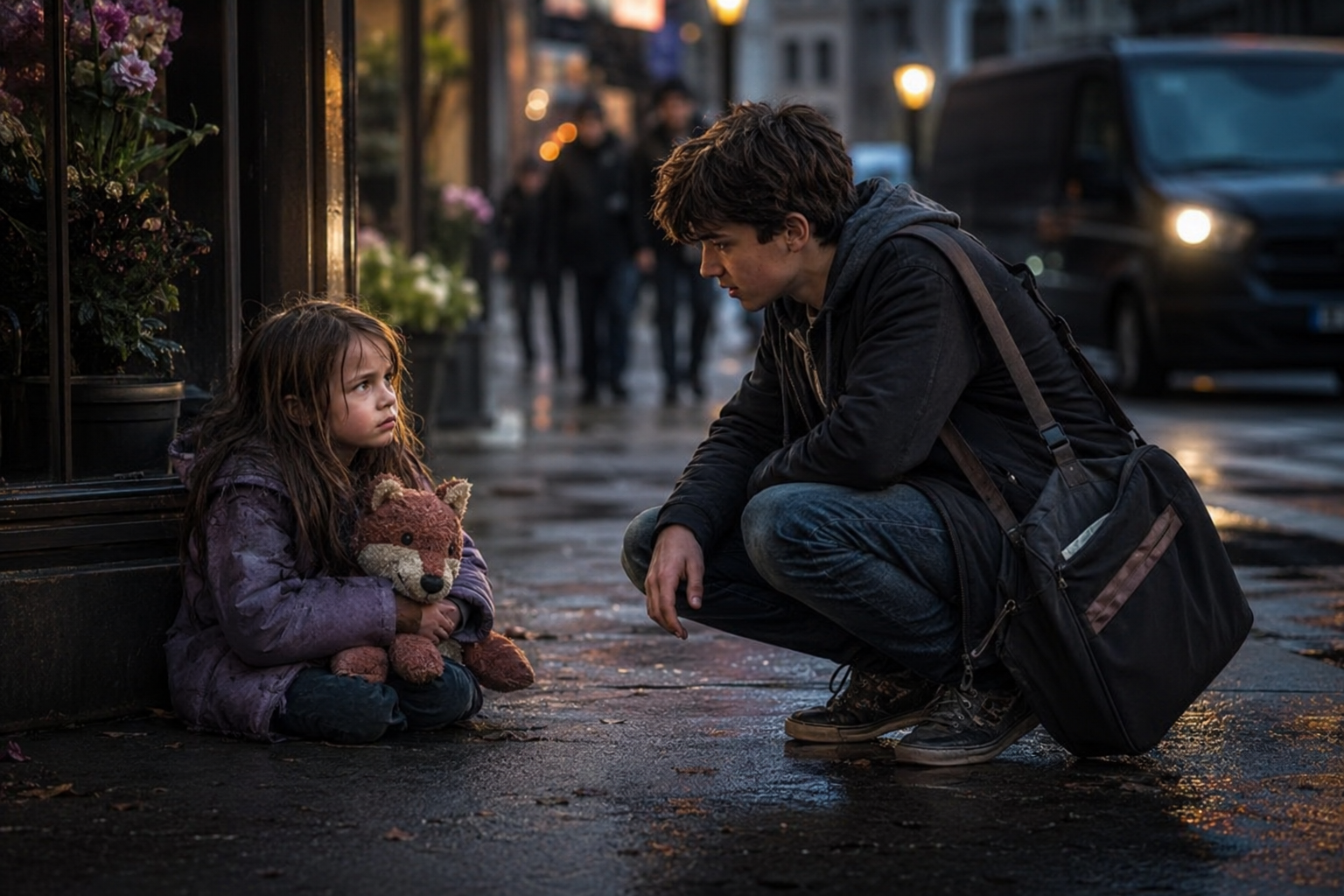
She looked no older than six.
Her faded lavender coat was much too thin for the cold autumn wind. One of her socks had slipped beneath her ankle, and the toe of her left shoe was torn open. Her brown hair hung across her face in uneven strands, as though someone had tried to brush it with trembling fingers and given up.
She held a stuffed fox against her chest.
The toy had once been orange, but dust and rain had turned its fur gray around the paws. One of its button eyes was missing.
The girl had been there for hours.
Some pedestrians noticed her and slowed down.
A woman carrying shopping bags glanced over her shoulder before continuing toward a taxi.
A businessman frowned at the child, checked his watch, and walked faster.
Two university students whispered that someone had probably called the police already.
No one had.
The girl never cried out.
She did not ask for food.
She did not approach anyone.
She simply watched the street with wide, frightened eyes and held the stuffed fox so tightly that her knuckles turned white.
Fourteen-year-old Noah Carter might have passed her too.
He was tired, cold, and already late getting home.
Every afternoon after school, Noah delivered newspapers across the eastern neighborhoods of Westbridge. The money was not much, but it helped his grandmother pay for groceries and heating. Since his parents had died in a highway accident when he was eight, Evelyn Carter had been the only family he had.
She never complained about money.
That was precisely why Noah worried about it.
He had finished his route and was cycling toward home when he noticed the child near the flower shop.
At first, she was only another figure in the corner of his vision.
He rode past her.
Twenty feet later, he slowed.
Something about the way she sat bothered him.
She was not looking around like a lost child hoping to recognize someone. She was watching the reflections in the shop windows, as though she was afraid to turn her head.
Noah stopped his bicycle.
Cars rushed past him.
He looked back.
The girl had lowered her face behind the stuffed fox.
For several seconds, Noah argued with himself.
An adult would help her.
A store owner would notice.
The police might already be coming.
But the street remained indifferent.
Noah turned his bicycle around.
As he approached, the girl pressed herself against the locked shop door.
“I’m not going to hurt you,” he said, remaining several steps away. “I just wanted to see whether you’re all right.”
She gave no response.
“My name is Noah.”
Her eyes briefly rose to meet his.
They were dark brown and rimmed with exhaustion.
Noah crouched near the curb without moving closer.
“Do you know where your family is?”
The girl’s gaze dropped immediately.
That reaction made him uneasy.
“You don’t have to tell me anything,” he continued. “But it’s getting cold. Is there someone I can call?”
Her lips moved.
No sound came out.
Noah waited.
Finally, she whispered, “Sophie.”
“What?”
“My name is Sophie.”
He offered a cautious smile.
“Hello, Sophie.”
She did not smile back.
Up close, Noah noticed how pale she was. There was dirt on her cheek, and a faint purple mark circled one wrist. It was partially hidden beneath her sleeve, but not well enough.
His stomach tightened.
“Have you eaten today?”
Sophie shook her head.
Noah opened his delivery bag and found an unopened apple and a small packet of crackers his grandmother had packed that morning.
He placed them on the pavement between them and backed away.
“You can have those.”
Sophie stared at the food but did not reach for it.
“It’s safe,” Noah said. “My grandmother packed it.”
The mention of a grandmother seemed to calm her slightly. She picked up the crackers and tore the packet open with unsteady fingers.
While she ate, Noah examined the street.
A dark blue van stood across the road near an alley.
It was parked beneath a broken streetlamp. The windows were heavily tinted, and the front of the vehicle faced away from them.
There was nothing unusual about a parked van.
Still, Sophie had begun trembling.
Noah followed her gaze.
“Is that what you’re afraid of?”
She stopped chewing.
“Did someone in that van bring you here?”
Sophie pressed the stuffed fox over her mouth.
Then she whispered, “They told me not to speak.”
The traffic noise seemed to fade.
“Who told you?”
Her eyes moved toward the van.
Noah looked again.
The vehicle appeared empty, but he could not see through the windows. For the first time, he noticed that the van had no rear license plate.
A cold sensation moved through his chest.
“Are they waiting for you?”
“I ran when the door opened.”
“Where?”
“At the gas station.”
“How long ago?”
“I don’t know.”
Sophie suddenly reached for his sleeve.
“Please don’t let them find me.”
Noah was only fourteen.
He had no car, no phone with reliable service, and no idea who might be inside that van.
But he understood one thing.
Leaving Sophie on the pavement was not an option.
“My grandmother lives nearby,” he said. “She’ll know what to do.”
Sophie stared at him.
“Can you ride a bicycle?”
She gave a small nod.
Noah secured his newspaper bag to the handlebars and helped her sit on the metal rack above the back wheel.
“Hold on to my jacket.”
As he began pedaling, he heard an engine start behind them.
He did not turn around.
He took the first side street, crossed a narrow pedestrian bridge, and cut through the parking lot behind an old church. Sophie’s arms tightened around his waist every time a vehicle approached.
Ten minutes later, Noah reached a modest white house at the edge of the neighborhood.
He left the bicycle beside the porch and hurried Sophie inside.
Evelyn Carter was standing in the kitchen, stirring soup.
She turned when the door opened.
“Noah, you’re late. I was beginning to—”
Her words stopped when she saw Sophie.
The wooden spoon slipped from her hand and struck the counter.
“Who is this child?”
Noah explained everything as quickly as he could.
The flower shop.
The missing shoe.
The mark on Sophie’s wrist.
The van.
The warning not to speak.
Evelyn did not interrupt him.
Her expression grew more serious with every sentence.
She knelt several feet from Sophie.
“My name is Evelyn. You’re safe here. May I bring you something warm?”
Sophie nodded.
Evelyn wrapped her in a thick knitted blanket and placed a bowl of soup on the table. Then she went into the hallway and called the police.
Noah watched through the curtains.
The dark blue van did not appear on their street.
That should have reassured him.
It did not.
Sophie managed only a few spoonfuls of soup before her eyes began closing. Evelyn prepared the couch and placed a pillow beneath her head.
Within minutes, the child was asleep.
Even then, she refused to release the stuffed fox.
Evelyn carefully pulled the blanket over her.
Something crackled inside the toy.
Noah heard it too.
A corner of glossy paper protruded from a torn seam near the fox’s missing eye.
“Is that a photograph?” he asked.
Evelyn hesitated.
“We shouldn’t search her belongings.”
“What if it tells us who she is?”
After a moment, Evelyn gently removed the folded photograph without disturbing the sleeping child.
She opened it on the coffee table.
The image showed Sophie standing between a man and a woman in an enormous garden. Behind them rose a stone mansion with white pillars, tall windows, and a circular fountain.
The man wore a tailored navy suit.
The woman rested one hand on Sophie’s shoulder.
Noah recognized them almost immediately.
He had seen their faces on television screens in shop windows throughout the week.
“That’s Grant Holloway,” he whispered.
Grant Holloway was the founder of Holloway Technologies, a global communications company worth billions. His charitable foundation had funded hospitals, schools, and disaster-relief programs across the country.
The woman beside him was his wife, Caroline.
And their daughter, six-year-old Sophia Holloway, had disappeared from the family estate four nights earlier.
Her photograph was everywhere.
News stations had broadcast it every hour.
Police had searched forests, rivers, highways, and abandoned buildings. Thousands of volunteers had joined the effort. A reward had been announced for any information leading to her safe return.
The entire country was searching for the child sleeping on Evelyn Carter’s couch.
Yet for most of that afternoon, hundreds of people had simply walked past her.
Evelyn covered her mouth.
“This cannot be possible.”
Noah turned the photograph over.
There was a message on the back, written in crooked blue letters.
The handwriting looked like it belonged to a young child.
Noah read the sentence twice.
Then he felt his skin grow cold.
Do not believe Uncle Victor.
Victor Holloway was Grant’s younger brother.
He was also the man appearing beside the police chief during every press conference.
He had cried in front of the cameras.
He had spoken about family loyalty.
He had personally organized the largest volunteer search in the state.
And a terrified little girl had hidden a warning about him inside her toy.
Before Noah could say anything, headlights swept across the living-room wall.
A vehicle stopped outside.
Evelyn moved toward the window.
Noah held his breath.
Blue lights flashed across the curtains.
The police had arrived.
But the photograph in Noah’s hand suggested that finding Sophie was only the beginning.
Part Two: The Man Leading the Search
Detective Lena Brooks arrived with two uniformed officers and a child-protection specialist.
She was calm, observant, and careful not to overwhelm Sophie when the girl awakened. Instead of questioning her immediately, Lena sat on the opposite side of the room and spoke softly about ordinary things.
She asked Sophie whether she liked the soup.
She asked the stuffed fox’s name.
“Rusty,” Sophie whispered.
Only when Sophie appeared comfortable did Lena mention the night she disappeared.
“What is the last thing you remember at home?”
Sophie twisted Rusty’s remaining button eye.
“I was sleeping.”
“Did someone wake you?”
She nodded.
“Who?”
“I didn’t see his face.”
“That’s all right. What happened next?”
“Someone carried me downstairs. I pretended I was still asleep.”
“Did you hear anything?”
“A man talking.”
“Did you recognize his voice?”
Sophie looked toward Noah.
He gave her an encouraging nod.
She turned back to the detective.
“Uncle Victor.”
No one moved.
Lena’s expression remained controlled, but the officer beside her slowly lowered his notebook.
“What did your uncle say?”
“He said they had to move me before Daddy found the papers.”
“What papers?”
“I don’t know.”
Sophie remembered being placed inside a van. She remembered a room with no windows and a woman who brought her food without speaking. She remembered Victor visiting once and arguing with another man.
The following afternoon, while the van stopped at a gas station, one of its doors had been left unsecured.
Sophie waited until the adults moved away.
Then she slipped out and ran.
She hid behind a delivery truck, followed strangers through several streets, and eventually reached the closed flower shop.
She had been too frightened to approach anyone.
She believed Victor’s men were watching every person who looked at her.
Lena listened without interrupting.
When Sophie finished, the detective requested the photograph.
Noah handed it to her.
The warning on the back immediately changed the atmosphere in the room.
Within minutes, Lena contacted the state task force. Officers were instructed not to inform Victor Holloway that Sophie had been found. The child would first be taken to a protected medical facility, where her identity could be confirmed and her parents could meet her under police supervision.
As the officers prepared to leave, Sophie clung to Noah’s hand.
“Are you coming?”
“I can’t go with the police,” he explained. “But you’re safe now.”
“You’ll visit?”
“I promise.”
Only then did she release him.
By dawn, Grant and Caroline Holloway had been reunited with their daughter.
Grant collapsed to his knees the moment Sophie entered the secure hospital room. Caroline held the child against her chest and wept until she could barely breathe.
Across the country, morning broadcasts interrupted their regular programs.
Sophia Holloway had been found alive.
The location and the identity of the people who had rescued her were temporarily withheld while investigators examined the possibility of a family conspiracy.
Victor Holloway appeared before reporters an hour later.
He called his niece’s return a miracle.
He thanked the police.
He smiled for the cameras.
He did not know that detectives were already studying every movement he made.
That afternoon, Lena returned to Evelyn’s house.
“I need to collect the original photograph as evidence,” she told Noah.
He retrieved it from the envelope where his grandmother had placed it.
As Lena slid the photograph into a protective sleeve, a narrow strip of paper fell from between its folded edges.
Noah picked it up.
Tiny numbers covered both sides.
There were dates, abbreviated company names, transaction amounts, and several sequences resembling bank-account codes.
At the bottom, someone had written a single word:
Meridian.
Lena frowned.
“Did Sophie put this inside the toy?”
“We didn’t know it was there,” Evelyn said.
Noah studied one of the abbreviated names.
“HCT Services.”
Evelyn leaned closer.
“I’ve seen that name before.”
Years earlier, she had worked in the accounting department of a small company purchased by Holloway Technologies. HCT Services had supposedly provided consulting support during the acquisition.
Evelyn remembered something else.
No one at the company had ever met an HCT consultant.
The invoices had simply appeared, been approved by executives, and disappeared into storage.
Lena photographed the paper and contacted a financial-crimes investigator.
The results came faster than anyone expected.
HCT Services was a shell company.
So was Meridian Strategic Partners.
Over five years, dozens of similar companies had received enormous payments from Holloway Technologies for services that were never performed.
The money eventually moved into private accounts connected to Victor Holloway.
Investigators uncovered forged contracts, falsified signatures, and confidential plans to force Grant out of the corporation.
Victor had been quietly stealing from his brother while preparing to seize control of the company.
Sophie had discovered the scheme by accident.
Four days before her disappearance, she had been playing hide-and-seek during a family gathering at the estate. She slipped into Victor’s private study and crawled beneath his desk.
Before she could leave, Victor entered with his financial adviser.
Sophie heard them discussing missing funds, forged approvals, and documents hidden inside a black cabinet.
Then she heard Victor say that Grant could not be allowed to discover the truth before the upcoming board meeting.
Sophie did not understand most of their conversation.
But she understood that her uncle was lying to her father.
That evening, she told Victor she had heard him talking about Daddy’s company.
Victor panicked.
If Sophie repeated even one sentence to Grant, the entire scheme could collapse.
He arranged to have the child removed from the estate, planning to make the disappearance look like an outside kidnapping. While the country searched in the wrong places, Victor intended to complete the transfer of company assets and disappear abroad.
He never expected Sophie to escape.
He certainly never expected a fourteen-year-old paperboy to turn around.
Two days after Sophie was found, detectives searched Victor’s properties.
They recovered financial records, false passports, encrypted storage drives, and surveillance photographs of the Holloway estate.
The dark blue van was discovered inside a private garage.
Victor was taken into custody while leaving a charity event organized in Sophie’s name.
The same reporters who had once filmed him begging for her return now watched silently as investigators escorted him away.
Grant Holloway later admitted that his brother’s betrayal hurt almost as deeply as Sophie’s disappearance.
But Sophie was home.
That mattered more than the company, the stolen money, or the public scandal.
One week later, a black car arrived outside Evelyn Carter’s small house.
Noah stared through the window.
“I think someone made a mistake.”
Grant Holloway stepped out of the car.
Sophie followed him, holding Rusty by one paw.
She ran across the lawn before Grant could stop her.
Noah opened the door, and Sophie threw her arms around him.
“You promised you would visit.”
“I was planning to.”
“You took too long.”
It was the first time Noah heard her laugh.
Grant invited Noah and Evelyn to the Holloway estate that afternoon.
The mansion looked even larger than it had in the photograph. Its entrance hall had marble floors, curved staircases, and windows taller than Evelyn’s entire house.
Noah felt uncomfortable the moment he stepped inside.
Sophie noticed.
“Don’t worry,” she whispered. “I get lost here too.”
Grant led them into a quiet library.
For several seconds, the billionaire simply looked at Noah.
Noah had seen him deliver speeches to thousands of people without hesitation. Now Grant seemed unable to find the right words.
“Detective Brooks told me what happened,” he finally said. “You had already passed Sophie when you decided to go back.”
Noah nodded.
“Why?”
“She looked scared.”
“Hundreds of people saw her.”
“I know.”
“They continued walking.”
Noah glanced at Sophie.
“I almost did too.”
“But you didn’t.”
Grant opened a wooden box on the desk.
Inside was a formal certificate offering Noah complete educational support through the Holloway Foundation. It included private-school tuition, university expenses, housing, books, and any professional training he chose to pursue.
Noah stared at it.
“I can’t accept this.”
“Why not?”
“I didn’t help Sophie because I wanted a reward.”
“That is exactly why I want you to have it.”
Evelyn’s eyes filled with tears.
Grant closed the box and placed it in Noah’s hands.
“You saw my daughter when the rest of the city had decided she was someone else’s responsibility. Money cannot repay that. Nothing can. But perhaps it can give you the opportunities your courage deserves.”
Noah looked toward his grandmother.
She nodded through her tears.
Sophie climbed onto the chair beside him.
“When I grow up, I’m going to help people too.”
“You already helped,” Noah said. “You kept the photograph.”
“I was scared.”
“Being brave doesn’t mean you aren’t scared.”
Grant looked at the boy with quiet admiration.
“What does it mean?”
Noah thought about the crowded pavement, the indifferent faces, and the moment he had nearly continued riding home.
“It means you turn back anyway.”
Months later, Noah returned to the same street.
The flower shop had reopened. Fresh roses and white lilies filled its windows. People still hurried past one another, staring at phones and watches.
The city had not changed.
But Noah had.
He understood now that terrible things often survived not because no one could see them, but because everyone assumed someone else would stop.
Sometimes the difference between tragedy and rescue was not wealth, strength, or authority.
Sometimes it was a single person willing to turn around.
On that cold afternoon, Noah Carter had been that person.
Because he stopped, a frightened child found safety.
Because Sophie trusted him, a carefully hidden conspiracy collapsed.
And because one ordinary boy refused to look away, an entire family was given the chance to begin again.

