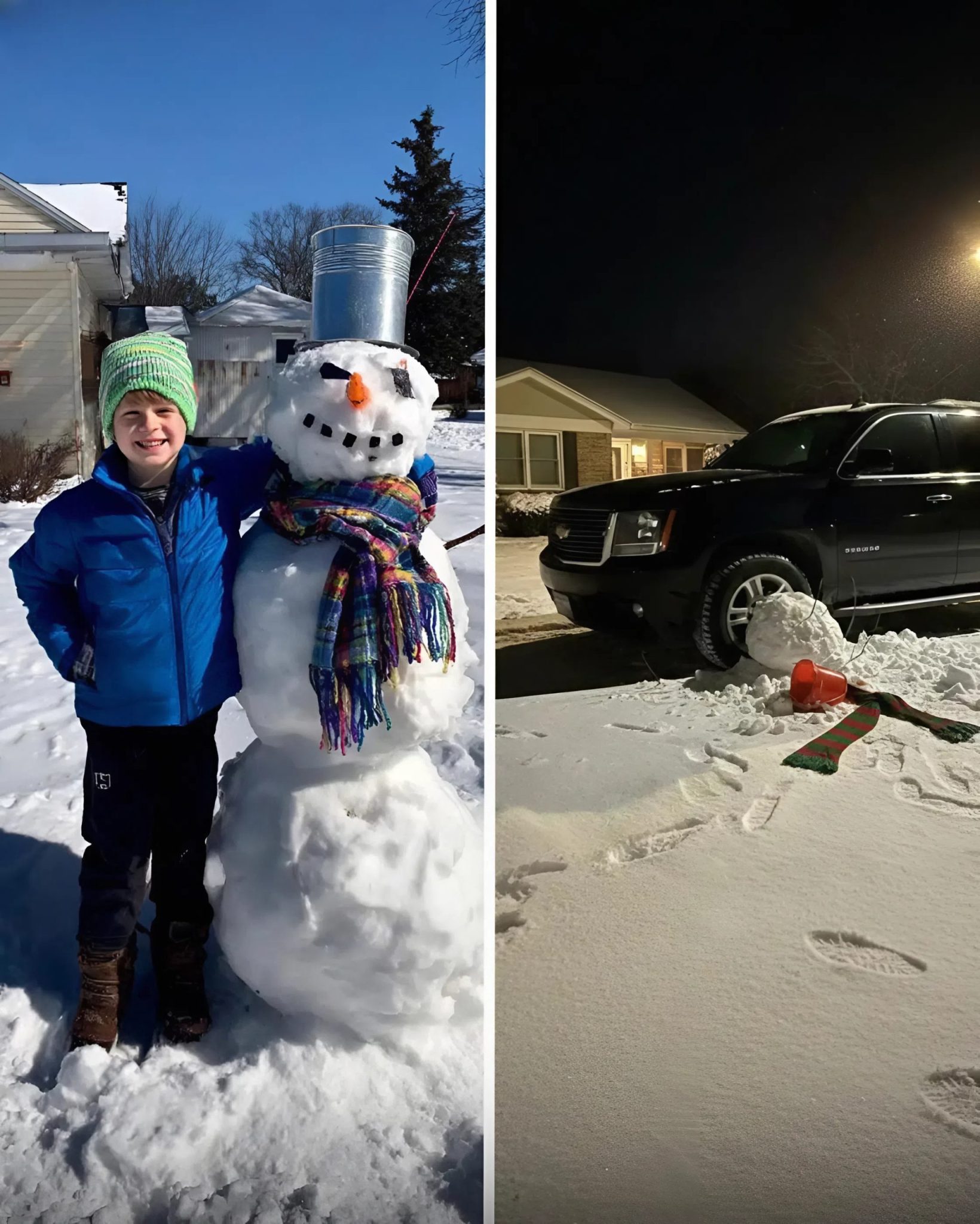
In a quiet suburban neighbourhood, eight-year-old Nick turned his front lawn into a fantastic gallery of snowmen, giving each one a name and treating them like colleagues. However, this winter kingdom was repeatedly destroyed by his neighbour, Mr Streeter, a man with a perpetually grim expression on his face, who had a habit of driving across the corner of Nick’s lawn to save a few seconds on his journey. Despite repeated polite requests from Nick’s mother to respect other people’s property and the boy’s hard work, Streeter dismissively claimed that ‘kids will be kids,’ deliberately crushing the frozen creations under his tyres.
The mental strain on Nick was obvious – he went through phases of crying and gritting his teeth, until he finally decided that if words didn’t help, he would have to mark his boundaries ‘physically’. When his mother asked about his mysterious new ‘plan,’ the boy simply assured her that he would not hurt anyone; he just wanted the destruction to stop. Statistics show that boundary disputes between neighbours account for nearly 25% of civil complaints in suburban neighbourhoods and often escalate when one party feels that their ‘territory’ or emotional effort is being systematically ignored.

The climax came on a dark winter evening when a sharp, metallic crack echoed through the neighbourhood, followed by the screech of a car hitting a stationary object. Nick had not placed his latest masterpiece, ‘Winston’, on the grass, but directly above a bright red fire hydrant standing on the border of their property. Disguising the heavy cast-iron fixture as a lumpy snowman, Nick set the ‘trap,’ relying entirely on Mr. Streeter’s bad habit. When Streeter attempted his usual shortcut, he encountered not soft snow, but a solid metal barricade that shot a fountain into the icy air.
The next few moments were a scene of icy chaos: soaked and furious, Mr Streeter banged on the family’s door, accusing the eight-year-old of being a ‘psycho’. The legal reality, however, was swift and clear: the damage was caused solely because Streeter veered off the road and onto private property. When the police and water authorities arrived to assess the damaged hydrant and flooded street, the neighbour was faced with municipal fines and a bruised ego. Nick’s mother said the hydrant was a ‘heavy metal boundary,’ but it served as a definitive lesson on the consequences of trespassing.

By the end of winter, the neighbourhood had settled into a cool but respectful calm. Mr Streeter now drives onto his property with excessive caution, making sure his tyres do not even touch a blade of the family’s grass. Nick continued to build his ‘army’ of snowmen for the rest of the season, and for the first time, they were able to melt naturally in the sun instead of being run over by a car. The ‘special snowman’ taught everyone a loud lesson: some boundaries are emotional, but those made of iron and ice are harder to ignore.