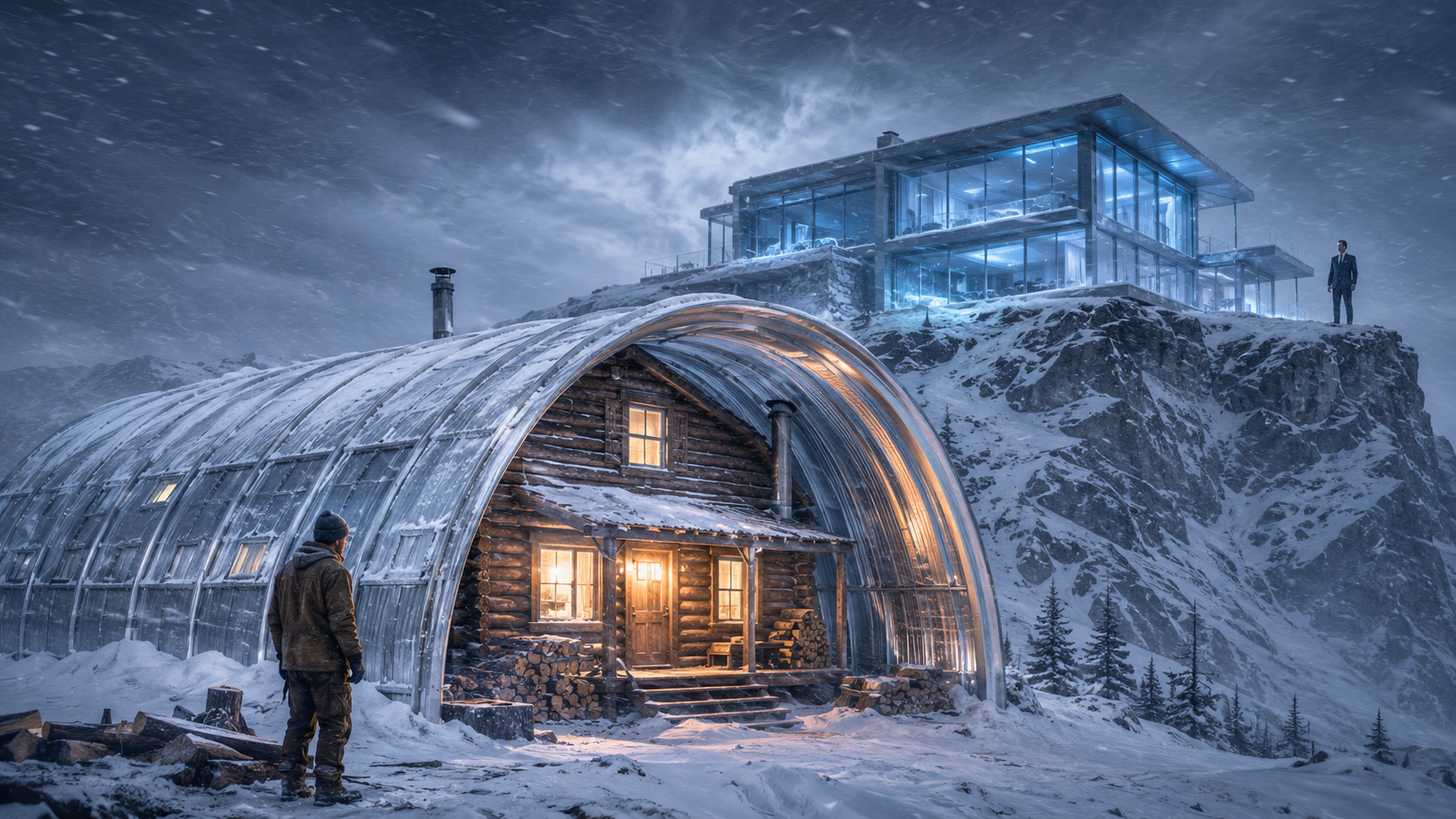
“Enjoy Your Silver Coffin,” the Billionaire Laughed — Until His Glass Mountain Mansion Froze Before Sunrise, While the Strange Metal-Wrapped Cabin Stayed 55 Degrees Warmer

The idea came back to Caleb Rowan on a night so cold the nails in the walls seemed to ache.

It did not return as inspiration. It returned as accusation.

He sat at the scarred kitchen table with a mug of black coffee cooling between his hands, listening to the wind scrape its claws across the cedar logs of the cabin. Every gust found a seam. Every seam whispered. Somewhere behind the stove, a thin ribbon of air slipped through the chinking and slid across the floor like an invisible snake.

His wife, Mara, had stuffed towels beneath the doors. Their son, Jasper, slept in a wool cap. Their little girl, Nell, was curled beneath three quilts, her small nose pink from the cold that kept finding its way inside.

The stove was full. The chimney was drawing. Caleb had stacked good birch and split pine all autumn. He had sealed the windows twice. He had patched the roof, hung blankets over the north wall, and banked the fire so carefully that he sometimes woke in the night not from cold, but from the fear of having slept too long.

Still, the cabin bled warmth.

Not because it was weak.

Because it was exposed.

That was the thought that would not leave him alone.

The wind did not merely pass over the Rowan place. It attacked it. Their cabin sat on open land below Blackpine Ridge, where the valley narrowed and the winter wind came screaming down like something poured from the mouth of the sky. Other houses had trees, barns, stone walls, neighboring roofs. Caleb had a cabin standing alone in a white field, taking every blow directly.

At dawn, he pulled a pencil from the junk drawer and began drawing.

Mara came in with her shawl pulled tight around her shoulders and stopped behind him.

“What are you doing?” she asked softly.

Caleb did not answer at first. He made another line, then another. Curved ribs. Steel panels. A second roof over the first. A space between the old cabin and the new shell.

Mara leaned closer.

“You’re drawing another building.”

“Yes.”

She frowned. “Around our building?”

He nodded.

“Caleb.”

“I know.”

“No, I don’t think you do. That looks like a barn swallowing a house.”

He almost smiled. “That is not the worst description.”

“It may be the kindest one.”

Outside, the wind struck the north wall so hard that a spoon trembled in a cup beside the sink.

Caleb looked toward the children’s room.

“I’m not trying to make it handsome,” he said.

“I know that.”

“I’m trying to make the wind hit something that isn’t where our children sleep.”

Mara’s expression changed. The doubt did not disappear, but it softened. She knew that tone in him. It was the voice he used when a problem had moved past inconvenience and become a vow.

Caleb Rowan had once been an Army field engineer. He had built bridges from broken parts, repaired water systems in places where the maps were wrong, and learned that survival rarely looked elegant. Survival looked strange. Survival looked improvised. Survival looked like whatever worked.

By spring, he had a plan.

By summer, he found the bones of it.

A decommissioned road-maintenance depot outside Helena auctioned old Quonset hut sections: curved steel ribs, corrugated panels, crates of bolts, warped doors, heavy brackets with government numbers still stenciled on them. Caleb borrowed a flatbed, drove six hours, and came home with a load of silver metal that flashed in the sun like fish scales.

Before he even finished unloading, the first truck slowed on the road.

By evening, half the valley had heard.

By morning, the story had grown teeth.

Caleb Rowan, people said, had finally cracked after last winter. Caleb Rowan was putting a shed over his cabin. Caleb Rowan was wrapping his home in scrap metal because he was afraid of snow. Caleb Rowan was building his family a silver coffin with a stove pipe.

Earl Madsen, who owned the lumberyard and considered innovation an insult to lumber, was the first man brave enough to say it to Caleb’s face.

He stood in the yard with his thumbs hooked under his suspenders, looking from the log cabin to the arching steel ribs laid out in the grass.

“You putting that over the house?”

“That’s the plan,” Caleb said.

Earl snorted. “Lord help us. I thought soldiers came home practical.”

“Some did.”

“And what do you call this?”

“A wind shield with a thermal buffer.”

Earl laughed until he coughed.

“That what we’re calling junk now?”

Caleb did not answer. He kept sorting bolts.

The laughter might have remained a local thing if Sterling Vale had not heard about it.

Sterling Vale owned half the ridge and almost everything people in the valley resented about the other half. He had made his money in luxury resorts, mineral leases, private equity, and whatever else wealthy men described vaguely when they preferred not to explain how profit had been extracted. His winter residence sat high above the valley: a glass-and-stone mansion with heated floors, imported slate, automatic climate systems, a generator house, a geothermal array, and a north-facing wall of windows so large it made the mountain appear to be part of the living room.

He called it The Aerie.

Everyone else called it Vale’s glass palace.

Sterling heard about Caleb’s project at Granger’s Supply, while buying kerosene heaters for the workers’ quarters near his lodge. He did not call them workers’ quarters. He called them auxiliary accommodations. A man with a cashmere scarf and polished boots could rename almost anything if people wanted his money badly enough.

Earl told the story with pleasure.

“Rowan’s putting a tin shell over his cabin,” he said. “Says it’ll keep him warm.”

Sterling turned, amused.

“A tin shell?”

“Like one of those half-round army huts.”

Sterling laughed with the polished cruelty of a man who had learned to make ridicule sound like conversation.

“That is not construction,” he said. “That is surrender.”

The men in the store laughed because Sterling Vale expected laughter and most people found it cheaper to give him what he expected.

Caleb was standing near the stove pipe section, holding a can of sealant.

Sterling noticed him.

“You’re Rowan, aren’t you?”

Caleb looked at him. “I am.”

“The man building the silver coffin.”

The store quieted. Not out of respect. Out of appetite.

There is a special hunger in small places when a rich man humiliates a poor man publicly. Even people who dislike the rich man lean closer to hear how far he will go.

Caleb set the sealant on the counter.

“I’m building an exterior windbreak around a dead-air space.”

Sterling smiled. “Of course you are.”

“It reduces convective heat loss.”

“Convective.” Sterling repeated the word as if tasting something cheap. “That sounds very technical for something my grandfather solved with thicker walls.”

“Your grandfather probably didn’t build a house with forty feet of glass facing the winter wind.”

The room sharpened.

Sterling’s smile did not vanish, but something colder stepped behind it.

“My home was designed by one of the best firms in the country.”

“I’m sure it was.”

“You have an opinion on it?”

Caleb should have said no.

Mara would later tell him that a man could keep his dignity without kicking a wolf just because the wolf wore Italian leather. But Caleb had spent too many nights watching frost form on the inside of his children’s window while men in town acted as if cold were a moral test and not a physical problem.

So he said, “It faces the wind wrong.”

Someone inhaled sharply.

Sterling stepped closer.

“Say that again.”

“Your mansion faces the wind wrong,” Caleb said. “That north wall is beautiful, but it’s a sail. It will be comfortable as long as every system works perfectly. If the power fails, or the intakes ice, or your dampers freeze, that glass will drain heat faster than you can replace it.”

Sterling’s voice dropped.

“My house has geothermal heat, propane backup, triple-pane structural glass, computer-managed climate zones, and generators that could run half this county.”

“Then I hope all of it works.”

For a moment, no one moved.

Then Sterling turned toward the men by the counter and raised his voice.

“Gentlemen, if Mr. Rowan’s junkyard tunnel keeps him warmer than my lodge keeps me, I will eat my own boots.”

Laughter burst through the store.

Caleb paid for the sealant and left.

That night, Mara found him outside under a work light, bolting the first steel rib into place. The curved arch rose above the cabin like the skeleton of some enormous sleeping animal.

“You heard what he said,” she guessed.

“Most of the county heard what he said.”

“Does it bother you?”

Caleb tightened a bolt until the wrench groaned.

“Yes.”

She waited.

He looked down at his hands.

“Not because he laughed. Because if I’m wrong, the children stay cold and everyone gets to say they knew better.”

Mara stepped closer, took the wrench from him, and put her hand over his.

“Caleb Rowan, listen to me. We were already freezing doing what everyone else does. If your strange idea fails, we are no worse than before. If it works, our children sleep warm. That is worth looking foolish for.”

He looked at her in the glow of the work lamp, and the loneliness of the idea loosened.

Together, they built the shield.

For four weeks, Caleb worked from first light until the stars came out. He set posts exactly two feet from the cabin walls. He anchored the steel ribs to a timber frame bolted into the extended foundation. He overlapped corrugated panels and sealed every seam against driven snow. He cut low vents near the foundation and high vents near the ridge, then baffled them so air could move slowly without becoming a draft.

He built a narrow service corridor between the original log walls and the new steel shell. He made a small airlock entry with two doors, because every winter door was a wound. He ran the chimney through both roofs with careful clearance and mineral wool protection, because heat meant nothing if fire took the house.

When it was finished, there was no denying it looked strange.

From the road, the Rowan cabin appeared to have been swallowed by a silver tunnel. The curved metal roof arched over the old log structure. The original cabin still stood inside, but its roofline was hidden, its walls protected, its windows looking out through covered gaps and framed openings. In certain light, the whole place looked less like a house than a stubborn machine built by someone who had run out of patience with weather.

Jasper loved it at once.

“We live in a fortress,” he announced.

Nell disagreed.

“We live inside a turtle.”

Mara walked the air gap slowly, one hand on the original log wall, the other near the steel shell.

“It still looks ridiculous,” she said.

Caleb nodded. “Feel the wall.”

She stopped.

Outside, the wind tore across the field, flattening dead grass and rattling the pines. Inside the corridor, the air was cold but still. Not warm, exactly. But calm. The steel took the violence. The log wall behind it was no longer under attack.

Mara placed her palm against the cabin wall and understood.

“It’s not being stripped,” she said.

“No,” Caleb replied. “It finally gets to hold what the stove gives it.”

The first snow came a week later.

By early December, the valley had divided into three camps: those who mocked Caleb openly, those who worried privately, and those who were waiting to see whether the absurd thing might work before choosing a side. Earl called it Rowan’s Folly. The waitress at Bell’s Diner said she hoped it worked because Mara was too good a woman to spend another winter stuffing rags under doors. Sterling Vale ignored it publicly, which meant his staff joked about it privately.

The only person at The Aerie who did not laugh was Sterling’s daughter, Lenora.

Lenora Vale had returned to Montana that autumn with her five-year-old son, Milo, after a divorce that the newspapers called graceful because wealthy people had paid lawyers to make pain look tidy. She had grown up around money the way fish grow up around water. She knew its comforts. She knew its poison. She loved her father, but she also knew he confused being obeyed with being correct.

The first time Milo saw the Rowan place from the back seat of the car, he pressed his mittened hands to the window.

“Mom,” he said, “that house has armor.”

Lenora slowed.

Caleb stood on a ladder adjusting a vent cap. Mara passed screws up to him from her coat pocket. Jasper and Nell dragged a sled through the snow near the woodpile. It should have looked foolish.

Instead, Lenora felt a small ache in her chest.

The place looked protected.

Not grand. Not expensive. Not impressive.

Protected.

That evening at dinner, Sterling mentioned Caleb’s cabin while slicing elk beneath a chandelier made from antlers no Vale had ever hunted.

“The man will rot his own house from the outside in,” Sterling said. “Condensation alone will ruin him.”

Lenora took a sip of wine.

“Maybe he knows something.”

Sterling stared at her as if she had complimented a raccoon on its architectural insight.

“He knows how to bolt scrap together.”

“He was an engineer.”

“A field engineer.”

“Sometimes the field is where people learn what survives.”

The table went quiet.

Sterling set his knife down.

“That sort of thinking is why people accept poor solutions.”

“No,” Lenora said carefully. “Sometimes it is why people survive when perfect solutions fail.”

Sterling’s jaw tightened.

His wife had died nine years earlier in a storm outside Aspen, when a helicopter pilot tried to beat weather that should have been respected. Sterling had bought safer aircraft afterward, better radar, better pilots, better everything except the humility to admit that sometimes the wisest system was refusal.

“Systems fail,” Lenora said softly.

“Systems fail when people neglect them,” Sterling replied.

“And people fail too.”

No one spoke after that.

Then winter came down hard.

The cold front arrived like punishment. The temperature fell below zero and stayed there. Nights sank to minus twenty, then minus thirty. Wind poured over Blackpine Ridge at sixty miles an hour, turning loose snow into a white smoke that found every crack, every hinge, every vent, every weakness.

In the valley, trucks refused to start. Water lines froze. Bell’s Diner closed after the kitchen drain iced solid. The school canceled classes when frost formed on the inside of the windows and one child’s wet scarf froze stiff on a metal coat hook.

At the Rowan cabin, the stove burned steadily.

For the first time since they had moved there, Mara woke before dawn and did not see her breath. Jasper kicked his blankets off in his sleep. Nell complained the cabin was too warm. Caleb checked the thermometer on the interior wall, then the one in the air gap, then the one outside.

Outside: minus twenty-six.

Air gap: eleven degrees above zero.

Inside: sixty-eight.

Mara stared at the numbers.

Caleb said nothing.

She took his hand.

At The Aerie, everything worked beautifully for four days.

The heated floors glowed beneath Italian stone. Sensors adjusted. Pumps circulated. Automated dampers whispered open and shut. The glass walls presented the storm like theater. Guests wore cashmere and drank brandy while the mountain vanished behind white fury.

Sterling made a point of mentioning this during a small holiday gathering he refused to cancel.

“My friends,” he said, lifting a glass before the enormous north windows, “this is the difference between enduring nature and mastering it. Weather is not romance. Weather is a problem to be engineered.”

His guests laughed because Sterling’s guests usually laughed on schedule.

Lenora stood near the fireplace with Milo leaning against her leg. She looked past the glass into the violent dark and thought of Caleb Rowan’s armored cabin below, low to the ground, curved back turned toward the wind.

Then the lights flickered.

Only once.

Sterling noticed.

So did Lenora.

So did the house manager, a pale man named Graham, who touched his earpiece at once.

The lights steadied.

Sterling smiled.

“Even civilization coughs,” he said.

More laughter.

Two hours later, the first alarm sounded in the service wing.

Powder snow, driven fine as flour by the wind, had packed into exterior intake vents and frozen there. The geothermal system began cycling irregularly. Backup propane heat engaged, but dampers in the upper climate system stuck half-open when moisture froze along actuator housings. The generator strained against ice-clogged airflow. The mansion was too intelligent in too many places, and each intelligent part assumed another intelligent part would compensate.

No single failure doomed the house.

Together, they began stealing warmth.

At 2:17 in the morning, Graham woke Sterling.

“Sir, we have a temperature drop in the north hall.”

Sterling sat up, annoyed before he was afraid.

“How much?”

“Nine degrees in under an hour.”

“Switch zones.”

“We tried.”

“Then override the dampers manually.”

“Some are frozen, sir.”

Sterling stared.

The phrase seemed indecent. Frozen dampers belonged in roadside motels and abandoned cabins, not inside a residence whose mechanical room had cost more than most houses in the county.

“Call the contractor.”

“Lines are down. Satellite is unstable.”

“Wake maintenance.”

“They’re already below, sir.”

For the next three hours, The Aerie fought the storm and lost by increments.

The great north wall of glass turned into a black mirror radiating cold. Warm air rose into vaulted spaces and vanished. Fireplaces designed for beauty could not heat rooms built like cathedrals. Guests gathered in coats around decorative flames. Staff taped towels over door seams. The generator coughed, restarted, strained, and coughed again.

By dawn, breath fogged in the main hall.

Sterling refused to leave.

The road was impassable, he said. The lodge had supplies. The systems would stabilize. The cold front would break. Panic helped no one.

People wanted to believe him because fear makes confidence look like competence.

At noon, Milo began coughing.

By late afternoon, his fever rose.

Lenora wanted to get him out, but Sterling insisted The Aerie remained safer than any attempt to travel. The road to town had vanished under drifts. Trees had fallen. Visibility was almost nothing. He spoke with the authority of a man accustomed to deciding reality for other people.

So Lenora stayed.

She wrapped Milo in blankets near the largest fireplace and watched the flames lick stone that had been chosen for appearance, not survival.

At sunset, the storm worsened.

A gust shattered an exterior glass panel in the west gallery. It was not the main wall, not a collapse, not the catastrophe architects feared. But it was enough. Needle-cold air screamed through the wing until staff sealed the opening with plywood, plastic, and shaking hands.

Then the generator stopped for eleven minutes.

For eleven minutes, The Aerie went dark.

Milo stopped answering his mother.

Lenora did not scream. She became very calm.

She lifted her son. His body felt too light, too slack, too far away. She carried him through the candlelit hall to where Sterling stood with Graham over a mechanical diagram.

“We’re leaving,” she said.

Sterling turned. “Lenora—”

“Now.”

“The road is impossible.”

“Not to town.”

He stared at her.

She said, “To the Rowan cabin.”

His face changed as if she had struck him.

“No.”

“My son is freezing inside your masterpiece.”

“There are guest rooms with fireplaces.”

“He needs warmth that stays. He needs people who are not pretending.”

Graham looked at the floor.

Sterling’s pride fought hard. Pride had built companies, crushed rivals, bought silence, rewritten headlines, and renamed failures as strategy. But fear had his grandson’s blue lips in its arms.

Ten minutes later, Sterling Vale stepped into the worst storm of his life beside his daughter and her child, walking downhill toward the house he had called a coffin.

The walk should have taken twenty minutes.

It took nearly an hour.

Snow erased the path. Twice Sterling fell. Once Lenora slipped, and Sterling caught both her and Milo with a sound that was half grunt, half sob. The wind made speech useless. Their flashlight beams became short white tunnels full of flying ice.

When the curved silver shape finally appeared through the storm, Sterling stopped.

For one irrational moment, it did not look like a coffin.

It looked like a ship.

Not built to impress the sea.

Built to survive it.

Then he was pounding on Caleb Rowan’s door.

Mara opened it.

For a heartbeat, she looked at Sterling Vale standing there covered in ice, Lenora behind him with Milo limp in her arms.

Then she stepped aside.

“Bring him in.”

No one asked why they had come. No one mentioned the store. No one repeated the joke.

Inside the cabin, the air felt impossible.

Warmth did not blast from vents. It did not perform. It simply stayed. It rested in the logs, in the floorboards, in the quilts, in the iron stove, in the still air of a room that had stopped fighting the wind.

Mara worked over Milo with the calm tenderness of a mother who had seen cold hurt children before. She stripped off his wet outer layers, wrapped him in warmed blankets, and held sweet tea to his lips when he stirred. Caleb fed two pieces of birch into the stove, not because the room needed them, but because fear needed something to do with his hands.

Jasper and Nell watched from the table, wide-eyed and silent.

Sterling stood near the door, melting snow dripping from his coat onto the floor. Without an audience, he looked smaller.

Lenora sat beside Milo, holding his hand.

After several minutes, the boy coughed, whimpered, and opened his eyes.

“Mom?”

Lenora broke.

She bent over him and cried with her whole body. Mara put a hand on her shoulder.

“You’re safe,” Mara said. “Both of you.”

Sterling turned toward the wall, but not quickly enough to hide the tears in his eyes.

Caleb saw them and looked away.

There are moments when being right arrives dressed like shame. Caleb had imagined, more than once, what it would feel like for Sterling Vale to stand inside the warm cabin. He had imagined satisfaction. Perhaps even the perfect sentence delivered at the perfect time.

But standing there while a child thawed under his daughter’s quilt, Caleb felt no triumph.

Being right did not feel good when the proof had nearly died.

Later, when Milo slept and the storm hammered harmlessly against the steel shell outside, Sterling approached Caleb.

“I want to understand it,” he said.

His voice was rough.

Caleb almost refused. He was tired. The man had mocked him, dismissed him, and nearly let pride freeze his own family. But then Caleb looked at Milo sleeping beneath Nell’s patchwork quilt and understood that knowledge withheld out of bitterness could become its own kind of cruelty.

So he took a lantern and led Sterling into the air gap.

The corridor between the cabin and the outer shell was narrow, dim, and strange. On one side stood the original log wall, warm enough to smell faintly of cedar. On the other side curved the corrugated steel shell, cold but dry. The storm struck the metal above them with a thousand tiny fists, yet inside the gap the air barely moved.

Sterling touched the log wall.

“It should be colder,” he said.

“Yes.”

“Why isn’t it?”

“Because the wind can’t touch it.”

Caleb lifted the lantern.

“Most people think walls lose heat only because they aren’t thick enough. That matters. But out here, wind is the thief. Moving air strips heat from surfaces fast. Last winter, this wall took the full force of it. I could burn wood all night and still lose.”

Sterling listened.

“The metal isn’t the blanket,” Caleb continued. “That is what people misunderstood. Steel conducts heat. They saw metal and thought cold. I’m not using it as insulation. I’m using it as armor. The shell takes the wind. The air gap stays mostly still. Still air slows heat loss. The cabin finally gets a calm space around it.”

He pointed to the low vent.

“The vents keep moisture from building up. The baffles stop drafts. The gap breathes slowly, but the wind never gets a straight shot at the logs.”

Sterling ran his hand over the wall.

“And your temperature?”

“Tonight? Fifty-five degrees warmer than outside.”

Sterling closed his eyes.

For a long moment, only the storm spoke.

Then he said, “I called it a coffin.”

Caleb looked at him.

“Yes.”

Sterling swallowed.

“I was wrong.”

Caleb did not answer immediately.

An apology from a proud man can be a beginning or a performance. The difference is what he does after the room stops listening.

Finally Caleb said, “You were cold tonight. That teaches faster than arguing.”

Sterling opened his eyes.

“My house cost thirty million dollars.”

“I know.”

“And this works better.”

“In this storm, yes.”

Sterling almost laughed, but it broke apart before it became sound.

“I built something to prove I could defeat the mountain.”

Caleb looked at the steel shell, trembling faintly under the wind.

“I built something because I knew I couldn’t.”

By morning, the storm had not ended, but the valley had changed.

Word traveled the way it always did: through radio calls, snowmobile reports, a lineman’s wife, the diner owner’s cousin, and Graham, who told the truth to a mechanic and watched it outrun him.

Sterling Vale had walked to Rowan’s Folly in the night.

His grandson had been warmed there.

The silver coffin had stayed warm.

The glass palace had frozen.

By afternoon, three neighbors arrived at Caleb’s door asking to see the air gap. By evening, Earl Madsen stood in the yard with his cap in his hands, staring at the curved shell like it had personally insulted his entire philosophy of lumber.

Caleb opened the outer door.

Earl cleared his throat.

“Suppose a man wanted to build something similar for a workshop.”

Caleb raised an eyebrow.

“A workshop?”

“Or a cabin.”

“Your cabin?”

Earl looked toward the road.

“Maybe.”

Mara, standing behind Caleb, coughed into her hand to hide a smile.

The cold snap lasted six more days.

The Aerie’s systems were repaired, but Sterling did not return to speaking about mastery. Not right away. He sent supplies down to the Rowans without attaching a speech to them. Caleb sent most of them back and kept only the medical kit for the children. Sterling tried again, this time sending a handwritten note instead of a truckload of pride.

It said simply:

I would like to learn before I build again.

Caleb read it twice.

Mara watched him.

“Well?”

“He wants to learn.”

“And?”

Caleb folded the note.

“Then he can start by listening.”

Spring came late that year.

When the snow melted, the silver shell still stood. It had dents from wind-thrown branches and scratches from ice, but the cabin inside was dry. The logs looked better than they had in years. The children had stopped waking with cold hands. Mara had stopped sleeping with one ear tuned to the stove.

People still called the structure odd.

But no one called it foolish.

That summer, Caleb helped three families build wind shells around exposed homes and one around the school’s north wall. He refused payment beyond materials, meals, and help when it was the next person’s turn. Sterling funded a community workshop without putting his name on it, which was the first useful thing his pride had ever done quietly.

At the workshop, Caleb stood before ranchers, carpenters, mechanics, and skeptical men who had once laughed into their coffee.

He did not give them a grand speech.

He held up a piece of corrugated steel.

“This is not magic,” he said. “It is not expensive intelligence. It is a shield. The lesson is simple: before you make heat, stop letting the wind steal it.”

Sterling stood in the back, silent.

Lenora sat beside Mara with Milo and Nell sharing cookies between them.

Afterward, Sterling approached Caleb in the yard.

“I owe you more than an apology,” he said.

“Yes,” Caleb replied.

Sterling accepted that like a man learning the weight of words.

“What do I owe?”

Caleb looked across the valley. The school roof flashed in the sun. The mountains stood high and indifferent. The wind moved through the grass, softer now, but never gone.

“Build differently,” Caleb said. “And when someone with less money knows something you don’t, listen before the storm makes you.”

Sterling nodded.

Years later, people in the valley still told the story whenever winter began sharpening its teeth.

They told it at Bell’s Diner when the first snow hit the windows. They told it at the lumberyard, though Earl pretended not to enjoy it. They told it to newcomers who asked why so many homes around Blackpine Ridge had curved outer shells, wind porches, baffled vents, and strange quiet corridors around old walls.

Some versions made Sterling crueler than he had been.

Some made Caleb wiser than he felt.

Some exaggerated the cold, the walk, the frozen mansion, the boy’s blue lips, the number on the thermometer.

But the heart of the story stayed true.

A rich man built a palace to impress the mountain.

A poor engineer built a shield because he respected it.

When the storm came, the mountain did not care what anything cost.

It only tested what worked.

And the strange silver cabin, mocked by everyone, held its warmth through the night

“Enjoy Your Silver Coffin,” the Billionaire Laughed — Until His Glass Mountain Mansion Froze Before Sunrise, While the Strange Metal-Wrapped Cabin Stayed 55 Degrees Warmer
“Stay Quiet, Mrs. Quinn. You’ve Just Stepped Into a Game Men Die Over.” — The Billionaire Who Forgot a Widow Could Count