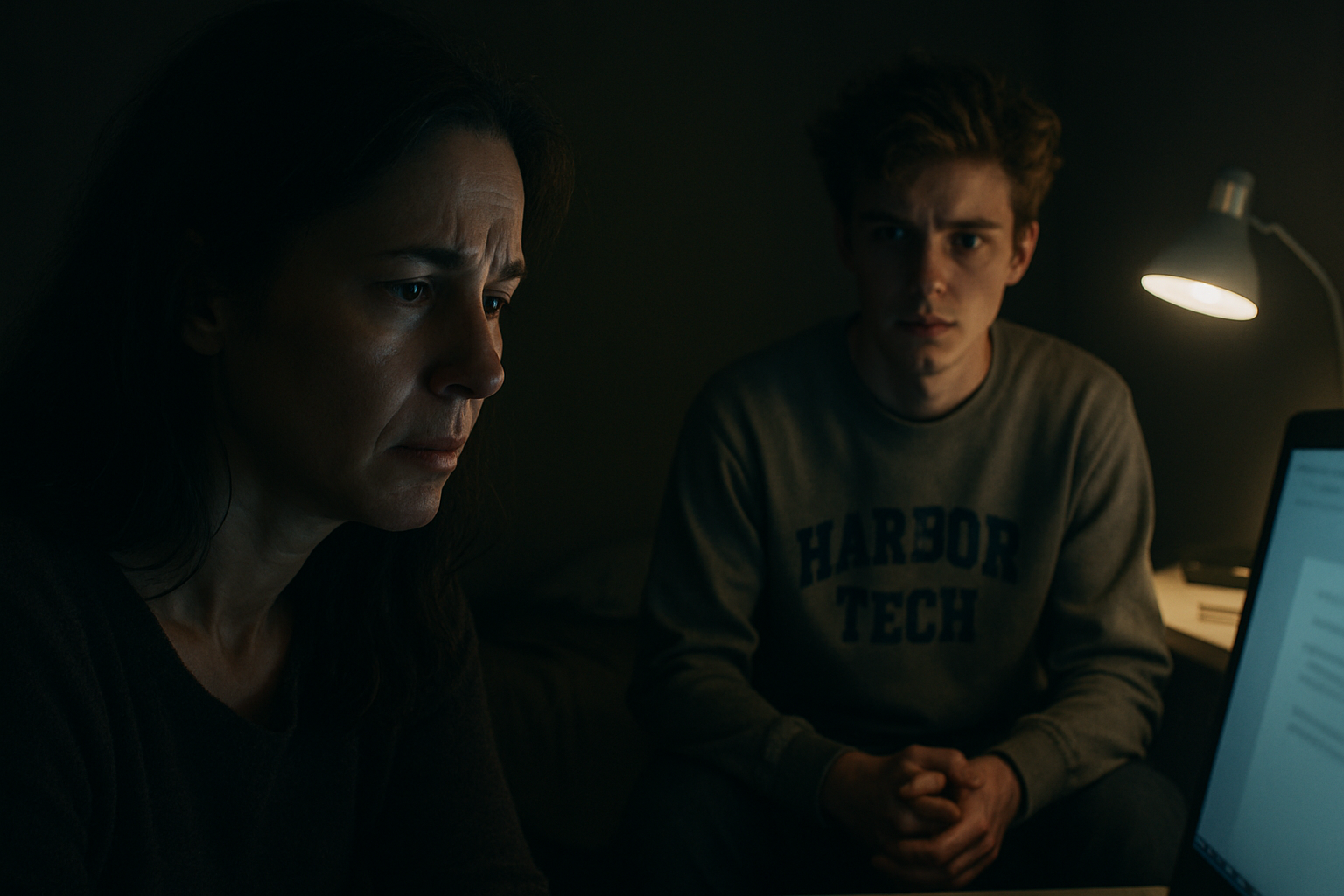
But endurance without truth becomes a room with no doors.
She had lived there too long.
That winter, at the first fundraiser for the Lenora Whitmore Caregiver Justice Foundation, Mara stood before a modest crowd in a hotel ballroom much smaller than the one where Grant had fallen.
She wore the silver branch brooch, restored now to its original purpose.
No camera.
No secret.
Noah sat in the front row beside Lydia, grinning as if he had never doubted her.
Though they both knew he had been the one to hand her the match when she finally stopped fearing fire.
Mara looked out at caregivers, attorneys, social workers, former spouses, adult children, and women who recognized one another by the tired posture of people who had carried invisible weight.
“For many years,” she began, “I believed a family was protected by keeping certain truths inside the house. I thought silence was dignity. I thought sacrifice would eventually be seen and honored.”
She paused.
“But silence can be stolen and used against you. Sacrifice can be erased if no record remains. And dignity is not the same as disappearing.”
The room held its breath.
“I do not regret exposing what happened,” Mara said. “I regret waiting until my son had to become braver than the adults around him. I regret confusing peace with the absence of conflict. But I am grateful that truth, even when it arrives brutally, can become a door. And when that door opens, we do not have to walk through it alone.”
Afterward, an older woman with trembling hands approached her.
“My husband says everything is in his name because he earned it.”
Mara took her hands gently.
“Then let’s find out what the records say.”
Months later, when a reporter finally asked whether her story was about revenge, Mara answered from the steps of the foundation office as snow began to fall behind her.
“No,” she said. “Revenge is wanting someone else to suffer because you suffered. Truth is refusing to keep bleeding just so the person holding the knife can look clean.”
The clip traveled everywhere.
People called her brave.
Elegant.
Ruthless.
Bitter.
Inspirational.
Strong.
Strangers argued over her marriage as if pain becomes simple when viewed through a screen.
Mara read almost none of it.
She had learned that public opinion could become another room without doors if she let it define her.
That evening, Noah came home for dinner.
Lydia brought pie.
The house, once Grant’s monument, had become warmer in his absence.
Books on tables.
Coats over chairs.
Laughter in rooms that used to wait for permission.
Mara had replaced the chandelier with softer lights and turned Grant’s study into a library for the foundation.
On the mantel stood a framed photograph of Mara and Noah at his high school graduation.
Grant was not in it.
He had missed the ceremony for a meeting.
At the time, Mara had cried in the parking lot.
Now she looked at the photo and saw not absence, but evidence.
They had already been a family.
Even when the man who should have joined them chose not to.
At dinner, Noah raised his glass of sparkling cider with great ceremony.
“To Mom.”
Lydia lifted her wine.
“To the woman who finally scared a billionaire.”
Mara laughed.
“I didn’t scare him.”
Noah smiled.
“You kind of did.”
“No,” Mara said, looking between her son and her sister. “I stopped being scared of him. That’s different.”
Outside, snow softened the driveway where Grant’s black car used to idle late at night.
Inside, the kitchen smelled of roasted chicken and cinnamon pie.
Ordinary.
Holy.
Mara thought of Milo somewhere beyond the city, hopefully safe enough to forget the cameras.
She thought of Lenora, whose late courage still mattered.
She thought of Selene, who had mistaken closeness to power for love and paid for the lesson in shame.
And she thought of Grant, alone with whatever remained when applause, fear, money, and performance were stripped away.
She did not forgive him that night.
Forgiveness, she had decided, was not a debt victims owed to make everyone else comfortable.
But she did release the last fantasy that one day he would explain the pain in a way that made it hurt less.
Some people never give closure.
Some people are only the locked door.
Healing begins when you stop begging it to open.
Mara stood to clear the plates, but Noah reached for them first.
“I’ve got it,” he said.
She let him.
Not because she needed help.
Because love offered freely should be accepted freely.
As he carried dishes to the sink, he glanced back with that half smile that had survived his father’s neglect, the scandal, the fear, and the terrible knowledge of how adults can fail.
“Hey, Mom?”
“Yes?”
“I’m glad we turned on the lights.”
Mara looked around the kitchen.
At the warm lamps.
The falling snow.
The life that was finally theirs without permission.
“So am I,” she said.