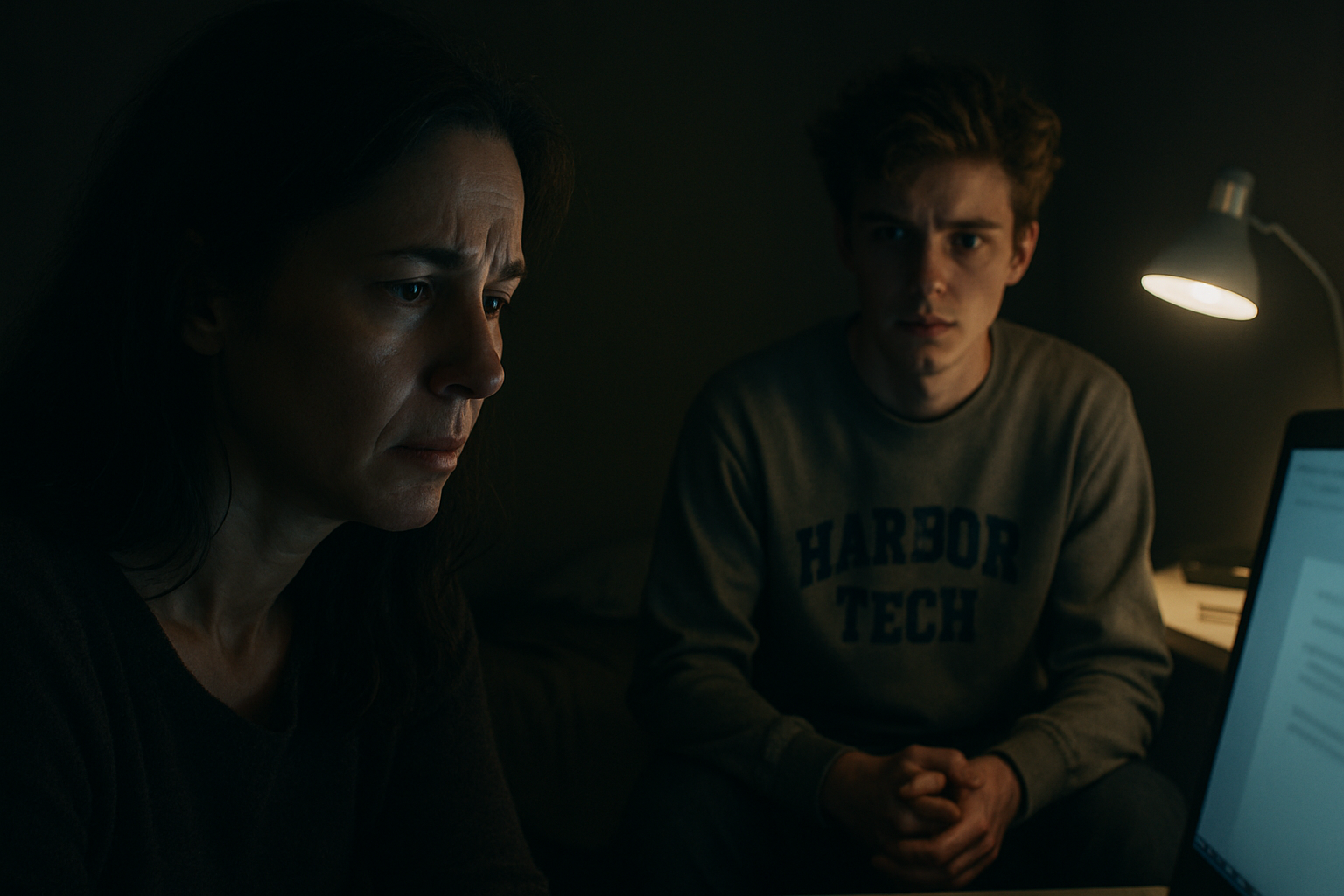
Mara walked to the window.
Outside, the lawn lay silvered with old snow. The harbor was hidden beyond the trees, but she could feel its cold pressing against the glass.
For years, she had lived inside Grant’s weather and mistaken pressure for climate.
He was late because she did not understand business.
He was distant because she asked too much.
Noah avoided him because Mara had made the boy too soft.
Now she saw the architecture under it all.
Not neglect.
Design.
“How did you get the recordings?” she asked.
Noah hesitated.
Mara turned.
“Noah.”
He rubbed his hands over his jeans.
“Grandmother Lenora.”
Grant’s mother.
The name moved through the room like a ghost.
Lenora Whitmore had died the previous spring after seven long years of partial paralysis and broken flashes of clarity. Mara had bathed her. Fed her. Sat through nights when Grant said he couldn’t bear to see his mother diminished.
When Lenora had been well, she had been severe. Old money. Cold manners. A woman who could make gratitude feel like a debt.
But illness had stripped away the performance.
In her final year, she had held Mara’s hand and whispered apologies Mara had never fully understood.
“What about her?” Mara asked.
Noah pointed to a small black drive on the desk.
“She left this for me. Her nurse gave it to me after the funeral. Grandma recorded things. Dad thought she couldn’t understand. He took calls in her sitting room because he thought she was furniture.”
Mara closed her eyes.
“There’s a letter,” Noah said.
He opened a scanned page in Lenora’s trembling hand.
Noah,
Your father mistakes silence for consent. Your mother saved this family when Grant would have sold his own name to impress men who despised him. If he turns on her, do not let him rewrite the story.
I was not good enough to her while I had the time.
Let this be one useful thing I do before I answer for the rest.
Mara pressed her fist to her lips.
She had stopped wanting vindication from Lenora years ago.
Yet here it was.
Too late to heal the past.
Not too late to matter.
Noah watched her, his face tight with worry.
“Mom, I didn’t hide it because I doubted you. I hid it because I needed to understand what I had. I’m sorry.”
Mara crossed the room and cupped his face in both hands.
For one breath, she saw every version of him.
The toddler reaching for Grant at the airport and being passed to a nanny.
The ten-year-old pretending not to care when Grant left before his school play scene.
The seventeen-year-old who stopped asking his father to show up because hope had begun to feel humiliating.
“You should never have had to carry this,” she said.
“I couldn’t let him do it to you.”
“He already did enough to you.”
Noah’s jaw trembled.
“Then let’s not let him finish.”
The next morning, humiliation arrived wearing perfume and holding a child’s backpack.
Mara had not slept. She had spent the night copying files with Noah, speaking twice with Serena Pike, and learning there is a kind of pain that does not destroy you.
It clarifies.
At 10:13, the doorbell rang.
On the security camera, Selene Hart stood beneath the portico. Beside her was Milo, bundled in a red coat, clutching a toy train.
Noah came into the foyer.
“Don’t open it.”
Mara looked at the child on the screen.
He shifted from one foot to the other, bored and blameless.
Whatever Grant and Selene had built, Milo had not built it.
“I’m opening the door.”
“Mom—”
“Stay close.”
Selene smiled when Mara opened the door.
It was a glass smile.
“Mara. I’m sorry to come without calling.”
“No, you’re not.”
The smile flickered.
“Grant asked me to pick up some documents from his study. And Milo wanted to see Daddy’s house.”
Milo peeked around Selene’s coat.
“Is this where Daddy sleeps?”
Behind Mara, Noah flinched.
Mara bent toward the boy.
“Hello, Milo. It’s freezing out there. Would you like some hot chocolate?”
Selene’s expression sharpened.
“That won’t be necessary.”
“The offer was for him,” Mara said. “Not for you.”
Milo looked up.
“Can I?”
Selene hesitated.
Then shrugged.
“Fine. Five minutes.”
Mara led them to the kitchen instead of Grant’s study.
It was the warmest room in the house, with blue-gray cabinets Grant had wanted replaced with cold white stone. Noah stood near the island, arms folded, watching Selene with the contained fury of a son old enough to understand betrayal, yet still young enough to be wounded by it.
Milo climbed onto a stool.
Mara made hot chocolate with real milk and three marshmallows.
Children remembered small kindnesses.
Adults forgot entire vows.
“Thank you,” Milo said.
“You’re welcome.”
Selene removed her gloves finger by finger and looked around.
“It’s smaller than I imagined.”
“The kitchen?”
“The whole house, actually. Grant always says you fought him on the Riverbend property because you’re sentimental.”
Noah let out a short laugh.
“He means Mom refused to sell the place she paid for.”
Selene’s eyes moved to him.
“You must be Noah.”
“And you must be the strategic consultant with a luxury SUV billed as client development.”