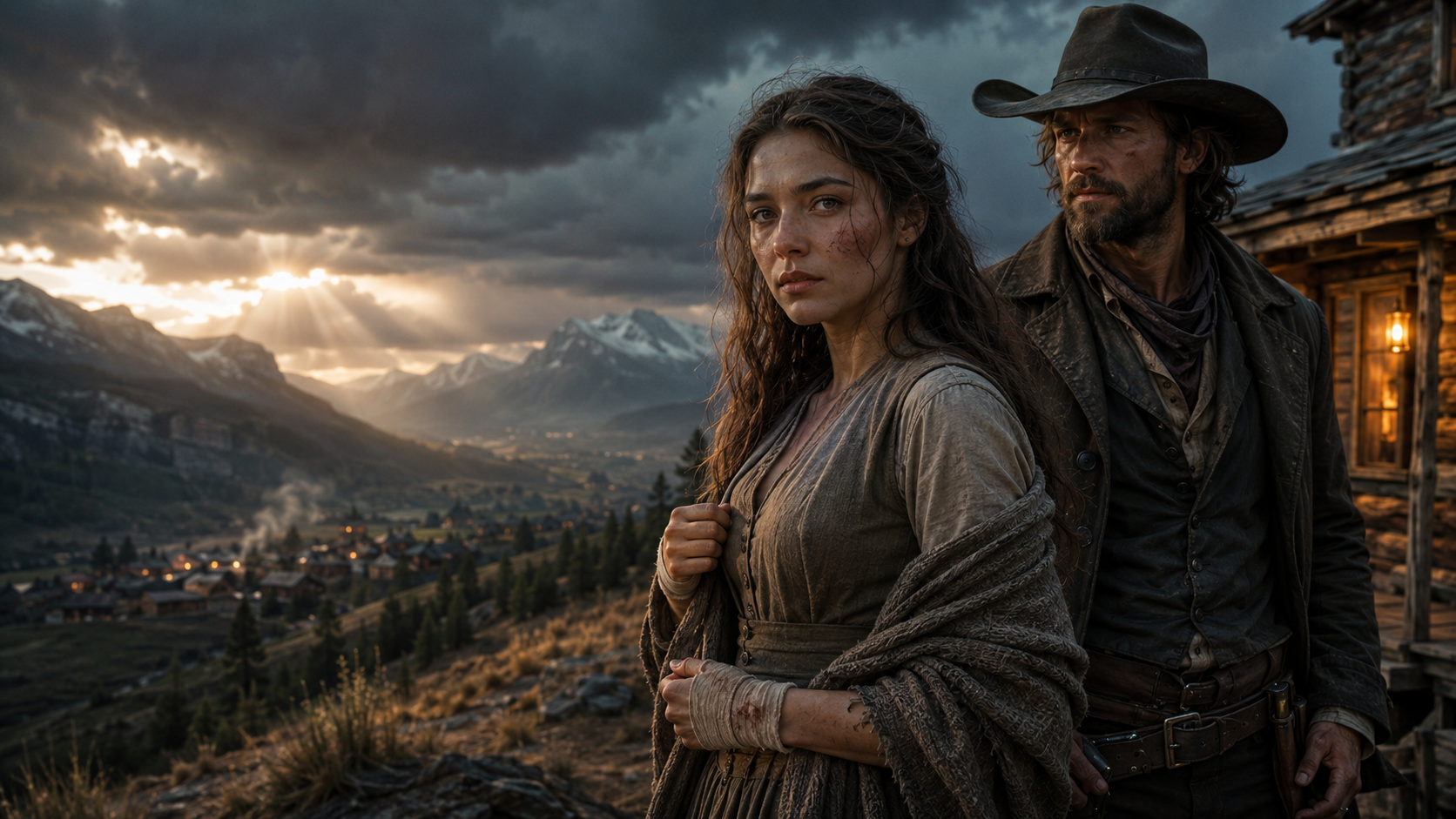
When Rowan Pike first saw the woman, she was standing at the edge of the storm like a thing the mountain had refused to swallow.
Rain ran from the brim of her torn bonnet. Mud covered the hem of her dress. One sleeve hung loose where the stitching had failed, and beneath it her arm was wrapped in dirty linen. She stood twenty yards from his cabin door, trembling so hard the lantern light caught the motion.
Most people who climbed to Pike’s Ridge came with a reason.
A mule with a broken leg.
A child blue with fever.
A man bleeding from a knife fight he swore had begun as friendly cards.
This woman carried no child, led no animal, dragged no wounded man behind her.
She had come carrying only herself.
And from the way she looked at the cabin, even that seemed too much.
Rowan opened the door wider. The fire behind him bent in the draft.
“Come in,” he said.
The woman did not move.
Her eyes, dark and fever-bright, fixed on him through the rain. “Are you Pike?”
“Depends who’s asking.”
“A dead woman.”
That made him step onto the porch.
Lightning opened the valley for a breath, showing him the narrow trail behind her, the black pines, the long fall down toward the town of Briar Glen. No horse. No wagon. No companion. She had climbed the ridge alone in weather that sent wolves into their dens.
Rowan’s voice lowered. “Who called you dead?”
Her mouth twisted, though not quite into a smile. “Everyone.”
Thunder rolled over the mountains.
“Everyone is rarely worth listening to,” he said. “Come inside before you prove them right.”
She swayed.
Rowan moved before she fell. He caught her by both shoulders, expecting bones. Instead he found a strong frame starved thin by fear and neglect. She gasped when his hand touched her sleeve.
“Pain?”
“All over.”
“That’s not an answer.”
“It’s the only one I have.”
He guided her into the cabin. She tried to pull away when the light reached her face, as if she expected him to recoil.
He did not.
He had seen men with half a cheek gone from cannon fire. He had seen miners dragged from collapsed shafts with stone dust packed into their lungs. He had seen childbirth turn a bed into a battlefield. A woman with cracked skin and frightened eyes did not scare him.
Still, he noticed everything.
The raw patches along her neck. The blistering around her wrists. The way she held her hands curled inward. The smell of cheap salve beneath rainwater and old wool. The hunger in her face. The shame sitting heavier on her shoulders than the wet dress.
He pointed to the chair beside the hearth. “Sit.”
She obeyed, then immediately looked ashamed for obeying.
“What’s your name?”
“Mara.”
“Full name.”
She hesitated. “Mara Wren.”
A seamstress name, Rowan thought. Or a widow’s name. Something quiet. Something people forgot until they needed mending done.
He set a kettle over the fire. “Who sent you up here, Mara Wren?”
“No one sends people to you.”
“Usually they send curses first.”
Her eyes flicked toward him. “They said you were dangerous.”
“I am, depending on the company.”
“They said you cut men open.”
“Only when leaving them closed would kill them.”
“They said you were thrown out of the army hospitals.”
“I walked out.”
“Why?”
“Because commanders enjoy clean ledgers more than living soldiers.”
She stared at him as if deciding whether that made him better or worse.
Rowan took a blanket from the peg and held it out. “Take off the coat.”
Her fingers froze at her collar.
“I need to see the wounds.”
“They’re not wounds.”
“What are they?”
Her throat moved. “The mark.”
He waited.
“The mark of rot,” she whispered. “Dr. Harrow said it was in my blood. He said it was eating me from the inside.”
Rowan went very still.
Dr. Lucian Harrow of Briar Glen wore a pearl tiepin, kept his nails polished, and spoke with the voice of a church bell. He also had a habit of deciding poor people were morally responsible for illnesses rich people found inconvenient.
“What else did Harrow say?”
“That I should not touch anyone. That no one should touch me. That my sheets should be burned. That the church should seat me outside. That if children came near me, they might carry it home.”
Rowan’s jaw tightened.
“Show me.”
Mara flinched.
He pulled a chair closer and sat opposite her. “You climbed six miles in a storm. Don’t stop at the door.”
Her laugh was small and broken. “You don’t understand. People screamed when they saw my hands.”
“I didn’t ask for people. I asked for the monster.”
Slowly, Mara unwound the linen from her right hand.
The cloth stuck to the skin in places. She bit her lip hard enough to turn it white. Beneath the wrapping, her hand was red, cracked, swollen around the knuckles, with shiny patches where blisters had opened and dried badly. The rash climbed her wrist like fire caught under the skin.