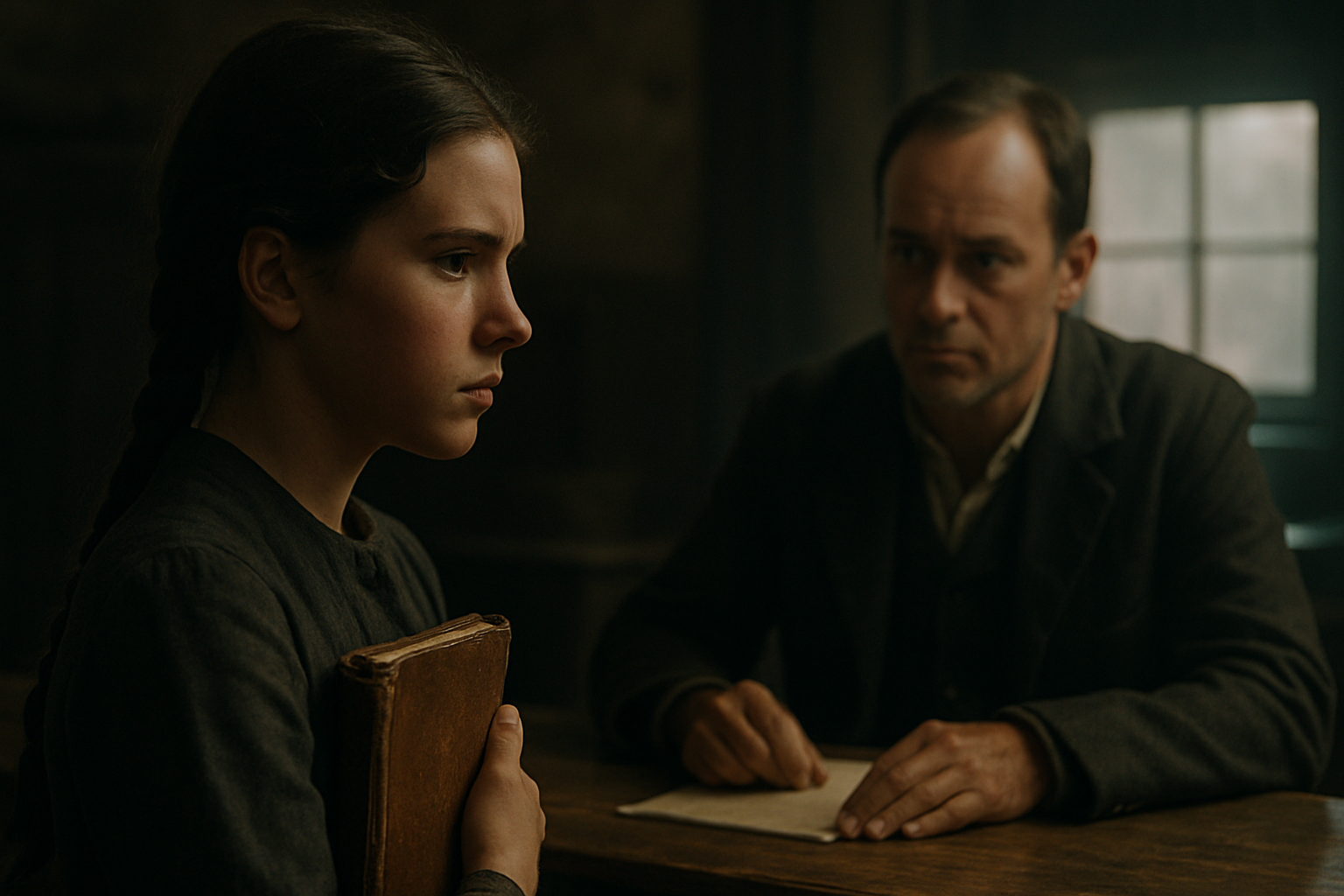
He faced Franklin.
“I oughta break your jaw.”
Franklin didn’t lift his head. “You ought.”
Garrett glanced at Hester. “Want me to?”
The absurdity nearly made Hester laugh.
“No.”
“Pity.”
Levi Woodson came next, bearing a notebook, his expression that of a man whose mind had transformed into a courtroom.
“Tell me all,” he requested.
Hester did.
She detailed Bronson’s visit, Pastor Stowe’s warning, Franklin’s confession, the canvas, the railroad survey, the debts. Olivia, weak but coherent, corroborated. Franklin signed a statement, hands trembling so badly Levi blotted the ink twice.
Then Hester showed Levi the dugout.
Not as a curiosity, but as evidence.
He measured wall thickness, roof pitch, chimney draw, interior temperature, exterior temperature, wood consumption, floor grade, condensation—or its absence. He queried, and Hester answered. Garrett listened, pretending indifference but failing.
“This,” Levi concluded, “isn’t luck.”
Hester was tired enough for honesty. “It felt like luck crawling to the chimney.”
“Luck survives mistakes,” he said. “You survived because you planned. That’s engineering.”
Garrett grunted. “Don’t inflate her head.”
Hester eyed him. “Too late. I reside in a hill. My head’s ample.”
He laughed.
Three days later, Pastor Stowe appeared in her doorway.
He seemed smaller without parishioners flanking him.
“I seek forgiveness,” he said.
She didn’t invite him in.
“Seek it from God.”
“I have.”
“What did He say?”
The pastor flinched.
Behind Hester, Olivia shifted, baby Eliza nestled against her shoulder. Franklin penned another confession, now naming Bronson’s full proposition.
Pastor Stowe saw and grasped his impending ruin.
“I believed I was restoring order,” he stammered.
“You aided a man in smoking me out during a blizzard.”
“I didn’t know Bronson would act amidst the storm.”
“You knew he’d act.”
Tears shone in eyes unworthy of them.
“Yes.”
Hester waited.
Outside, men repaired roofs, women boiled snow for washing, children hauled split wood. The town, honest under weather’s lash, had no energy for polite falsehoods.
“What do you want?” she inquired.
“To make amends.”
She thought of the lost infant, the young couple, Becker’s daughter, Garrett’s children sleeping atop broken frames, her mother’s letter, her chimney-sooted hands.
“You’ve a parlor larger than my home,” she said. “Open it to families until spring. Your woodpile goes first to homes with children. You’ll confess, not prettily, but truthfully. Never again recommend marriage for shelter when a girl can build her own.”
His face paled.
“It’ll end my ministry.”
“No,” Hester corrected. “It’ll reveal if you ever possessed one.”
He bowed his head.
Dorian Bronson attempted to leave Timber Valley before the road cleared.
Garrett Larkin halted him.
Garrett later claimed, “I just stood in a horse’s way.” Silas’s bruises suggested otherwise.
The territorial marshal arrested Silas on charges evolving from fraud to more intriguing accusations following Levi’s discovery of his railroad speculation correspondences. Franklin avoided jail, partially because Hester declined pressing charges, partially because Olivia’s testimony emphasized Bronson’s lead. But Franklin forfeited his claim settling debts, and for the first time, worked land he didn’t pretend to own.
In February, the Dakota Frontier Journal published Levi Woodson’s article:
A PRAIRIE HABITATION THAT HELD SIXTY-FIVE IN FORTY BELOW
It should’ve centered on Hester’s dwelling.
It became about Hester.
That irked her.
The article chronicled a sixteen-year-old homesteader crafting a low-cost earth-sheltered home using sod insulation, air gaps, drainage grading, and thermal mass concepts. It compared fuel consumption between her dugout and three traditional homes. It noted frame and stone shelters failed extreme cold, her dugout sustaining livable temperatures efficiently. It omitted her blizzard childbirth and attempted murder.
Hester preferred it so.
The community didn’t.
By March, three families sought her designs. By April, nine. By May, seventeen.
Hester charged five dollars per consultation, not greedily, but because free advice was too readily ignored. When paid, they listened.
“No,” she instructed Garrett, examining his half-dug hill. “Not there. Water’ll breach the wall.”
Garrett wiped sweat. “You always this bossy?”
“When paid.”
“I regret it all.”
“You’ll regret drowning more.”
Wilhelm Becker hired her to modify his stone house. She showed him to add an inner sod wall with vents managing moisture. He argued for hours, then followed her exactly. That winter, his walls ceased sweating.
Matilda Winslow turned her storage cellar into a warm boarding room for those unable to afford wood. Ellen Larkin insisted on window wells wide enough for morning sun. Levi translated Hester’s insights into plans newspapers and government agents grasped.
“Professors eastward would take pages to explain what you say in one sentence,” he mused one evening.
“What sentence?”
“Water flows downhill.”
She smiled. “They’re welcome to it.”
Olivia stayed through spring.
Initially, Hester wasn’t sure how to handle her. Forgiveness wasn’t a door opened once. It was like the dugout—dug slowly, fortified carefully, never safe if neglected.
Olivia wasn’t instantly sweet. Shame didn’t render her gentle overnight. But motherhood softened something fear had sharpened. She lab