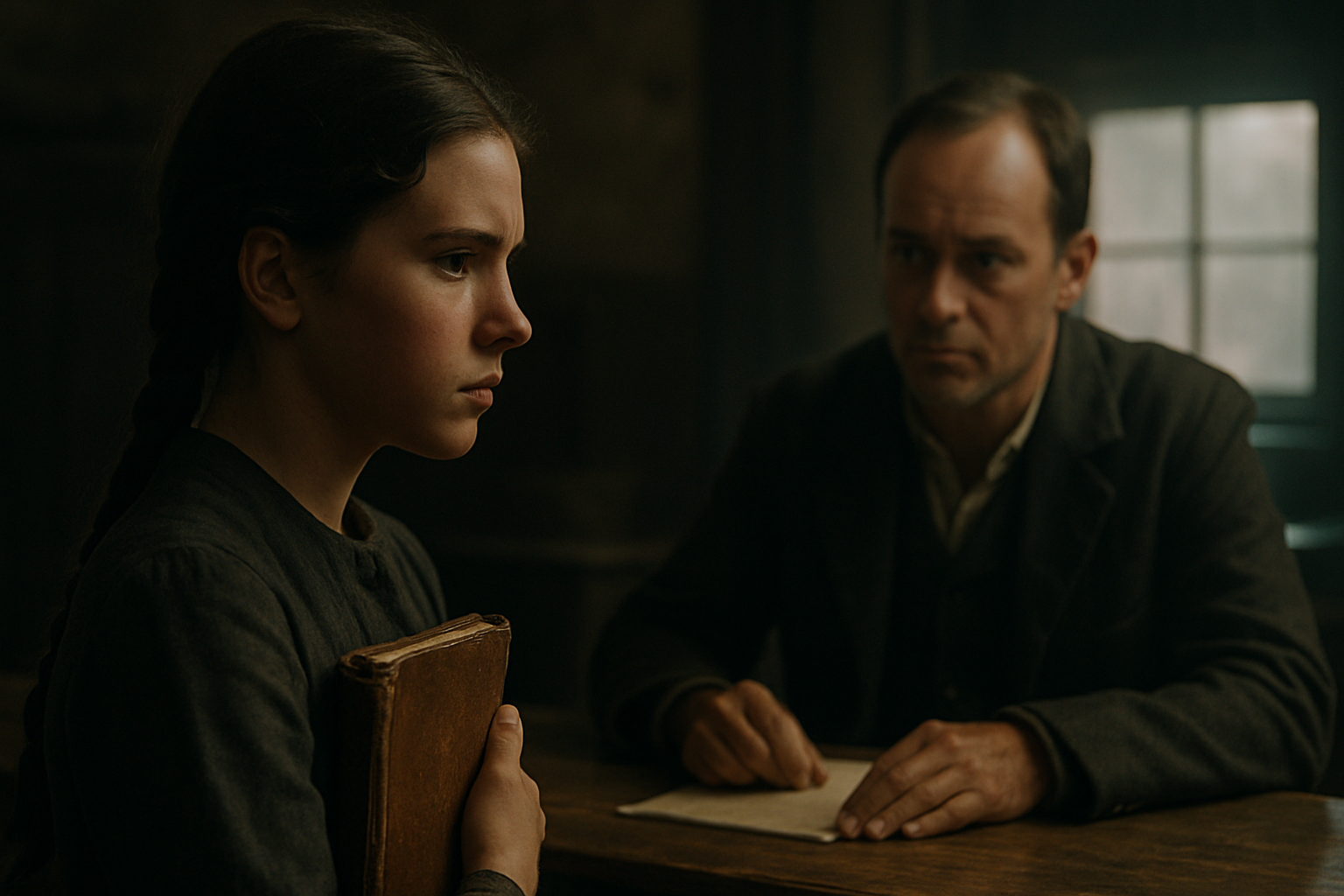
Wind above roared so fiercely the dugout hunkered deeper, instinctively burrowing. The door rattled against its bar. Snow hissed through some slender gap. The chickens erupted in a clamor of alarm.
Hester lit the lamp despite her hands’ desire to tremble.
Inside: fifty-four.
Outside, through a cracked peephole: thirty-one below.
She fed the stove. Not too much. A raging fire could crack pipe or misdraw. Slow heat. Steady heat. Let the clay absorb. Let the walls learn again.
By dawn, the outside world vanished.
Sky gone. Creek gone. Road and settlement erased. Only white violence and the sound of something immense passing overhead.
Hester remained inside.
She read. Cooked. Slept in fragments. Hourly, she checked the chimney draw, a thread near the stove seam. It pulled inward. Good. She cracked the door, shoveling snow back before it sealed her. The cold bit her heavily, but she retreated into warmth with gratitude sharp as pain.
The first day passed.
Then the second.
By the second night, the outside thermometer became useless, crusted in ice. Snow banked against the entrance till only the inward-opening door saved her from being trapped. Wind whipped over the roof, but the sod held firm. Beams creaked, deep and slow, like old men coughing.
Hester touched each and whispered, “Hold.”
Around midnight, the stove smoked.
At first, faintly.
A gray tendril curled from the seam, flattening under the ceiling.
Hester stood instantly.
The draft thread hung limp.
“No,” she whispered.
She opened the stove. Smoke billowed out.
Chimney blocked.
For one frantic second, fear blanked her mind. Gideon’s warning echoed back. Keep your chimney clear. If blocked, smoke would fill the dugout. Carbon monoxide would send her to eternal sleep. Warm, safe, and dead.
She wrapped her face, grabbed the poker, opened the cleanout at the chimney base. Ash spilled out. No obstruction there.
The trouble lay above.
Outside.
Hester stared at the door.
To clear the chimney, she needed to confront the storm.
She tied the rope around her waist, grabbed the shovel, forced the door open. Snow collapsed inward. Wind struck like a hammer blow. She dropped to her knees, crawling since standing was impossible. The rope seared through her glove as she followed it to the willow, then angled up the slope where the chimney stood.
She saw nothing.
Not a foot ahead.
Her world shrank to rope, shovel, breath, pain.
Cold stabbed her skirt. Ice formed on lashes. Twice she lost the pipe and had to sweep until metal clanged beneath her glove.
Found it.
She dug.
Snow packed around the chimney, but not enough for a full block. Something else was wedged inside.
Hester thrust the poker down.
It struck fabric.
She twisted, yanked, pulled.
A wadded canvas came free, stiffened by ice, blackened at one edge.
Canvas.
Not snow.
Not accident.
Someone had sabotaged her chimney.
For a moment, the storm stepped aside for a hotter terror to flood in.
Dorian.
Franklin.
Pastor Stowe.
Someone meant to let her own home kill her and let the blizzard take the blame.
Her body wanted to freeze at the realization.
Then smoke puffed from the pipe, hot and alive.
Hester shoved the canvas in her coat, cleared the rim, crawled back down half-blind, falling more than entering through the doorway, slamming it shut, gasping on the floor as smoke cleared above and the stove resumed its draw.
She didn’t cry.
Her anger burned hot enough.
The third day dawned without light, the storm still raging, though weaker now, like a beast tiring. Hester hadn’t slept. She sat at the table, the frozen canvas beside her, her mother’s journal under her hands.
Who?
Her mind circled the question.
Who hated enough to quietly kill?
Dorian had motive. Franklin had debt. Pastor Stowe had reputation. Garrett had pride, but he’d witnessed the dugout’s success, and his meanness was loud, not hidden.
Late afternoon, the wind dropped suddenly.
Silence engulfed her.
She opened the door to a wall of snow.
It took her half an hour to dig enough to squeeze through. Outside, the cold was beyond counting. Lungs emptied. The prairie transformed into white dunes, fence posts buried, creek erased, houses reduced to smoking dots.
Hester climbed the hill, surveying Timber Valley.
A chimney silent.
Another followed.
Then movement near the road—three figures staggering, one falling, one rising, one carrying something bundled.
From the Foster place.
Even from a distance, Hester recognized Franklin’s gait.
For a long moment, she stood, canvas hidden in her coat, watching him struggle.
She could shut the door.
She could survive.
The thought was clean, cold.
Then Olivia collapsed.
Franklin tried lifting her, failing. The bundle under his arm moved weakly.
Hester cursed, grabbed the rope, descended the hill.
By the time she reached them, Franklin’s face was gray beneath the ice in his beard.
“Hester,” he croaked.
Olivia moaned. The bundle wasn’t the newborn she expected but little Jacob, Olivia’s fourteen-month-old nephew taken in after tragedy. His cheeks waxy, his cries threadbare.