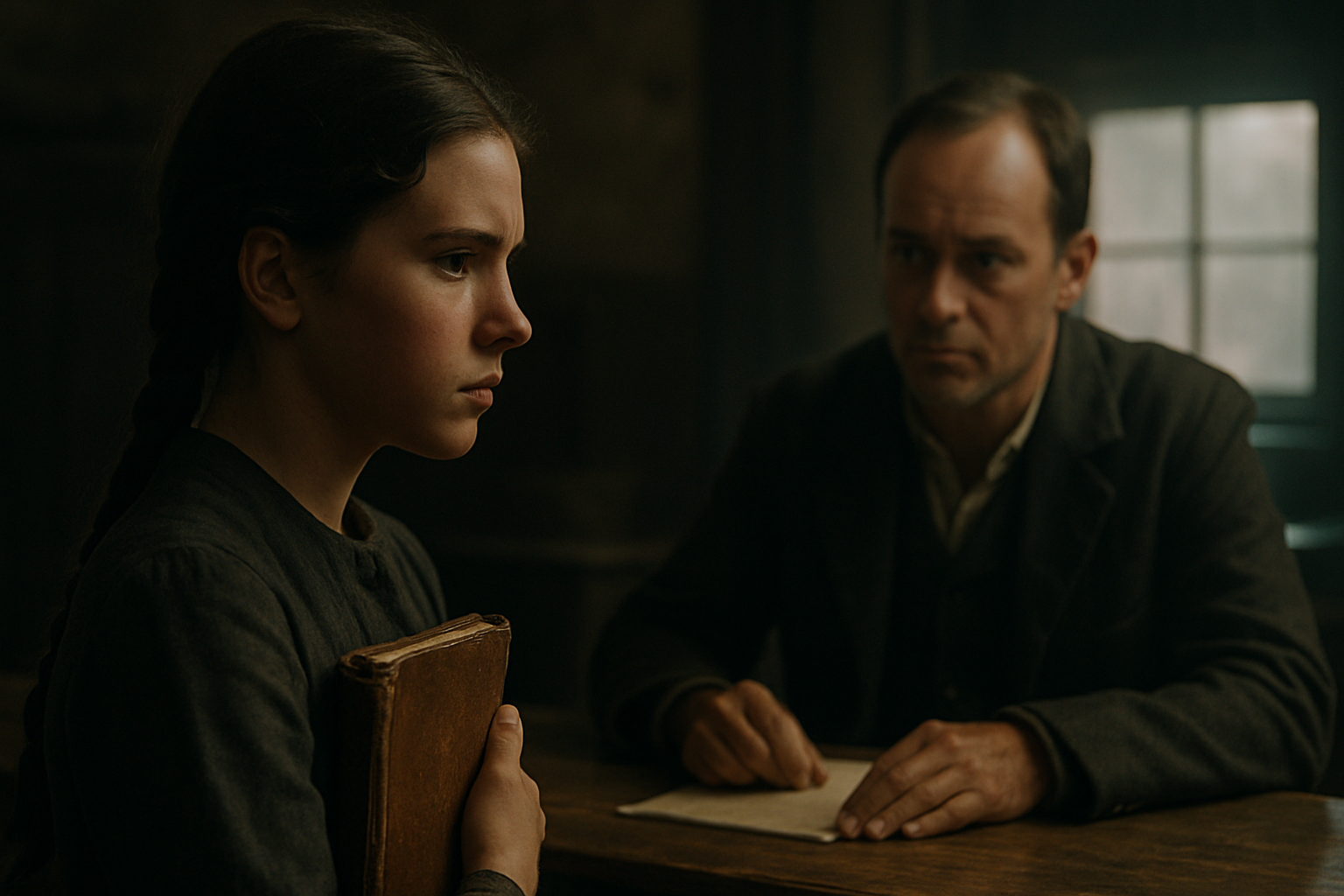
Hester stared at him.
No one had ever called anything she did patient before.
“My mother claimed potatoes sometimes knew more than carpenters,” she recalled.
Levi smiled. “Your mother sounds formidable.”
“She was.”
“Then she taught you well.”
The compliment hit a bruise inside Hester. She turned away, feigning busyness with the lamp.
“Will it hold?”
“If you manage air and moisture, yes. Crack the door in daylight. Keep the chimney clear. Watch for condensation. Don’t let pride keep you from asking for help.”
She glanced sidelong at him. “Does everyone here think I’m made of pride?”
“No,” Levi replied. “Some think you’re made of scandal. Some think you’re made of folly. I’m starting to think you’re made of arithmetic.”
She nearly laughed.
Nearly.
The first week taught her what theory couldn’t.
The dugout was darker than a house. Even with two windows, winter sunlight entered warily. Hester burned the lamp longer than planned, trading kerosene for sanity. At night, the walls seemed to breathe—not move, but exist with a closeness both soothing and unsettling.
She learned where to stack wood to dry instead of mold. She learned to crack the door an inch at noon, even when cold air crawled inside like a living thing. She found a small morning fire raised the room’s temperature to sixty-four, maintaining warmth long after flames died. She discovered that silence underground differed from silence above. Less empty. More attentive.
People came.
Mostly women.
Matilda Winslow brought bread, saying nothing about propriety. Mrs. Becker delivered pickled cabbage, eyeing the drainage with suspicion. Garrett’s sister, Ellen, came with her children, masking worry with curiosity.
“Is it lonely?” Ellen asked.
Hester looked around the single room. Bed in one corner. Table in another. Shelves cut into the wall. Stove. Trunk. Journal.
“Yes,” she said.
Ellen seemed startled by the honesty.
“But not as lonely as being unwanted in someone else’s house.”
Ellen glanced toward the door where her children prodded frozen grass with sticks.
“My husband says you’re making us all look foolish,” she said.
“I’m not trying to.”
“That might be worse.”
By mid-December, a cold front swept in.
Six below. Twelve below. Seventeen below at dawn, with a wind slicing through ordinary walls to chill bones in their sleep.
In Garrett Larkin’s timber house, the stove devoured wood every two hours. His youngest awoke crying as frost formed inside his window. In Wilhelm Becker’s stone house, walls sweated by day and froze by night. Pastor Stowe preached perseverance while his wife tucked blankets around parishioners’ knees.
In Hester’s dugout, the thermometer read fifty-eight at dawn.
She fed three sticks to the stove, brewed coffee, and watched the room climb to sixty-three.
On the third cold snap morning, Garrett called.
He didn’t dismount initially. Sat on his horse while Hester split kindling in her woolen sweater, her breath faint but untroubled.
“How much wood you burning?” he demanded.
“Six, maybe seven pounds daily.”
“That’s a lie.”
Hester swung the hatchet. The kindling split.
“It would be a peculiar lie.”
“My house burns forty.”
“I know.”
His face reddened against the windburn. “What’s that supposed to mean?”
“Your chimney smokes like a train.”
He eyed the thin gray tendril above her dugout.
“Let me see,” he said.
Hester rested the hatchet. “Ask nicely.”
Garrett’s eyes narrowed.
For a moment, she expected him to ride off. But cold had worn him down longer than pride had fortified him.
“May I see?” he muttered.
Hester opened the door.
Garrett ducked inside and halted.
The warmth didn’t blast like a stove’s heat. It enveloped. It radiated from walls, floor, and air. No draft crawled under the table. No frozen corners lurked behind the bed. It felt less like entering a room than stepping into a creature’s steady heartbeat.
Garrett removed one glove, pressing his palm to the back wall.
“Well, I’ll be damned,” he whispered.
Hester stood by the door, granting him the dignity of silence.
His gaze danced from the stove to beams to chimney.
“My grandfather had a bank barn in Ohio,” he admitted, “built into a hill. Cool in summer, warm in winter. I slept there with dogs when Pa got mean.” He swallowed. “I forgot.”
Hester’s anger softened despite herself.
“People forget what doesn’t look grand.”
Garrett chuckled without humor. “No. People forget what poor folks knew first.”
He left without conceding she was right. But after that, he stopped claiming she’d die.
That should’ve sufficed.
It wasn’t.
A week before Christmas, Dorian Bronson came calling.
Hester saw him through the window’s well, a tall silhouette cloaked in black, his stride deliberate, full of self-assuredness. At forty-seven, thick-waisted, clean-shaven but for a gray mustache, every inch of him reeked of a man used to others stepping aside.
She met him outside.
“No need to stand in the cold,” he said. “Invite me inside.”
“No.”
His smile tightened. “Still sharp.”
“Still disinterested.”