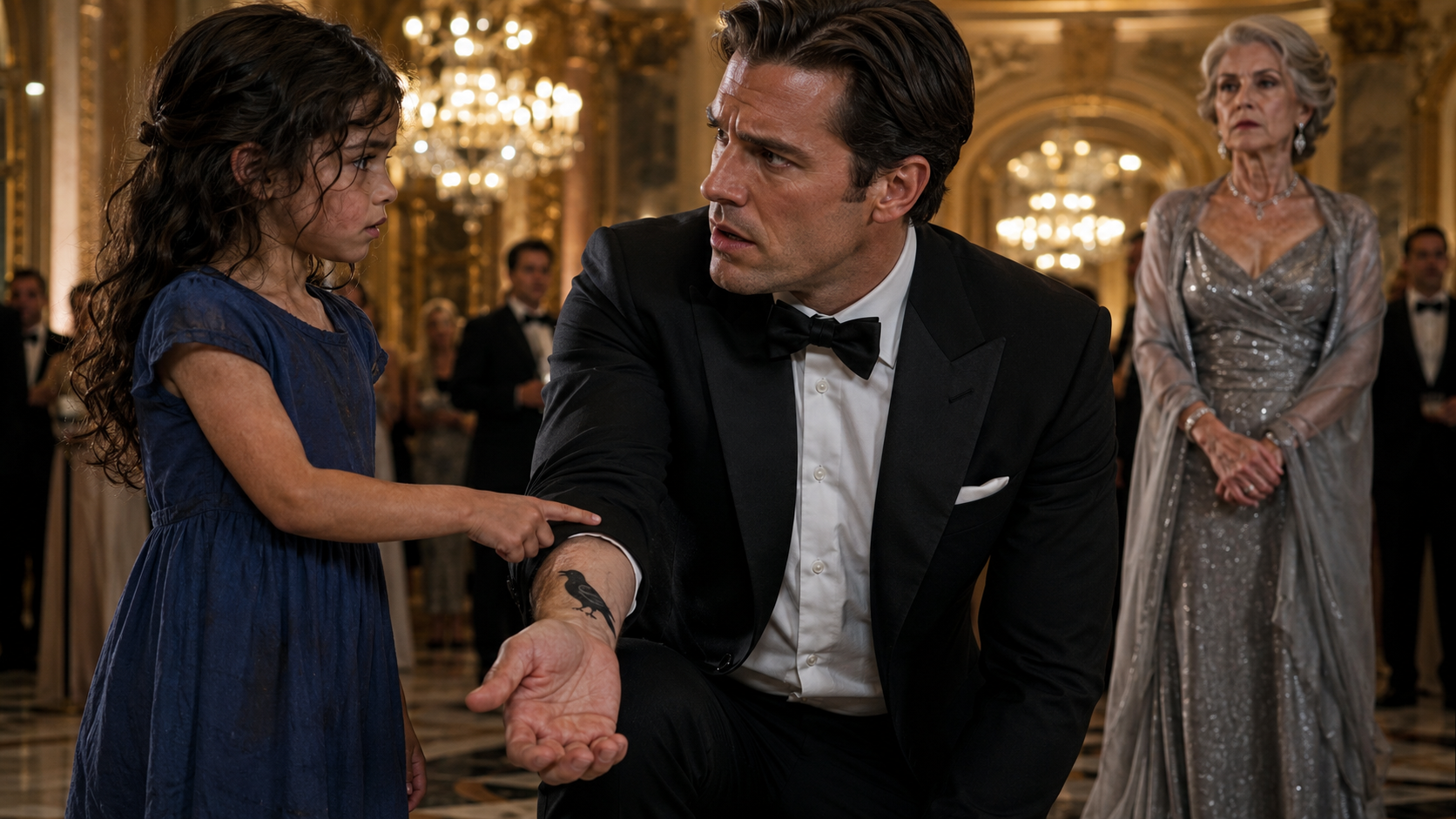
Barefoot Girl Pointed at a Billionaire’s Tattoo and Whispered, “My Daddy Has the Same Bird”

Adrian Vale hated charity galas, especially the ones held in his own name.

From the top balcony of the Meridian House ballroom, he watched three hundred people in black silk, white diamonds, and carefully practiced compassion applaud a video about children who had nowhere warm to sleep. The applause sounded expensive. It rose beneath the crystal chandeliers, bounced off gold-veined marble pillars, and settled into the kind of silence only rich people could afford.

On the stage below, his foundation director smiled into the microphone. “Thanks to Mr. Vale’s generosity, tonight’s pledges will fund emergency housing for more than two thousand families.”

Adrian lifted his glass but did not drink.

Generosity.

The word always tasted wrong in his mouth. He had inherited a shipping empire, turned it into an infrastructure-tech kingdom, and doubled it before thirty-eight. Newspapers called him disciplined. Investors called him ruthless. Women’s magazines called him unreachable. But no one ever called him generous unless there was a camera nearby.

His left cuff had slipped back again.

Adrian tugged it down before anyone noticed the tattoo on the inside of his wrist.

A black bird with one broken wing.

He had paid a tattoo artist in Prague to ink it fifteen years ago after the North Pier fire, back when grief still felt like a room he could leave if he walked fast enough. He had never explained it publicly. His publicist once suggested removing it from every magazine photograph. Adrian told her she could remove herself from his payroll instead.

The bird stayed.

It was the only honest thing he owned.

“Stop brooding,” said a dry voice behind him.

Adrian did not turn. “Good evening to you too, Grandmother.”

Vivienne Vale stood beside him in a silver gown that made her look carved from moonlight and old money. At seventy-six, she was still the most feared woman in any room she entered. Her hair was white, her diamonds were older than some countries, and her smile had ruined more careers than Adrian’s temper ever had.

“You look bored,” she said.

“I am bored.”

“You look ungrateful.”

“I am also that.”

Vivienne’s gaze moved over the crowd below. “These people came to admire you.”

“They came to be seen admiring me.”

“Same thing, darling.”

Adrian finally looked at her. “Not to me.”

Her smile thinned. “Still pretending you’re morally superior to the money that feeds you?”

Before he could answer, a small sound cut through the balcony’s polished quiet.

Bare feet slapping marble.

Adrian turned.

A little girl stood at the entrance to the balcony corridor, breathing hard, one hand pressed against the wall for balance. She could not have been more than seven. Her dark curls were unevenly braided, her blue dress was wrinkled, and her feet were bare and dirty, as if she had run through an alley, a kitchen, and half the city before arriving beneath the chandeliers.

A security guard rushed behind her.

“Sir, I’m sorry. She came through the service hall. We tried to stop—”

The girl darted behind a marble column.

Adrian lifted one hand. The guard froze.

“What’s your name?” Adrian asked.

The girl peeked out. Her eyes were enormous, gray-green and too serious for a child.

“Mira,” she said.

Vivienne’s nostrils flared. “This is a private event.”

Mira ignored her.

She stared at Adrian’s wrist.

His cuff had slipped again.

The little girl stepped out from behind the column, pointing at the black bird tattoo.

“My daddy has the same bird,” she whispered.

Every word in the corridor died.

Adrian looked down at his wrist, then back at the child.

“What did you say?”

Mira swallowed. “My daddy has that bird. Only his is burned around the edges.”

Vivienne went so still that Adrian felt the change before he saw it.

The security guard shifted uneasily. “Sir, should I call someone?”

“No,” Adrian said.

Mira came closer, still staring at the tattoo. “Daddy says birds like that don’t sing anymore.”

Vivienne’s voice cut the air like glass. “Then tell your daddy the bird is dead.”

Mira turned to her.

For the first time, the child looked frightened.

Not confused. Not shy.

Frightened because she recognized the kind of adult who smiled before hurting someone.

“My daddy said dead birds don’t pay men to follow us,” Mira whispered.

Adrian’s blood went cold.

Vivienne’s expression did not change.

The ballroom applause rose beneath them again, distant and cheerful, as if the world below had no idea that something ancient and rotten had just opened its eyes on the balcony.

Adrian crouched slowly so he would not tower over the child.

“Mira,” he said softly, “where is your father?”

Her lower lip trembled. “Outside. They wouldn’t let him in. He told me to stay in the kitchen, but the man with the red scar saw me. So I ran.”

“What man?”

She looked at Vivienne, then back at Adrian.

“The one Grandma Silver knows.”

Adrian rose.

Vivienne laughed once, very quietly. “Children say nonsense when they’re frightened.”

Mira shook her head. “I don’t say nonsense. Daddy says nonsense gets people killed.”

Adrian heard something in that sentence that no child should know how to carry.

He turned to the guard. “Seal every service exit. Quietly. No alarms. Bring Isabelle to the west library.”

Vivienne’s eyes sharpened. “Adrian.”

He did not look at her. “Now.”

The guard hurried away.

Mira hugged herself. “Are you mad?”

“No,” Adrian said. “But I need to ask you something. Did your father give you a message?”

Her small face changed.

Children were terrible liars when they wanted cookies.

They were frighteningly good liars when they had learned fear.

She lowered her voice. “He said if I ever saw the bird on someone who looked like a prince, I should tell him two words.”

Vivienne stepped forward. “Enough.”

Adrian’s tone turned lethal. “Move one more inch and I will have my own grandmother escorted out of my building.”

Vivienne stopped.

Mira looked from one adult to the other.

Then she whispered, “Gray Chapel.”

For a moment, Adrian did not understand.

Then the world tilted.

Gray Chapel was not a place. It was not a chapel. It was not something a child could have overheard from television or gossip.

Gray Chapel was the name of a sealed trust account his father had created before his death. Adrian had seen it once, years ago, in a locked estate document. The account had supposedly been empty. A dead end. A clerical ghost from the old Vale Maritime days.

His father’s lawyers had told him Gray Chapel meant nothing.

His grandmother had been in the room when they said it.

Adrian looked at Vivienne.

For the first time in his life, she looked old.

Only for a second.

Then the mask returned.

“You are making a spectacle of yourself,” she said.

“No,” Adrian replied. “I think you made one fifteen years ago. I just never knew where to look.”

Mira whispered, “Can I have my shoes back?”

Adrian looked down.

Her feet were scraped, one toe bleeding onto his polished marble floor.

Something inside him, something he had buried under money and discipline and carefully maintained distance, cracked clean through.

“Who took your shoes?” he asked.

“The kitchen man said barefoot kids look homeless in rich rooms.” She lowered her head. “I am not homeless. We just move a lot.”

Adrian took off his jacket and wrapped it around her shoulders.

It swallowed her whole.

“You’re safe now.”

Vivienne made a small sound of contempt.

Mira looked up at him with brutal honesty. “Daddy says rich people only say that before asking what the price is.”

Adrian could not blame her father.

“Then your daddy has met the wrong rich people.”

Vivienne smiled. “Has he?”

Adrian looked at her. “We’ll find out.”

The west library had no cameras.

That was why Adrian chose it.

His security chief, Isabelle Crane, arrived within two minutes. She was former military, calm under pressure, and one of the only people in the building Adrian trusted without needing paperwork first. She took in Mira, the bloody feet, Adrian’s jacket, Vivienne’s perfect composure, and said nothing until Adrian spoke.

“Find the girl’s father.”

Isabelle nodded. “Name?”

Mira answered before Adrian could ask. “Owen Dane.”

Vivienne’s hand tightened around her diamond clutch.

Adrian saw it.

So did Isabelle.

“Is he on the guest list?” Adrian asked.

“No,” Mira said. “Daddy delivers flowers. He said rich people trust flowers more than men.”

Adrian almost smiled, but the situation did not deserve it.

Isabelle touched her earpiece and murmured instructions.

Vivienne sat in a green velvet chair as if she owned both the furniture and the oxygen. “Owen Dane is dead.”

Mira stiffened.

Adrian turned slowly. “How would you know that?”

Vivienne lifted one pale shoulder. “Because men with that name were investigated after North Pier. Arson. Insurance fraud. A coward who disappeared when questions became inconvenient.”

Mira’s eyes filled with tears. “My daddy is not a coward.”

Vivienne leaned toward her. “Then why does he hide behind children?”

Adrian crossed the room so quickly Vivienne’s smile faltered.

“Speak to her like that again,” he said softly, “and blood will not protect you.”

For the first time, Mira looked at him as if he might be more than another dangerous adult in an expensive suit.

The library door opened.

Isabelle stepped in with two guards.

Between them stood a man in a damp delivery jacket, one sleeve torn, knuckles bruised, face pale with the kind of panic only a parent could know.

His eyes found Mira.

“Bug.”

“Daddy!”

Mira ran to him, nearly tripping over Adrian’s jacket.

Owen Dane dropped to his knees and caught her like the room might steal her. He held her head against his chest, whispering something Adrian could not hear. His hands shook. One wrist showed beneath his sleeve.

A black bird with one broken wing.

Burn scar through the body.

Adrian stared.

Owen noticed.

His face hardened instantly.

“You,” he said.

Adrian did not move. “You know me?”

“I know your name.”

“That wasn’t my question.”

Owen stood, keeping Mira behind him. “Your name was on the checks.”

Vivienne rose. “This is absurd.”

Owen looked at her, and his hatred was older than the child hiding behind his leg.

“No,” he said. “This is late.”

Adrian heard the difference.

Not wrong. Not absurd.

Late.

He poured water into a glass and placed it on the desk between them.

Owen did not touch it.

“Fifteen years ago,” Adrian said, “North Pier burned. My father died six months later. The investigation named electrical failure.”

Owen gave a humorless laugh. “Of course it did.”

“You know different.”

“I told different.”

“To whom?”

Owen’s eyes flicked to Vivienne.

Adrian felt his pulse slow.

It always happened when fury became useful.

“To whom?” he repeated.

Owen said, “Your family’s investigator. City fire office. Police. A private lawyer named Martin Kell. I told all of them the west gates were chained from the outside. I told them men were inside before the smoke started. I told them your father’s demolition crew had been clearing records for weeks. I told them I saw Vivienne Vale’s driver hand cash to the night supervisor.”

Mira clutched his coat. “Daddy.”

Owen looked down and softened immediately. “I know, Bug.”

Adrian turned to Isabelle. “Get every North Pier record out of storage. Internal, public, insurance, legal, archived emails. Tonight.”

Vivienne laughed. “You can’t possibly believe him.”

Adrian did not look away from Owen. “Why did you disappear?”

Owen’s jaw tightened. “Because two days after I gave a statement, my apartment was broken into. Three days after that, my sister’s car brakes failed. A week later, a man showed me a photograph of my pregnant wife buying groceries and told me accidents happen to women who marry witnesses.”

Mira looked up. “Mommy?”

Owen closed his eyes.

The room went quiet.

Adrian’s voice changed. “Your wife?”

“Leah. She died three years ago. Not because of them. Cancer did what they couldn’t.” Owen’s mouth twisted. “But she spent ten years looking over her shoulder because your family needed empty land and clean paperwork.”

Vivienne’s face was stone. “You have no proof.”

Owen reached inside his jacket.

Every guard moved.

Adrian lifted his hand. “Let him.”

Owen took out a folded paper wrapped in plastic. It was old, soft at the creases, smudged with smoke at one corner.

He placed it on the desk.

Adrian unfolded it.

A map.

North Pier, fifteen years ago.

Service corridors. Exits. Fire stairs. Storage bays. Tenant offices. A red circle around the west gate.

And in one corner, drawn by hand, the black broken-wing bird.

Adrian could barely breathe.

“My mother drew this,” he said.

Owen looked at him sharply.

Adrian touched the corner of the map. “Selene Vale used that mark in her private files. She called it the heron because herons survive where land and water fight each other.”

Owen’s anger faltered. “Your mother was the one who told me to copy the map.”

“My mother died before the fire.”

“No,” Owen said. “Your family said she died before the fire.”

Adrian looked up.

Vivienne spoke first, too quickly. “He is lying.”

Owen’s voice lowered. “I met Selene Vale three nights before North Pier burned. She wore a brown coat, no jewelry, hair tucked under a scarf. She said if anything happened, I should keep the map hidden and find the boy with the bird.”

Adrian felt the room recede.

“The boy?”

“She said her son had the same mark.”

Adrian looked at his tattoo.

“I got this after the fire.”

Owen shook his head. “Then she meant another son.”

Vivienne’s face went white.

Adrian turned to her.

“What does that mean?”

Vivienne stood very straight. “It means this man has learned enough names to invent ghosts.”

Owen’s laugh was ugly. “Ghosts? You buried a living woman in a private clinic and called her unstable.”

The silence that followed was not silence at all.

It was the sound of Adrian’s life cracking under its own architecture.

“My mother died in Switzerland,” he said.

“No,” Owen replied. “Your mother survived long enough to hide evidence.”

Vivienne moved toward the door.

Isabelle blocked her.

Adrian’s voice came out almost calm. “Sit down.”

Vivienne looked at her grandson as if seeing him for the first time and disliking what she saw.

“You should be careful,” she said. “Family stories are never clean.”

“Neither are crime scenes.”

That night, Meridian House stopped pretending to be a charity gala.

Adrian’s guests were told there had been a security concern. Cars arrived. Champagne was abandoned. Reporters outside received nothing but polished statements. Inside, the west library became a war room.

Mira ate soup from a porcelain bowl worth more than Owen’s rent. She kept glancing at the door as if expecting men to rush in and take her father away. Adrian noticed she did not sit with her back to windows.

Children learned fear by repetition.

Owen stood the whole time.

“You can sit,” Adrian said.

“I know.”

“You’re bleeding.”

“I’ve bled in worse rooms.”

Adrian accepted that.

Isabelle returned with the first records shortly after midnight. Public files said North Pier burned because of outdated wiring. Insurance files said Vale Maritime received ninety-two million dollars after the loss. Internal board summaries praised “strategic recovery opportunities.” A redevelopment plan had been approved six weeks later.

Owen watched the documents appear on screens.

“People died,” he said.

“Twelve,” Adrian answered quietly. “The official report said eight.”

“Twelve,” Owen repeated. “I carried two out myself. One died in my arms before the ambulances came.”

Adrian looked at the list of names.

Names he had seen before and avoided remembering.

Porters. Dock clerks. A night cook. Two immigrant brothers hired off-book. A young woman from the tenant advocacy office. A janitor who had traded shifts to attend his granddaughter’s recital the next morning.

Twelve people turned into numbers.

Mira had fallen asleep on the library sofa, Adrian’s jacket still around her, one bandaged foot peeking out from beneath the hem.

Owen sat on the floor beside her.

Not the chair.

The floor.

As if comfort might make him careless.

At 2:17 a.m., Isabelle found the first crack.

“Martin Kell,” she said.

Adrian looked up. “The private lawyer Owen mentioned?”

“Yes. He was paid through a consulting firm after North Pier. Same firm received deposits from Gray Chapel.”

Owen stared. “Gray Chapel is real?”

Adrian nodded. “It was supposed to be empty.”

Isabelle’s expression said it was not.

“How much?” Adrian asked.

“Over forty million moved through it in fifteen years.”

Vivienne, still seated under guard, closed her eyes for half a second.

Adrian saw.

“So that’s what my father left behind,” he said. “Not guilt. A machine.”

Vivienne opened her eyes. “Your father was weak. He wanted greatness but did not have the stomach for its cost.”

Owen stood so fast one guard reached for his weapon.

Adrian stepped between them.

“You speak like that in front of my daughter,” Owen said, shaking with fury, “and I will forget every law your money ever bought.”

Mira stirred on the sofa.

Owen froze.

Adrian lowered his voice. “Take her upstairs. There’s a secure suite.”

“No.”

“They know where you live.”

Owen’s face tightened.

Adrian saw the answer before he heard it.

“You don’t have a home anymore,” Adrian said.

Owen looked away.

Mira, half asleep, whispered, “The blue apartment has mold.”

Owen’s pain was immediate and naked.

Adrian turned to Isabelle. “Prepare the family residence. Independent staff only. No Vale board access. No old security contractors.”

Owen barked a bitter laugh. “You think I’m moving my kid into a palace?”

“No,” Adrian said. “I think men who threaten children already know your hiding places.”

Owen’s anger fought with terror.

Terror won.

At dawn, Adrian brought them through a private tunnel to his residence above the lake.

Mira woke in the elevator and stared at the glowing floor numbers.

“Daddy,” she whispered, “is this a rocket?”

Owen kissed her hair. “No, Bug.”

Adrian said, “Technically, it’s more like a very expensive box.”

Mira considered that. “Rich people have weird boxes.”

For the first time all night, Owen almost smiled.

Almost.

The residence had three floors, a winter garden, a kitchen Adrian rarely entered, and views so wide the lake looked like a second sky. Mira pressed both hands to the glass.

“Do birds get scared this high?” she asked.

“Sometimes,” Adrian said.

“What do they do?”

“They look for something steady.”

She looked at Owen. “I have Daddy.”

Adrian looked away.

By noon, the first threat arrived.

Not by phone.

Not by email.

By hand.

Someone left a child’s red shoe outside Adrian’s private garage.

Mira’s missing shoe.

Inside it was a folded note.

Tell the delivery rat to return what Selene hid, or the chick learns how birds fall.

Owen went gray.

Adrian read the note twice, then handed it to Isabelle.

“Find who placed it.”

Owen’s voice shook. “This is why I ran.”

“I know.”

“No, you don’t. You think protection is guards and glass and armored cars. Protection is never using your real name on a lease. It’s teaching your kid not to answer when strangers say they know her mother. It’s leaving before she memorizes the color of her bedroom walls.”

Adrian took the anger because he deserved more than Owen had words for.

“You’re right.”

Owen looked at him with contempt. “Don’t agree with me like that fixes it.”

“It doesn’t.”

“Then what does?”

Adrian looked at the red shoe.

“Proof.”

The proof came from a place no one expected.

Not from North Pier.

Not from Gray Chapel.

Not from a server.

From a music box.

Adrian had not entered his mother’s locked conservatory since he was nineteen. Vivienne had kept it sealed after Selene’s supposed death, saying grief made rooms dangerous if preserved too long. Adrian had believed her because believing her was easier than asking why the lock had been changed.

Now Isabelle cut it open.

The room smelled of dust, dried roses, and rain trapped in old wood. Sheet music lay on the piano. Dead vines curled around a glass wall. In the corner stood a carved wooden heron with a brass key hidden beneath its wing.

Mira spotted it first.

“Bird,” she said.

Adrian knelt and turned the key.

The music box inside the heron played four cracked notes.

Then the base opened.

Inside were three things.

A photograph of Selene Vale alive six months after her official death.

A bundle of letters.

And a miniature tape recorder.

Adrian could not move.

Owen took Mira into the hallway before the adults pressed play.

Selene’s voice filled the dead room.

Thin. Tired. Terrified.

“Adrian, if you are hearing this, I failed to reach you. North Pier was not an accident. Your father authorized the pressure campaign, but Vivienne controlled the money. Councilman Lowell Pike demanded the site cleared before the harbor vote. They chained exits to keep tenant activists from interrupting the demolition transfer. They planned smoke, not death. That is what they will say. Do not let them make intention smaller than consequence.”

There was static.

Then another voice, male and young.

“I won’t sign this.”

Adrian knew the voice.

Dorian.

His younger brother.

His dead younger brother.

Adrian gripped the table.

Dorian had died in a boating accident twelve years ago, drunk and reckless, according to the official story.

The tape continued.

Vivienne’s voice, colder than winter marble.

“You will sign because this family does not survive on sentiment.”

Dorian: “People burned.”

Vivienne: “People are always burning somewhere.”

Selene: “He’s your grandson.”

Vivienne: “He is a Vale. He will learn.”

The tape clicked.

A second recording began.

A man Adrian recognized from campaign posters and old dinner photographs.

Lowell Pike.

Former councilman. Current governor.

“Keep Dane quiet. If he talks, make him the arsonist. If Selene keeps digging, move her somewhere private. If the boy asks questions, give him grief. Grief makes excellent fog.”

The room seemed to fold inward.

Adrian sat down because his legs no longer trusted him.

Isabelle whispered, “We need duplicates. Now.”

Owen appeared in the doorway without Mira.

He had heard enough.

“Now you know,” he said.

Adrian looked at him.

For fifteen years, Owen had lived with a truth that money had strangled. Adrian had lived inside the house built over it.

“I’m sorry,” Adrian said.

Owen’s face hardened. “I don’t need sorry.”

“No,” Adrian said. “You need the world to hear it.”

Vivienne disappeared before sunset.

Isabelle’s team found her guard unconscious in a service elevator and her tracking jewelry abandoned in a restroom sink. By midnight, every news outlet in the country was asking why Adrian Vale had canceled three board meetings and why Governor Pike’s office had suddenly issued a statement denying “recycled conspiracy theories regarding a tragic industrial accident.”

Adrian had not gone public yet.

That meant someone had warned them.

Owen packed.

Adrian found him in the guest suite placing Mira’s drawings into a grocery bag.

“Don’t,” Adrian said.

Owen did not turn. “You don’t get to say that.”

“They want you to run.”

“They want my daughter scared. Staying here gives them a better target.”

“Leaving gives them darkness.”

Owen spun around. “Darkness kept her alive.”

Mira stood in the bathroom doorway in borrowed pajamas with tiny moons on them. She held her red shoe in both hands.

“Are we doing night moving again?” she asked.

Owen’s face broke.

He knelt. “Bug, I’m trying to keep you safe.”

She looked at the shoe. “Safe never stays.”

Adrian felt those three words land harder than any accusation.

Owen pulled her close. “I’m sorry.”

Mira looked over his shoulder at Adrian.

“Can birds be witnesses?” she asked.

Adrian crouched. “Sometimes they’re the only witnesses brave enough to sing.”

The next morning, Owen Dane gave a sworn statement to federal investigators.

Not because Adrian asked.

Because his daughter wanted to stop moving.

The case exploded in pieces.

Martin Kell was arrested trying to board a private flight to Lisbon. The former fire investigator admitted reports had been altered. Two retired security contractors described chaining the west gates under orders they claimed came from “above.” Bank records tied Gray Chapel to shell companies, hush payments, forged relocation funds, and a private medical facility where Selene Vale had been held under a false psychiatric file until her death.

Then Vivienne made her mistake.

She called Adrian.

Isabelle recorded the call through legal channels while federal agents listened.

Vivienne’s voice was elegant as ever. “You are destroying your own blood.”

Adrian stood in his mother’s conservatory, staring at the carved heron.

“No,” he said. “I’m identifying it.”

“You think Owen Dane is innocent? He ran.”

“He was hunted.”

“He took money.”

“He took survival.”

Vivienne laughed softly. “You sound like Selene. She always mistook weakness for virtue.”

Adrian closed his eyes.

“Did you lock her away?”

A pause.

Then Vivienne said, “Your mother was going to ruin everything.”

“Answer me.”

“I preserved the family.”

“You buried her alive.”

“I gave her doctors.”

“You gave her silence.”

Vivienne’s voice sharpened. “And what will you give the world, Adrian? A noble confession? They will eat you first. Your company. Your name. Your board will remove you before breakfast. Investors do not reward sons who set fire to their own inheritance.”

Adrian looked through the glass wall at Owen teaching Mira how to tie the borrowed shoes the housekeeper had bought her.

“My inheritance was already on fire,” he said.

Then he ended the call.

Vivienne Vale was arrested two hours later at a private airstrip.

Governor Pike lasted longer.

Powerful men always did.

He called the investigation political theater. He called Owen unstable. He called Adrian a guilt-ridden billionaire trying to purchase redemption. His lawyers attacked everyone. They said Selene’s recordings were emotional fragments. They said Owen’s memory was corrupted by trauma. They said a barefoot child’s statement had been manipulated.

But evidence does not care who dislikes it.

The trial began in winter.

Mira did not testify. Owen refused to let her be used as a symbol, no matter how badly reporters wanted the barefoot girl in front of a microphone. Adrian agreed.

“She’s a child,” Owen said outside court when someone shouted a question about her.

Adrian stepped beside him. “And children are not props for adult guilt.”

That clip went everywhere.

Inside the courtroom, Owen testified for seven hours.

The defense asked why he ran.

He answered, “Because no one protects poor witnesses for free.”

They asked why he changed names.

He answered, “Because my wife was pregnant and men with clean shoes knew where she bought bread.”

They asked why he accepted shelter from Adrian Vale.

He looked at the jury and said, “Because my daughter’s feet were bleeding in a room full of people wearing jewels, and he was the first one who looked down.”

The room went silent.

Adrian testified next.

He admitted what the newspapers never expected him to admit.

That his fortune had been fed by land cleared through intimidation. That he had ignored inconsistencies because grief was easier than truth. That his foundation had helped strangers while his own family’s victims remained unnamed. That money could polish a lie until the world mistook it for history.

The prosecutor asked, “Mr. Vale, why bring this forward now?”

Adrian looked at Owen.

Then at the back row, where Mira sat between Isabelle and the housekeeper, coloring a bird with one black wing and one gold wing.

“Because a child recognized something I had turned into decoration,” he said. “She saw a wound and called it by its real name.”

The tapes ended the trial.

Selene’s voice.

Vivienne’s voice.

Governor Pike’s voice.

Dorian refusing to sign.

The jury heard the chain orders. The payment instructions. The plan to frame Owen. The order to confine Selene. They heard the sentence that made even the judge close his eyes.

“Grief makes excellent fog.”

The verdict took eleven days.

Guilty.

Vivienne did not cry.

Governor Pike shouted at his lawyers.

Martin Kell wept into his hands.

Owen closed his eyes.

Adrian looked at the families of the twelve dead and understood that justice could arrive and still be late enough to be ashamed of itself.

Outside the courthouse, snow fell onto a city that had spent fifteen years pretending North Pier was only a tragedy and not a crime.

Reporters screamed Adrian’s name.

He stepped to the microphones with a prepared statement in his coat pocket.

Then he left it there.

“Twelve people died at North Pier,” he said. “Their families were given settlements instead of truth. Owen Dane was threatened into silence. Selene Vale was erased for trying to expose what happened. My family benefited from that silence, and I benefited from my family.”

Cameras flashed.

His voice shook once.

He let it.

“No verdict returns the dead. No sentence restores fifteen years. But today, the lie has a name. So do the victims. And their names will outlast ours.”

He stepped back.

Owen did not speak.

Mira slipped her small hand into his.

She was wearing new shoes.

Not red ones.

Yellow ones with little stars.

Spring came late that year.

Adrian resigned from two boards, sold the North Pier redevelopment assets, and used the proceeds to create the Heron Door Fund, a national protection network for threatened witnesses, displaced families, whistleblowers, and workers trapped under rich men’s paperwork.

Owen hated the name.

“It sounds like a fairy tale,” he said.

Adrian looked at Mira’s drawing on the refrigerator of their new apartment. “Maybe she deserves one.”

Owen moved into a modest brick building three blocks from Mira’s school. Not Adrian’s penthouse. Not a safehouse. A home. The front door was blue. Mira taped birds to every flat surface. Owen became a certified building safety inspector, and the first time he found a chained emergency exit, he cut it himself while the owner threatened to sue.

“Get in line,” Owen told him.

Adrian visited on Saturdays at first because of paperwork.

Then because Mira insisted billionaires needed normal sandwiches or they became “too shiny and sad.”

Then because Owen stopped telling him not to come.

Their friendship did not become easy.

Some things never did.

But it became steady.

One afternoon, nearly a year after the verdict, Mira asked Adrian if the bird on his wrist still hurt.

He looked at the tattoo.

“Sometimes.”

She nodded wisely. “Daddy says scars are just places that remember loudly.”

Owen, washing dishes at the sink, froze.

Adrian smiled faintly. “Your daddy is right.”

Mira climbed onto a chair and held out a new drawing.

Three birds flew above a building by the water.

One black bird with a broken wing.

One brown bird carrying a yellow bird.

One silver bird standing in an open doorway.

Adrian pointed. “Which one am I?”

Mira tapped the silver bird. “That one.”

“Why?”

“Because you had a big house but forgot where the door was.”

Owen laughed before he could stop himself.

Adrian looked at him.

For the first time, Owen’s smile carried no suspicion.

Adrian framed the drawing and hung it in the lobby of the first Heron Door shelter, built on land that had once belonged to Vale Maritime. Above the entrance, there was no family name, no donor plaque, no polished bronze tribute to wealth pretending to be mercy.

Only twelve names.

And beneath them, in small black letters:

THE BIRD WAS NEVER DEAD.

Years later, people still told the story wrong.

They called Adrian Vale the billionaire who destroyed his own dynasty.

They called Owen Dane the delivery man who brought down a governor.

They called Mira the barefoot girl who walked into a ballroom and exposed a fifteen-year conspiracy with one sentence.

But Adrian knew the truth was simpler.

A child saw a bird.

A father stopped running.

A dead woman’s voice found daylight.

And a family empire built on silence finally fell because the smallest person in the most expensive room had not yet learned to be afraid of telling the truth.

Barefoot Girl Pointed at a Billionaire’s Tattoo and Whispered, “My Daddy Has the Same Bird”
20 times cats “ruined” the perfect shot