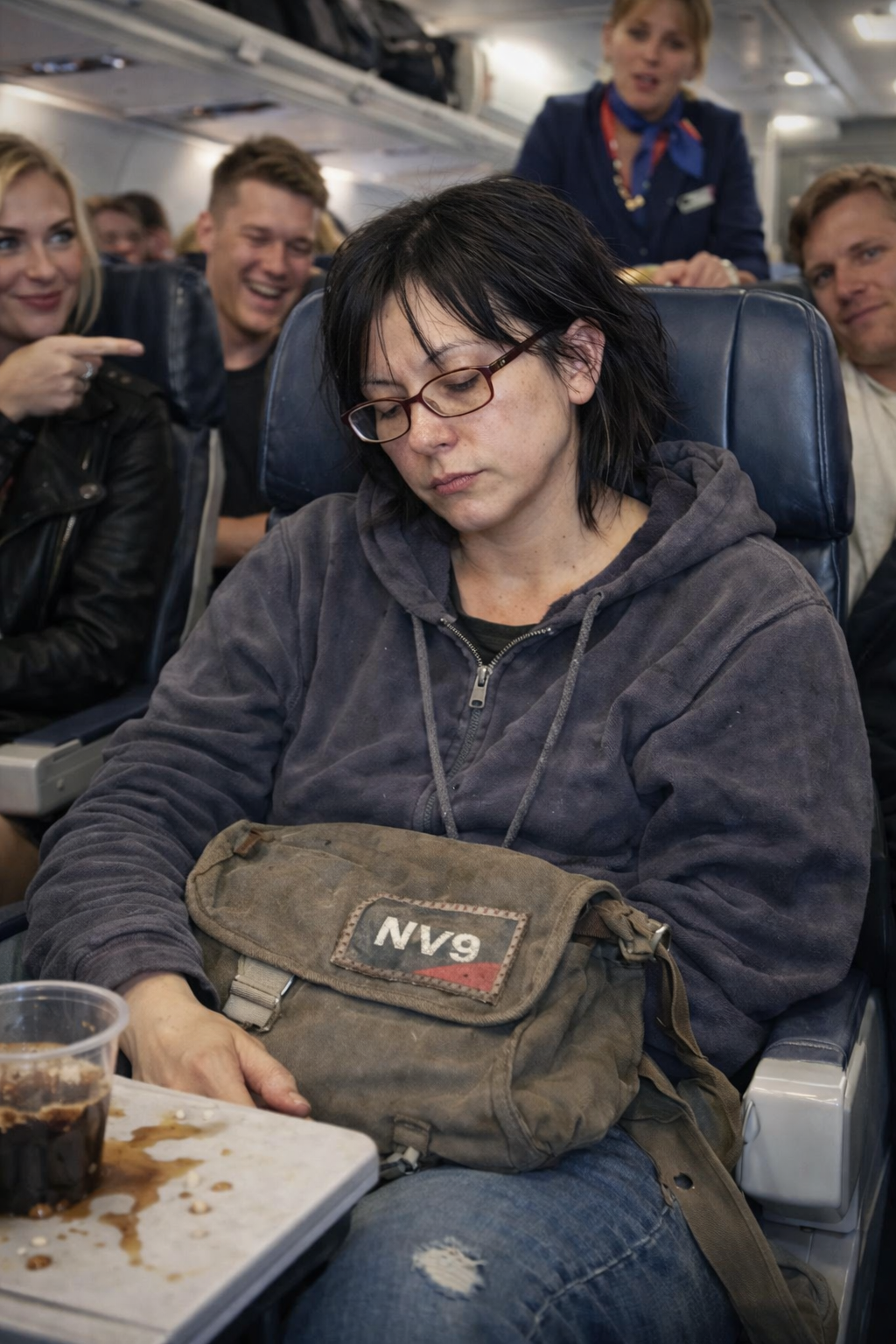
The wording was awkward.
The intent was sincere.
Captain Ellis was invited.
So was co-pilot Ben Ruiz.
Rachel received an invitation too—sent to an old email address pulled from outdated licensing records.
No one expected a reply.
None came.
Still, on the day of the ceremony, one chair remained on stage.
Unlabeled.
Empty.
The moderator acknowledged that the honoree had declined public recognition.
Then Captain Ellis stepped forward.
He glanced at the cameras.
At the audience.
At the empty chair.
Then quietly folded the prepared speech in his hand and set it aside.
“I saw a lot of fear that day,” he said. “Some of it was honest. Some of it disguised itself as authority. And in the middle of all of it stood a woman who never raised her voice, never asked for recognition, and never made the situation about her pride. She saw the problem, named it plainly, and kept working while others debated whether she looked qualified enough to matter.”

He paused.
The room was completely silent.
“If she ever hears this,” he added, turning slightly toward the empty chair, “I want her to know something. Some of us believed her the moment we understood what we were seeing. We just wish we had understood sooner.”
That line led the evening news across multiple states.
Rachel didn’t watch any of it.
In a small garage outside Pendleton, Oregon, she stood over the open hood of an aging pickup, her hands deep in a carburetor that had long outlived its best years.
The air smelled of oil, rubber, and stale coffee.
A radio murmured classic country in the background.
Hank, her employer—a broad man with a gray beard and a bad knee—walked in, wiping his hands on a rag.
“They’re talking about that mystery plane woman again,” he said casually.
Rachel tightened a bolt.
“Seems to happen.”
Hank leaned against the doorway, watching her.
He’d known her for three years.
Knew she worked early, fixed what others gave up on, and never spoke much about the life she’d lived before arriving with a toolbox and a quiet reference from a forgotten crop pilot.
He also knew better than to push too hard.
“You ever hear the name Night Viper Nine?” he asked lightly.
Rachel didn’t freeze.
That told him enough.
She simply wiped her hands.
“Maybe,” she said.
Hank nodded.
He didn’t ask more.
“Hell of a story,” he muttered.
“Seems that way.”
He gave her a look, then stepped back out.
Rachel stood alone.
For a moment, a faded tattoo showed beneath the grease on her wrist.
Then her sleeve slipped back into place.
For most people, that would have been the end.
A plane lands.
A mystery grows.

The world moves on.
But people rarely leave something like that alone.
Not when they feel they owe it something.
Nina was the first to find Rachel.
Not because Rachel was careless—
But because Walter was patient.
Between the notebook, old records, maintenance receipts, and small-town connections, they traced her path back to eastern Oregon.
It took two weeks.
When Nina suggested showing up unannounced, Walter shook his head.
“We don’t chase people just to satisfy curiosity,” he said.
“So what do we do?”
He thought for a moment.
“Something kinder.”
They mailed the notebook.
No questions.
No demands.
Just a simple note:
You left this behind.
Thank you—for all of it.
—Walter and Nina
Three days later, a plain envelope arrived.
Inside—
The same card.
Turned over.
In careful handwriting:
You handled it with care.
Tell the little girl to keep drawing.
—R.M.
Walter smiled like a man who had just found something rare.
Nina nearly shouted with excitement.
“She answered.”
“She did.”
“That means she doesn’t hate us.”
Walter gave her a sideways look.
“Us? I wasn’t one of the fools in row nine.”
She laughed.
Then quieted.
“Do you think she’ll ever step forward?”
Walter shook his head.
“No. And maybe the people who need her most are the ones who’ll never get to claim her.”
At first, that sounded sad.
Later, Nina realized it was something else.
Wisdom.
And so the story stayed where it belonged.
Not on a stage.
But in people.
Like a mirror.

Years later, those who had been on Flight 472 remembered her.
Not as a legend—
Though some tried to make her one.
Not as a mystery—
Though she remained one.
They remembered her as a correction.
A quiet one.
A human one.
A woman mistaken for weakness because of how she looked.
A stranger whose calm unsettled authority.
A passenger who didn’t ask to be believed—
Only to be listened to in time.
And if the story changed people—
It wasn’t because she saved a plane.
It was because she showed a cabin full of adults what they had been reading wrong all along.
Thank you for reading this story.
If it stayed with you—even a little—feel free to share your thoughts.