I was sixty-seven when I finally found the courage to do something I had postponed for years.
I traveled to another country alone.
After my husband died, my life seemed to stop moving. Every morning I made coffee, bought groceries, and took care of the house. In the evenings, I turned on the television more for the sound than for the programs, then sat by myself in the quiet. Eventually, solitude became so familiar that I hardly noticed how completely it had taken over my days.
One afternoon, my daughter Claire said:
“Mom, you don’t have to spend the rest of your life living only in the past.”
For some reason, her words struck a nerve.
“And what exactly do you suggest?” I asked. “Starting over at my age?”
She smiled.
“Why not?”
Three months later, a plane ticket was tucked inside my handbag.
The first days of the trip reminded me that the world could still surprise me. I wandered through unfamiliar streets, sat in little cafés, and listened to languages I could barely understand. More than once, I laughed at myself while trying to communicate with shopkeepers through a translation app.
Then I met Daniel.
It happened by chance outside a small coffee shop. The zipper on my handbag suddenly split open, sending several things scattering across the pavement. Daniel bent down and helped me gather everything.
“Looks like your bag has decided to travel without you,” he joked.
I laughed before I could stop myself.
That was how it began.
Daniel was a little over fifty. He spoke softly, never interrupted, and listened as though, for those few minutes, there were no people in the world more important than the person sitting across from him. Not once did he make me feel that my age was something awkward or inconvenient.
He told me that he had lost his wife several years earlier.
“After she died, I didn’t want to speak to anyone for a very long time,” he admitted.
Something inside me responded to those words immediately.
It felt as though we understood one another in a way that was both rare and strangely comforting.
Over the next few days, we walked for hours, talked about our lives, and stopped at quiet little restaurants. Daniel showed me corners of the city I would never have discovered on my own.
On our last evening together, he suddenly said:
“Tonight, I’d like to take you somewhere special.”
I laughed.
“Please don’t tell me you’ve decided to kidnap me.”
Daniel smiled.
“I promise you have nothing to fear.”
He led me to a small but unmistakably expensive restaurant.
That was where the first warning appeared.
The moment Daniel stepped inside, one of the waiters looked at him and went visibly pale.
“You again?” the man blurted out, then fell silent.
Daniel gave him a quick, almost imperceptible look.
But I noticed.
“I thought you said you’d never been here before,” I said.
“You must have misunderstood me,” he replied far too quickly.
A few minutes later, his phone rang.
“Excuse me. I have to take this. I’ll only be gone five minutes.”
He stepped outside.
Five minutes passed.
Then another five.
I was beginning to wonder whether I should leave when I heard a familiar voice coming from a courtyard at the back of the restaurant.
But Daniel sounded completely different.
I moved carefully toward the half-open door.
A woman was speaking.
“Are you absolutely certain she suspects nothing?”
I stopped breathing.
Then Daniel answered:
“She trusts me. Everything will go exactly as planned.”
My palms turned cold.
I took one more step and saw them.
Yet the woman standing opposite Daniel was not what frightened me most.
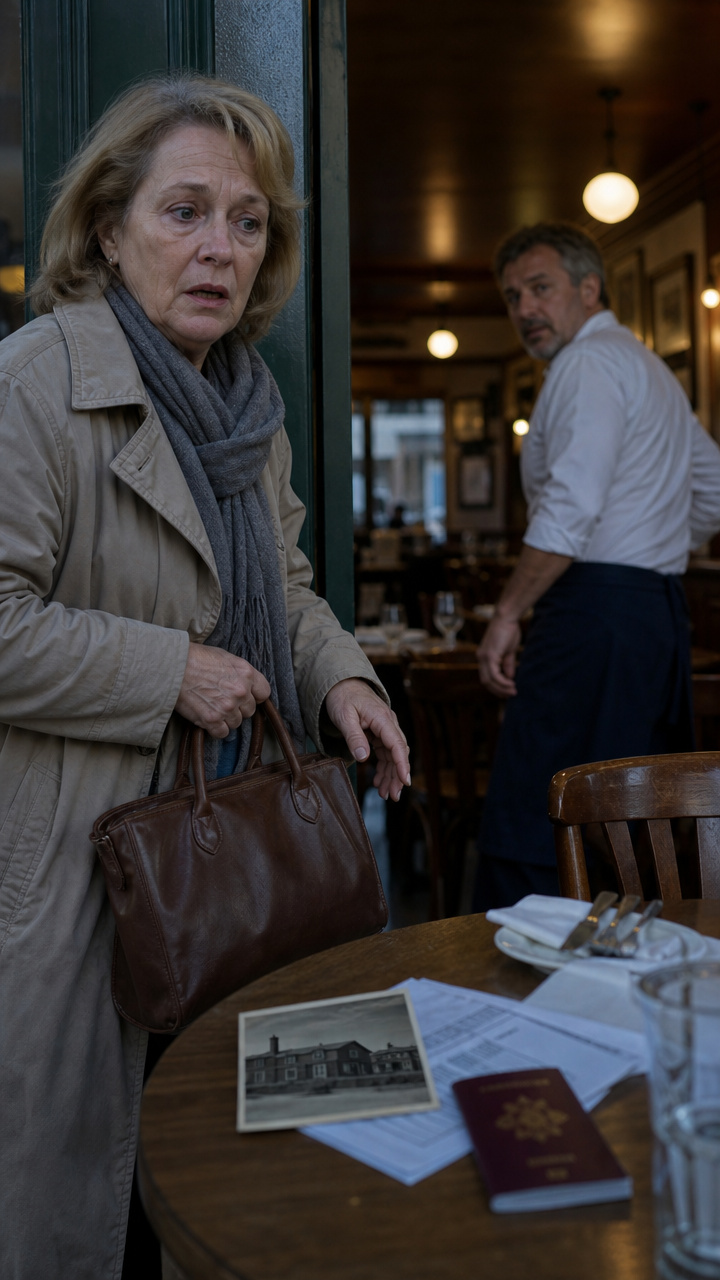
It was what lay on the table between them.
At that moment, I understood that the evening had been arranged long before I ever walked through the restaurant door.
And I needed to disappear before they realized I had heard everything.
Chapter Two: What I Was Never Meant to See
I stood frozen behind the partly open door, afraid that even breathing might give me away.
On the small table lay my passport, a photograph of my house, and a sheet of paper covered with figures.
At first, I tried to convince myself that I had made a mistake.
Perhaps the passport belonged to another woman.
Then I saw the photograph.
It was my house.
The same house I had left several days earlier when I began my trip.
“You said she had money,” the woman murmured. “But are you certain the property is actually in her name?”
Daniel was silent for a moment.
“I checked. The house belongs to her. She has a bank account too.”
The floor seemed to shift beneath me.
I pressed my back against the wall, terrified that the slightest sound would expose me.
Why had he been collecting information about my home?
Only days earlier, I had casually told Daniel that I lived alone and had kept the small house after my husband’s death. I had spoken without suspicion, never imagining that he was storing every detail away for later use.
“And what if she starts asking questions?” the woman said.
“She won’t. Tonight, it will all be finished.”