“I was told I had about a year,” she said, in a voice that was soft but carried clearly across the silent ballroom. “That was eleven years ago.” She paused. “I have four grandchildren I wouldn’t have raised. I watched one of them graduate from college last spring. A garden I planted twice. A dog named after a president who is very spoiled and absolutely worth it.” She smiled. “And I have a young woman who never once let me thank her properly, because every time I tried, she changed the subject.” She looked at me directly. “You gave me eleven years, sweetheart. I have been trying to give them back ever since.”
“You gave me eleven years, sweetheart.”
She sat down.
I don’t know exactly what the room sounded like then because I stopped being able to hear it properly. I know people were crying. I knew Russell was beside me, which he hadn’t been a moment before.
My father was watching me the way he always watches me when something big is happening.
Deborah was still standing.
She looked like a woman who had arrived somewhere she hadn’t intended to go.
My father was watching me.
She came to the repair shop four days later.
I was there helping Dad sort through paperwork, which is something I do badly, and he appreciates it anyway.
The bell above the door rang, and I looked up expecting a customer, and there she was in a cashmere coat that cost more than our monthly shop insurance, looking at the oil-stained floors and the engine parts on the shelves the way people look at places they’ve never let themselves see before.
Dad offered her coffee from the machine in the corner that makes it too strong. Deborah accepted, which surprised me.
I looked up expecting a customer.
She apologized. Not a short one. Not the kind that explains itself into forgiveness and then waits for you to provide the relief. A real one, measured and difficult, that sat with the weight of what she’d said in front of two hundred people and didn’t try to make itself smaller.
Dad accepted it the way he accepts most things.
I accepted it, too.
She apologized.
She stayed for about twenty minutes. She looked at the photographs Dad has pinned behind the register over the years, me at various ages, a few certificates, a birthday card I made him when I was seven that he framed because he said the drawing looked exactly like the car he was fixing at the time.
On her way out, Deborah turned back, and she looked at me with something I can only describe as respect.
“Why didn’t you ever tell anyone?” she asked. “About Mrs. Evelyn. Any of it.”
She looked at me with respect.
I thought about it for a moment.
Then I gave her the only answer I had.
“The good things you do don’t stop being good just because nobody sees them.”
She nodded once.
Then she got in her car and drove away.

I gave her the only answer I had.
Through the shop window, Dad watched her go with his hands in his pockets.
Then he looked over at me, and he was smiling in that way he has, the quiet kind, the kind that means he’s proud but doesn’t need to say it out loud because he knows I already know.
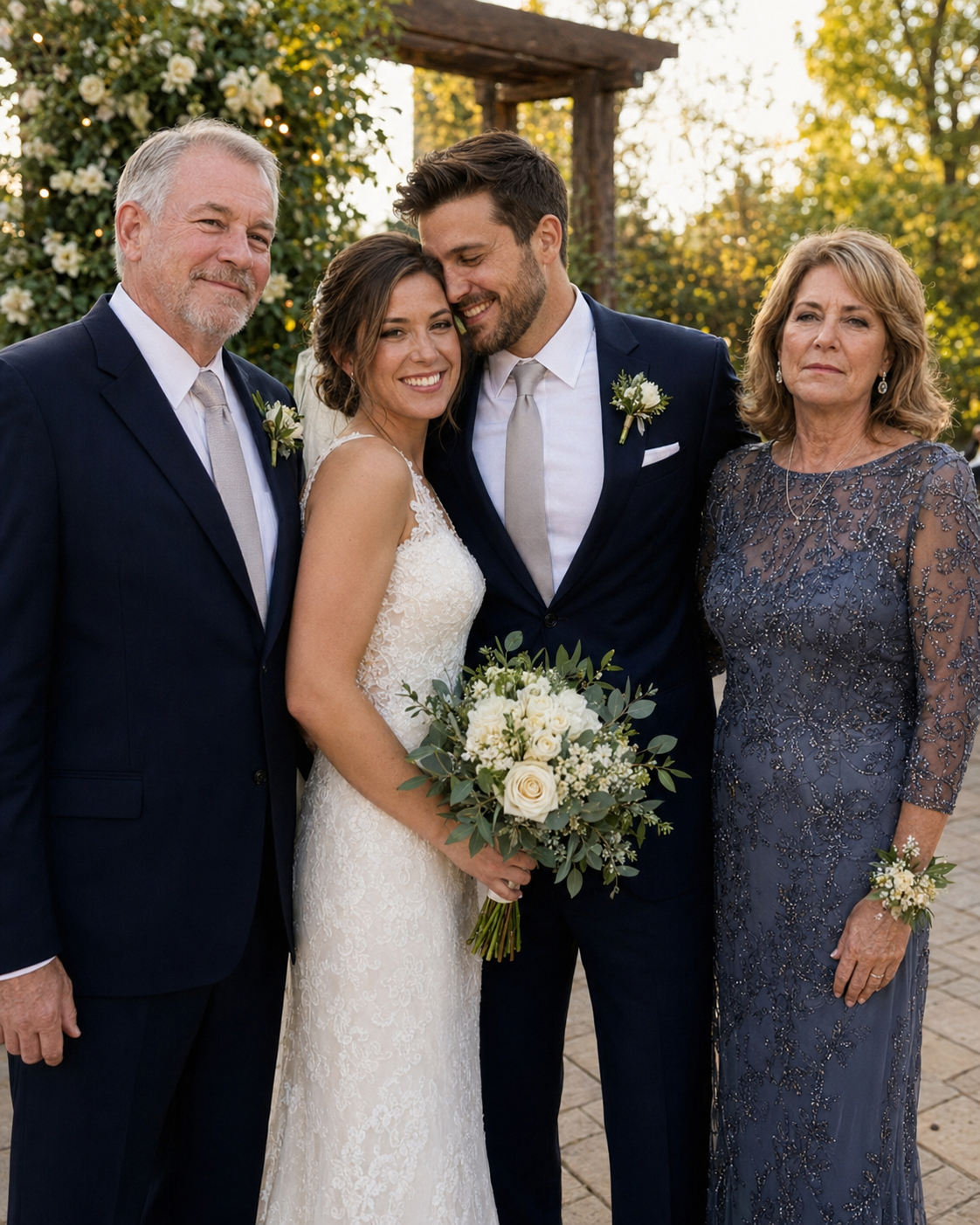
There is a photograph from the wedding that Russell’s best man took without anyone noticing. Dad at his table, just after Mrs. Evelyn sat back down, holding his leather folder, looking at me across the ballroom.
He’s proud but doesn’t need to say it out loud.
Russell framed it. It hangs in our hallway now.
That’s the thing about being raised by someone who fixes things patiently, without complaint, behind a gas station on Route 9.
You learn that the most important work is almost never the work anyone sees.
But sometimes someone is paying attention, anyway.
The most important work is almost never the work anyone sees.