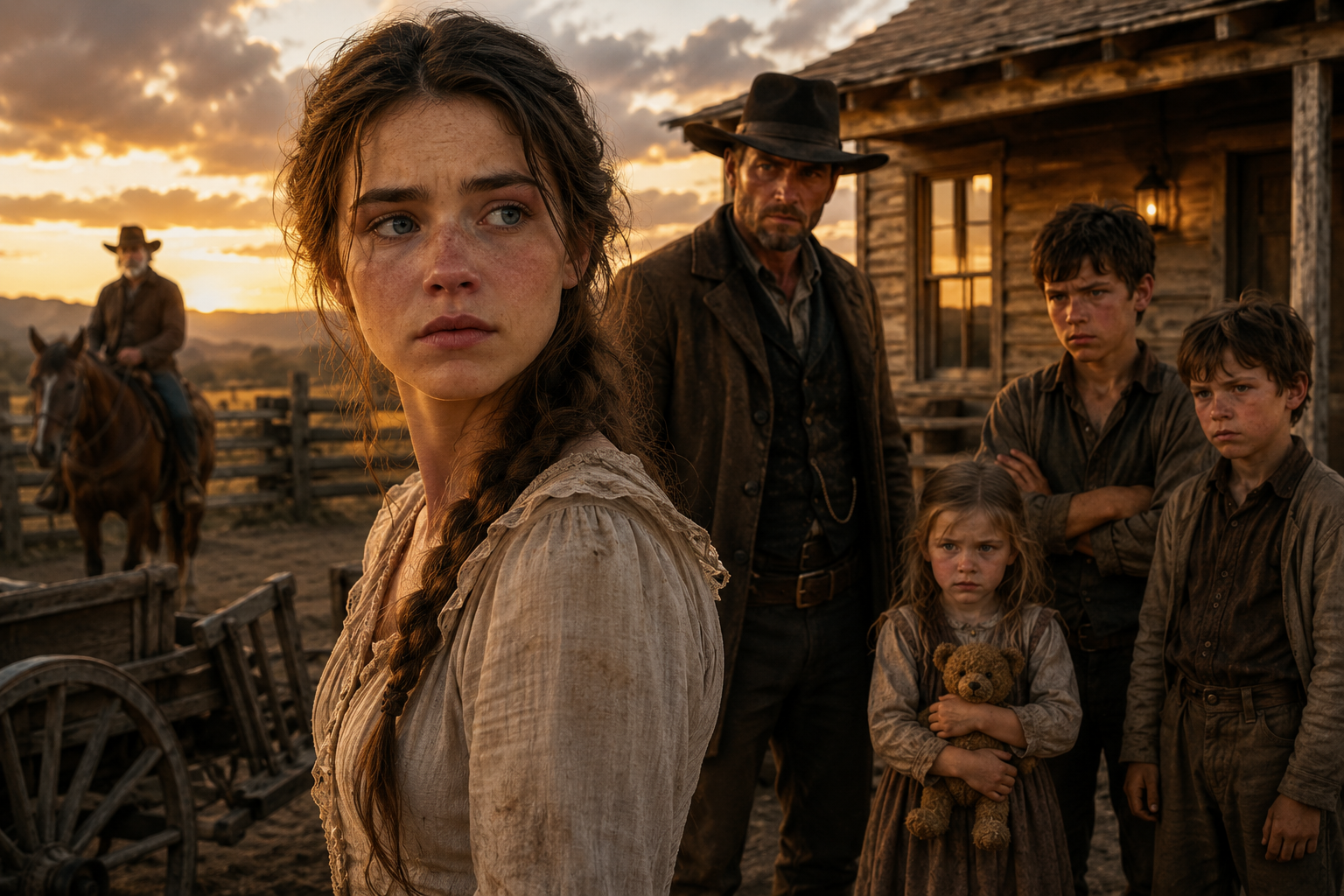
Eliza laughed once, bitterly.
Caleb looked at her then, and something raw moved through his face.
“But somewhere between your burned biscuits and Rosie’s fever and Jonah letting you near his mother’s grave, the truth changed on me. I did not touch you, did not enter your room, did not speak what I felt, because I would rather lose you than take one inch of your life that wasn’t freely given.”
The creek moved beneath thin ice.
Eliza’s throat tightened despite herself.
“You let me believe I was bought.”
His eyes closed briefly.
“That is the thing I do not know how to forgive myself for.”
“I did not need you to love me tonight,” she whispered. “I needed you not to make me feel owned.”
He nodded once, as if the words had cut exactly where they should.
“Then come back,” he said. “Not because you owe me. Not because the children need you. Come back because it is freezing, and because morning gives people better chances than midnight.”
Eliza hated that he was right.
She hated even more that when he removed his coat and held it out, he did not step close enough to put it on her himself.
He let her choose.
She took it.
And she went back.
Not because the wound had healed.
It had not.
But because some apologies begin as actions before they become words.
In April, the valley turned green.
Caleb took Eliza riding to the western ridge where the grass grew high and wind bent it in silver waves. At the top stood an old oak and, beneath it, a small stone marker.
Eliza knew before he spoke.
“Marianne’s favorite place,” he said. “She said church ceilings were too low for God.”
Eliza stood beside him, feeling suddenly like an intruder in someone else’s love.
Caleb reached into his coat and took out a small silver locket.
Eliza’s breath caught.
It was her mother’s.
She knew it by the tiny dent near the clasp, the one she used to rub with her thumb as a child.
“Where did you get that?” she whispered.
“Marianne kept it.”
“My mother knew your wife?”
“They were girls together. Friends once. Life separated them, but letters remained.”
Eliza reached for the locket with shaking fingers.
Inside was a faded curl of hair and a scrap of paper in her mother’s handwriting.
For my Eliza, when truth is safer than silence.
Eliza looked up slowly. “What truth?”
Caleb’s face went pale beneath the sun.
“There are things I should have told you the first night.”
“Then tell me now.”
He looked toward the ranch house in the distance, small beneath the huge sky.
“Tonight,” he said. “I swear it. Tonight.”
She should have demanded it there.
Later, she would think of that moment often and wonder how many sorrows are born from waiting just one more evening.
But the wind was soft. The locket was warm in her hand. Caleb’s face held fear, not deceit.
So she nodded.
By dusk, the storm came.
It rolled over the ridge black and fast, slamming rain against the windows and spooking every animal in the yard. Caleb and Jonah ran to secure the corral gate. Micah, disobeying orders, darted after a loose lantern tumbling through the mud.
Eliza was in the kitchen with Rosie when she heard Jonah shout.
Then a scream.
She ran outside without a shawl.
A mare had broken loose, wild-eyed and rearing near the lower gate. Micah had slipped in the mud directly in her path.
Jonah threw himself at his brother.
Micah rolled clear.
The mare’s hooves came down.
Jonah fell.
The next hours broke into pieces.
Caleb carrying Jonah inside.
Rosie screaming.
Micah covered in mud, repeating, “He pushed me, he pushed me, he pushed me.”
The doctor arriving near midnight with rain dripping from his hat.
“Head wounds are cruel,” he said. “We wait.”
For four days, Jonah did not wake properly.
He burned with fever. He muttered for his mother. He fought invisible hands in his sleep. Caleb sat beside the bed until his body looked carved from guilt.
Eliza kept the house moving because someone had to. She fed Rosie. Washed mud from Micah’s hair. Changed cloths on Jonah’s forehead. Forced Caleb to drink coffee and broth.
On the fourth evening, while thunder muttered beyond the hills, a wagon arrived.
Vernon Pike climbed down.
Eliza saw him from the window and felt the past reach for her throat.
He looked worse than before. Thinner. Meaner. His coat was stained and his beard untrimmed. Debt and drink had hollowed him out, but cruelty still stood straight inside him.
Caleb met him on the porch.
Even through the closed door, Eliza heard Vernon’s voice.
“I hear the boy’s dying. House falling apart. Good time to finish business.”
“There is no business,” Caleb said.
Vernon laughed. “There is if there was never a marriage filed. Preacher checked for me. No record. Means the girl isn’t your wife.”
Eliza’s blood went cold.
Vernon raised his voice, knowing she could hear.