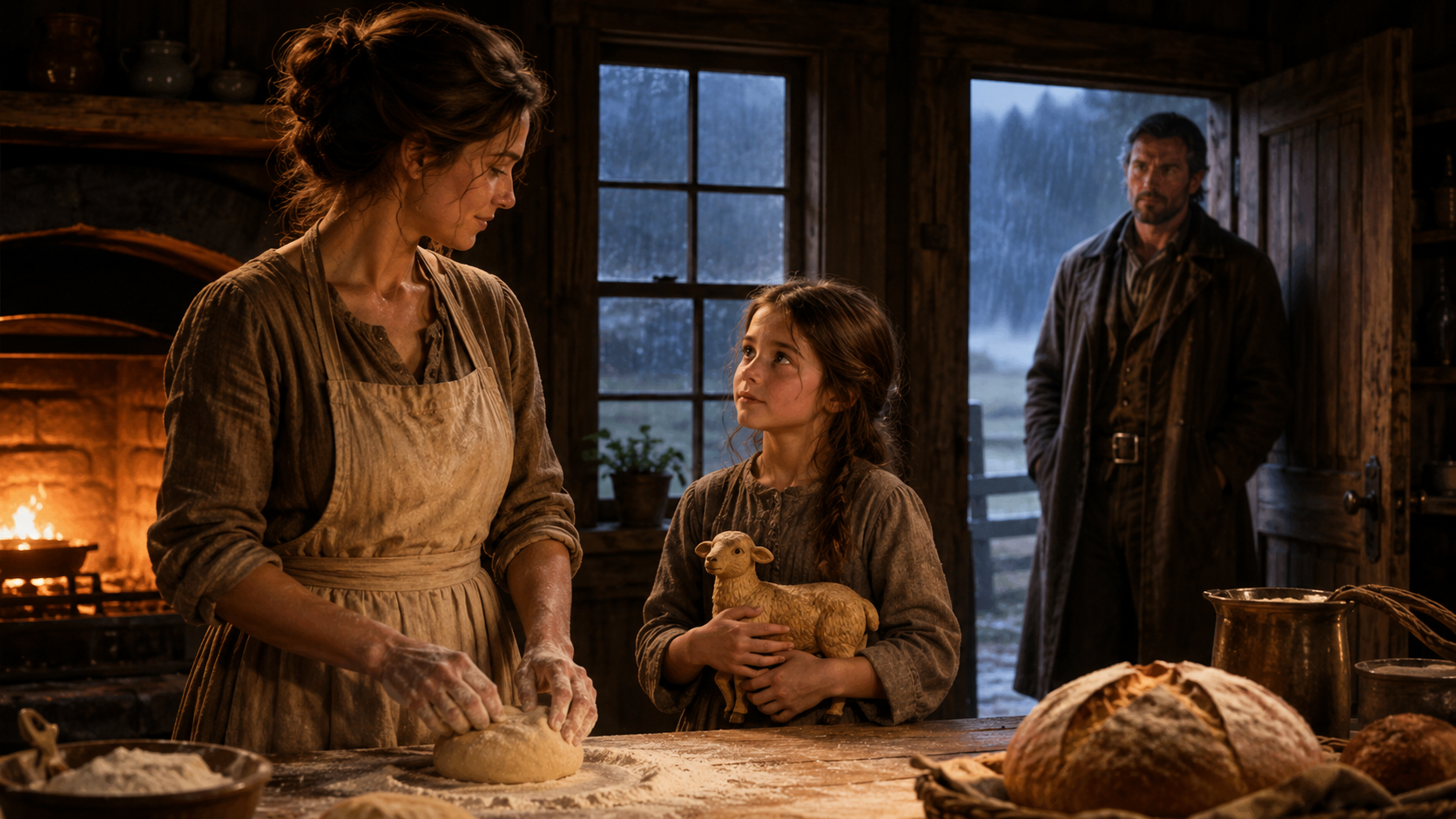
All He Asked For Was a Baker… But the Silent Girl’s First Words Exposed Every Lie in the House

When Rowan Hale placed the notice in the Ashford Gazette, he used only seven words.

Baker wanted. Room included. No questions asked.

He paid the printer in cash, pulled his hat low, and walked out before anyone could start a conversation. Rowan had built a reputation in Ashford Ridge as a man who could buy cattle, bury grief, and silence a room without raising his voice. People respected him, feared him a little, and pitied him when they thought he was not looking.

He owned a broad piece of land at the edge of the cedar hills, a house too large for one widower, and a daughter who had not spoken in nearly three years.

Her name was Elodie.

She was eight years old, thin as a candle flame, with solemn gray eyes and a habit of disappearing before adults could pity her. After her mother’s death, people said the child had lost her voice from shock. Doctors came. Preachers prayed. Teachers tried gentle questions. Neighbors brought dolls, ribbons, sugared plums, and soft-voiced promises. Elodie accepted none of them. She moved through the Hale house like a ghost who had forgotten she was alive.

Rowan stopped inviting people to help.

He dismissed two governesses, three cooks, one nurse, and a widow from the church who insisted the girl only needed “firm cheerfulness.” By autumn, the kitchen had gone cold more often than not, the pantry smelled of old flour, and Rowan was eating burned biscuits with the patience of a man punishing himself.

So he asked for a baker.

Not a miracle.

That was what he told himself the morning Marion Bell arrived with a carpetbag, a covered basket, and rainwater dripping from the brim of her hat.

She stood on the porch without shrinking from the weather or from Rowan’s stare. She was not young enough to be foolish, not old enough to be invisible, and not delicate in the way men liked women to be delicate. Her hands were broad, reddened by work, and marked with pale scars. Her dark hair was braided tightly at the back of her neck. Her coat had been mended at both cuffs, but the mending was neat, almost proud.

“You Hale?” she asked.

“I am.”

“You need bread?”

“I need a baker.”

“Then we may have business.”

Rowan looked past her shoulder. “You come alone?”

“I came with sourdough starter, two knives, and enough sense not to answer questions that are not part of employment.”

For the first time in months, Rowan almost smiled.

Almost.

“My house has rules,” he said.

“Most cages do.”

His eyes sharpened.

Marion did not apologize. She only shifted the basket on her arm and waited.

“The work begins before dawn,” Rowan said. “Breakfast at five. Supper at six. Bread every day. No drinking. No gossip. No visitors without permission. And you do not trouble my daughter.”

“I do not trouble children.”

“You do not speak to her unless she speaks first.”

“Children hear silence too, Mr. Hale.”

“I said you do not speak to her.”

Marion studied him then, not with fear, but with the careful attention of someone measuring a burn before touching the kettle. At last she nodded.

“I heard you.”

That was not the same as agreement, and Rowan knew it.

Still, he moved aside.

The house smelled like money losing a fight with sorrow. The entrance hall was polished, the parlor expensive, the staircase carved beautifully enough to belong in a bank or a judge’s house. But dust gathered in corners. Curtains hung too heavy over windows that needed light. Somewhere upstairs, a floorboard creaked and then went silent.

Marion heard it.

Rowan heard her hear it.

“My daughter keeps to herself,” he said.

“So do I.”

He led her to the kitchen.

It was a disgrace.

Marion stopped in the doorway and took in the cold stove, the stained worktable, the sacks of flour left open to damp air, the cracked bowls, the rusted peel, the neglected oven, and the mouse droppings near the potato bin.

Rowan watched her face, expecting disgust.

Instead, Marion removed her gloves.

“Well,” she said, “at least no one can accuse the place of pretending.”

“You can leave if it does not suit you.”

“I have cleaned worse.”

“Where?”

She set her basket down. “Behind me.”

That ended the questioning.

By dusk, Marion had scrubbed the table until its grain appeared like old memory. She boiled cloths, aired the pantry, burned spoiled flour, sharpened knives, and set her starter near the stove as if placing a sleeping infant beside a hearth. She made supper from beans, onions, ham bone, potatoes, and discipline. The smell moved through the house slowly, entering rooms that had forgotten food could be an invitation.

Rowan came in from the barn at six and found the table set.

He sat. He ate.

He said nothing.

Marion did not wait for praise. She washed what she used, covered the leftover bread, and began planning morning dough.

That was when she felt the stare.

A girl stood in the kitchen doorway.

Elodie Hale wore a faded green dress, one sleeve slightly shorter than the other, and boots that had been polished by someone who loved routine more than comfort. In her hand she held a small wooden lamb, rubbed smooth at the edges. Her eyes were fixed on the jar near the stove.

Marion remembered Rowan’s rule.

She also remembered what it felt like to stand in a room while adults made you into a wound instead of a person.

So she did not move toward the child. She did not smile too brightly. She did not ask a question.

She simply uncovered the jar.

“This,” Marion said softly to the stove, “is Beatrice. She is older than any sensible jar of flour ought to be. She smells sour, looks dreadful, and still manages to make bread rise. There is dignity in that.”

Elodie did not blink.

Marion fed the starter flour and water, stirring slowly.

“Some things only wake when they are fed gently,” she continued. “Too much heat kills them. Too much cold makes them sleep. But patience…” She tapped the spoon on the rim. “Patience can bring back what looks gone.”

A shadow fell across the doorway.

“Elodie,” Rowan said.

The girl vanished.

Rowan’s face was hard. “I gave you one rule.”

Marion covered the jar. “I did not ask her for anything.”

“You spoke.”

“To my starter.”

“Do not be clever with me.”

“I am not clever with men who confuse control with protection.”

The room changed.

Rowan stepped closer, but Marion did not step back. His gaze dropped then to the bruise half-hidden beneath the high collar of her dress. It was yellowing at the edge, old enough to be leaving, recent enough to have mattered.

“Who hurt you?” he asked.

“A man who believed a wedding ring was a deed of ownership.”

His jaw tightened.

“Is he looking for you?”

“Likely.”

“What is your name?”

“The one I gave you.”

“That was not my question.”

“No,” Marion said. “It was not.”

For a long moment, only the stove ticked between them.

Rowan looked toward the stairs where Elodie had disappeared.

“I hired a baker,” he said at last.

“You got one.”

“I did not ask for trouble.”

“Trouble rarely waits to be invited.”

He gave a humorless breath. “Breakfast at five.”

“Then you should sleep.”

His mouth moved as if another answer wanted to come out. It did not. He left.

Marion rose at three-thirty.

She had learned to wake before danger. Long before Ashford Ridge, long before the Hale kitchen, long before she bought a train ticket under a name her husband did not know, Marion had lived by the moods of Victor Bellamy. Victor liked coffee hot, shirts pressed, silence immediate, and fear visible. He had trained a whole household to listen for the difference between his footsteps and his temper.

Even after she escaped him, her body still obeyed his clocks.

So she worked in the dark.

Dough was different from men. Dough told the truth. If it was too dry, it cracked. If it was too wet, it clung. If neglected, it failed without malice. It did not punish a woman for being tired. It did not call patience weakness. It did not ask why her arms were strong or why her waist did not fit a fashionable dress. Bread required warmth, time, and hands willing to begin again.

Marion had hands.

At five, Rowan entered to find coffee, fried eggs, crisp potatoes, biscuits, and two brown loaves cooling under linen.

He stopped.

Marion glanced up. “Something wrong?”

“No.”

He sat.

He ate as if every bite offended his pride by being good.

When he finished, he carried his plate to the basin.

At the door, he paused.

“Bread holds together,” he said.

Then he left.

Marion looked at the empty doorway.

“For that man,” she murmured to Beatrice, “that was poetry.”

Three nights later, she left a small plate on the kitchen table after supper: stew, buttered bread, and half a pear baked with cinnamon. Then she turned her back and polished the stove.

The chair scraped.

A spoon touched porcelain.

Marion kept polishing.

The child ate in silence, and Marion guarded that silence like a flame in wind.

When she finally turned, Elodie was gone.

The plate was empty.

Marion stood with the rag in her hand and felt something shift inside her chest. Victor had once told her that women like her needed to be useful because they could not be admired. She had carried that sentence for years, heavy and hidden.

Now a silent child had eaten her bread, and the sentence lost a little weight.

The first word came on a Sunday morning.

Marion had found a tin of cardamom pushed behind jars of beans. It still held its fragrance, green and sharp, like faraway kitchens and clean winter air. She made sweet buns before dawn, rolling the dough thin, brushing it with butter, sprinkling brown sugar and spice, then twisting each piece into a knot.

Elodie appeared at the doorway just as the first tray came from the oven.

Marion set one bun on a plate and placed it at the table.

“They are best warm,” she said, facing the counter, “but warmth should never be forced on anyone. A person may wait until the steam stops frightening them.”

Elodie sat.

She broke the bun with both hands. The first bite made her eyes close for one heartbeat.

Then she whispered, “Mama made knots.”

Marion’s whole body went still.

She did not turn quickly. She did not gasp. She did not rush across the room and turn the child’s courage into a spectacle.

She only said, very gently, “Then she had good hands.”

Elodie stared at the bun.

“She sang when she baked.”

“What did she sing?”

The girl’s lips trembled.

“I forgot.”

Marion’s throat tightened. “Forgetting is not betrayal.”

Elodie looked up.

“It feels like it.”

“I know.”

The child studied her as if those two words mattered more than comfort.

Then she slid from the chair and left.

Marion waited until the footsteps faded. Only then did she grip the table with both hands and bow her head.

She did not tell Rowan.

Some first words are not announcements. They are doors opened from the inside.

After that, Elodie returned.

Not every day. Not predictably. She came like a wild bird, always ready to fly. Marion never trapped her with questions. She explained flour, yeast, heat, knives, salt, honey, and patience. She let the kitchen become a place where words could appear without being hunted.

“This is how dough feels when it has rested enough,” Marion said one evening, pressing the child’s palm gently against a smooth round. “It pushes back, but not angrily.”

Elodie touched it with wonder.

“Alive,” she whispered.

“Yes.”

“Like Beatrice?”

“Exactly like Beatrice.”

“Like me?”

Marion swallowed.

“Yes,” she said. “Very much like you.”

The next week, Rowan came in from the cold and found his daughter standing on a stool, flour on her cheek, shaping rolls beside Marion.

He stopped so suddenly the door remained open behind him.

Elodie’s fingers froze.

Marion did not look up sharply. She did not give Rowan the power to frighten the moment.

“Fold the edge under,” she said calmly. “Same as before.”

Elodie obeyed.

Rowan closed the door.

He removed his hat.

For a long time, he said nothing.

Then he sat at the table as if his knees had forgotten their duties.

At supper, Elodie carried her own plate in and sat across from him for the first time in three years. Rowan stared down at his soup like a man afraid direct looking might shatter glass.

“Bread holds together,” he said.

Elodie looked at him.

“You always say that,” she whispered.

The spoon slipped from Rowan’s hand and struck the bowl.

Marion turned toward the stove and busied herself with nothing, because some kinds of mercy require privacy.

Trouble arrived two days before the first snow.

Marion had gone into Ashford Ridge with Gideon Pike, Rowan’s old foreman, to deliver bread to the mercantile. By then half the town had learned that the Hale kitchen produced loaves worth lining up for. Women who once looked past Marion now greeted her by name. Men who had laughed at the idea of paying for bread now bought two loaves and claimed one was for a neighbor.

She was counting coins when a voice behind her said, “Well now. If it isn’t Mrs. Bellamy.”

No one in Ashford Ridge knew that name.

Marion turned.

A man in a velvet-collared coat stood near the barrel of dried apples, smiling with all his teeth and no warmth. Lennox Gray. Victor’s card companion. A man who always smelled faintly of tobacco and other people’s secrets.

“My name is Marion Vale,” she said.

“Not according to your husband.”

The store grew quiet.

Lennox stepped closer. “Victor is worried sick. Says you are confused. Says you stole from him. Says there is a reward for bringing you home before you harm yourself.”

“How generous is his concern?”

“Six hundred dollars.”

Marion’s hands went cold.

Gideon shifted beside her, but Marion touched his sleeve.

Wait.

“I will give you nine hundred,” she said.

Lennox laughed. “You don’t have nine hundred.”

“Not today.”

“Then why would I wait?”

“Because Victor does not reward men who make him look slow,” Marion said. “If you found me and delayed telling him, he will wonder what else you delayed. Victor dislikes wondering.”

The smile weakened.

She had guessed correctly. Men like Victor kept other men on leashes and called it friendship.

“Thirty days,” Lennox said.

“Forty.”

“Thirty-five.”

“Done.”

“If you run?”

“If you speak before then, I write Victor that you tried to sell me twice.”

Lennox’s face hardened.

Marion stepped closer. “And Lennox? I have lived with a cruel man. Do not mistake me for a frightened one simply because I know how fear works.”

On the ride home, she told Gideon enough.

Not everything.

Not the locked bedroom. Not the signed papers. Not the servants paid to hear nothing. Not the doctor who had called bruises “nerves.” But enough.

Gideon listened with his jaw clenched.

“You need nine hundred dollars in thirty-five days,” he said.

“Yes.”

“You earn wages, not miracles.”

“I bake bread.”

“That is not a bank.”

“No,” Marion said. “But hunger pays faster than sympathy.”

That night, after Elodie slept, Marion asked Rowan to let her use the kitchen for commercial baking. She offered him half the profits.

“No,” he said.

She had expected it.

It still struck like a door slammed in the face.

“You have not heard the arrangement.”

“I heard trouble breathing.”

“I can bake before breakfast. Gideon can deliver. Your house will not suffer.”

“My house already suffered enough before you came.”

The words silenced them both.

Rowan stood in the small office off the hall, ledger open, lamplight making shadows under his eyes.

“What kind of debt does a woman owe to a man she ran from?” he asked.

“The kind written with her name by someone else’s hand.”

His face changed.

“That is not debt.”

“No,” Marion said. “It is a cage made of paper.”

Rowan looked down at his ledger, then back at her.

“If he comes here?”

“I am trying to prevent that.”

“That is not an answer.”

“It is the only honest one I own.”

The wind pushed against the window.

At last Rowan said, “Half the profits. Your work here comes first. If that man threatens my daughter, I stop being polite.”

Marion believed him.

That frightened her more than the refusal would have.

For the next month, she worked like a woman racing winter.

She rose at three. She baked household bread first, then rye loaves for the mercantile, sweet buns for the hotel, biscuits for the lumber crews, and hand pies for miners headed north. Her knuckles split. Her shoulders ached. Flour lived in her hair and in the seams of her dresses. Elodie worried over every cut with grave authority.

“You are bleeding again.”

“It is only a little.”

“Blood is not seasoning.”

Gideon laughed so hard he had to leave the room.

Even Rowan began watching her too closely. One morning before dawn, he entered the kitchen, took a bowl from her hands, and set it down.

“Sit.”

“I am busy.”

“You are swaying.”

“I am thinking.”

“You are about to think yourself onto the floor.”

She tried to glare, but exhaustion blurred the effort.

“I am short,” she admitted. “Two hundred and ten dollars.”

Rowan left the kitchen.

When he returned, he carried a tin cash box.

“No,” Marion said.

“Yes.”

“Rowan—”

“It is an advance.”

“I do not take charity.”

“Good. I am not offering charity. I am investing in bread.”

He counted the money onto the table.

Then he said, quietly, “My daughter asked me this morning whether we could open her mother’s music room.”

Marion looked up.

“She has not said the word mother to me in three years,” Rowan continued. “You came into a dead kitchen and made it breathe. You made my child feel safe enough to remember aloud. Take the money.”

So she did.

She paid Lennox Gray two days before his deadline in the back room of the mercantile while Mrs. Voss pretended to sort buttons with the attention of a judge.

Lennox pocketed the bills.

“Victor always preferred elegant women,” he said, looking Marion over. “Never understood why he married you.”

The old shame rose.

Then, unexpectedly, it burned itself out.

“No,” Marion said. “He preferred obedient women. He mistook my kindness for obedience. Men do that when they are not as clever as they think.”

Lennox’s smile vanished.

“If Victor hears from you,” she continued, “I will make certain every newspaper between here and the capital learns that you accepted money to hide a battered wife from the husband who forged her name. Imagine your mother reading that.”

Lennox left without another word.

For the first time in years, Marion walked through Ashford Ridge without trying to make herself smaller.

Winter settled in silver and blue. The bread business grew. Elodie laughed sometimes—briefly, fiercely, as if laughter had escaped before she could stop it. Gideon began eating in the kitchen “for quality inspection.” Rowan lingered near the flour bins and asked Marion’s opinion on grain, oven stone, hired hands, fence repairs, and whether the old smokehouse could become a bakehouse.

He did not court like a man in poems.

He courted by listening.

Then Alden Crowe arrived.

He came in a black carriage with brass lamps, wearing city boots too polished for country mud. Alden Crowe owned mines, railroad shares, two banks, and enough lawyers to make truth feel negotiable. He looked at land the way wolves look at lambs.

Marion watched from the kitchen window as he spoke to Rowan near the barn. Crowe pointed toward the creek, then toward the hills, then toward the house.

Rowan went still.

Twenty minutes later, he entered the kitchen and sat down.

“He wants the land,” he said.

Marion poured coffee. “What did he offer?”

“Twenty thousand.”

“That is not an offer. That is bait.”

“He says the new rail spur will cross the valley. If I sell now, I profit. If I refuse, the county may take what it needs.”

“May?”

“That was only the first knife.” Rowan rubbed both hands over his face. “He claims there is a defect in the water rights. Says the creek was never properly transferred to my grandfather. Without water, I cannot run cattle.”

Marion sat across from him.

“Do you have the original deed?”

“Somewhere. My father kept papers like a storm keeps leaves.”

“My father was a clerk,” Marion said. “I know records. If the water rights are in the original grant, Crowe is bluffing.”

Rowan stared.

“You never told me that.”

“You never asked who I was before I became useful.”

The words were not cruel.

That made them harder to deny.

They searched until midnight. Gideon opened trunks. Marion sorted brittle papers by lamplight. Rowan found tax receipts, cattle records, letters from his wife, and a photograph of her at a piano with baby Elodie on her lap.

“She used to sing in the mornings,” Rowan said.

Marion held the photograph carefully.

“She looks happy.”

“She was kind,” he said. “Not soft. Kind.”

“She would have loved Elodie’s laugh.”

Rowan looked away.

At last, Gideon found the deed inside a cracked leather folder beneath winter blankets.

The document granted the Hale family the land and “all waters, springs, streams, banks, and natural courses attached thereto, in perpetuity.”

Marion read it twice.

“Ironclad.”

The next morning, Rowan filed a copy at the county office.

Crowe was waiting there.

Of course he was.

By noon, Crowe requested a meeting at the Windsor Hotel.

“That is a trap,” Gideon said.

Marion tied her bonnet. “Then we bring teeth.”

At the hotel, Crowe sat behind white linen and silver spoons, smiling as if the room belonged to him because he had chosen to breathe in it. He produced a promissory note from twenty years earlier. Rowan’s father, he claimed, had borrowed four thousand dollars against the ranch. With interest, the debt now exceeded sixty thousand.

Rowan went pale.

Marion picked up the note.

The paper was wrong.

Too smooth. Too clean at the fold. The ink too fresh where age should have softened it. The signature imitated hesitation, not age.

“It is forged,” she said.

Crowe’s eyes narrowed. “Careful, Mrs. Bellamy.”

“Miss Vale,” Rowan said.

Marion did not look away. “Old paper tells the truth if you know how to listen.”

“An amusing statement from a baker.”

“I understand yeast,” Marion said. “Small things split large structures when they are given time.”

Crowe stood.

“You have until the first of December. Sell, and the debt disappears. Refuse, and the bank proceeds.”

That night, Marion made a plan.

Not a noble plan.

A necessary one.

Ashford Bank kept old ledgers in a rear records room. Gideon knew the night clerk, whose sister needed medicine from the city. For one hundred dollars and a promise of silence, the clerk left the back window unlatched for thirty minutes.

Rowan hated every piece of it.

“This is illegal.”

“Yes.”

“We could be jailed.”

“Yes.”

“You answer too calmly.”

“I am not calm.”

“You look calm.”

“I was married to a man who fed on fear. I learned not to serve it warm.”

They entered the bank after dark. Marion carried a small camera borrowed from Mrs. Voss. Rowan carried a shaded lantern. Gideon watched the alley.

The record room smelled of dust, oil, and old lies.

Marion found the year within minutes. Loan books, receipts, mortgage files, discharged notes. She searched for Hale.

Nothing active.

Then Rowan opened a folder marked Settled Rural Accounts.

Inside lay the original note.

Same amount. Same date. Same borrower.

Across the front, faded with age, was stamped Paid in Full.

Marion photographed it. She photographed the ledger entry, the discharge mark, the file label, and the empty place where an active claim should have been.

“We have him,” Rowan whispered.

A key turned in the front door.

The lantern went dark.

Footsteps entered the office.

Alden Crowe’s voice floated through the bank, smooth as oiled wood.

“I know you are here. Dust is honest. People rarely are.”

Marion felt Rowan tense beside her.

Crowe cocked a pistol.

“I will count to three.”

Marion stepped out before two.

Crowe smiled. “The baker.”

Rowan and Gideon followed.

Crowe placed a deed on the desk. “Sign the ranch over tonight. I forget you broke into a bank.”

Rowan looked at the paper. Marion saw the calculation in his eyes: land against prison, pride against Elodie’s safety.

He was about to surrender.

“No,” Marion said.

Crowe turned. “No?”

“You call the sheriff. We explain why we came. Then you explain why your forged note contradicts the original record.”

“No one believes thieves over me.”

“Perhaps not.” Marion lifted the camera. “But newspapers believe photographs.”

For the first time, Crowe stopped smiling.

The back door opened.

Mrs. Voss entered with the sheriff, the night clerk, and two ranch hands.

Gideon lowered his rifle toward the floor but did not put it away.

“Move your hand from the pistol,” he said. “I am friendly most days. This is not one of them.”

By dawn, Crowe’s claim was dead.

By noon, his lawyer called the matter a clerical misunderstanding.

By supper, Elodie sat at the kitchen table with flour on her nose and said, “We beat the wolf.”

Rowan looked at his daughter.

“Yes,” he said. “We did.”

Then the final ghost came.

Victor Bellamy arrived at sunset in a hired carriage, wearing a dark suit, a silk cravat, and the expression of a man who believed the world was a room he had already paid for.

“Marion,” he said from the yard.

She stood on the porch. Rowan was beside her. Gideon leaned against the rail. Elodie stood half-hidden behind the door.

“My name,” Marion said, “is Marion Vale.”

Victor smiled. “Your name is whatever I allow it to be.”

Rowan took one step forward.

Marion touched his arm.

“No,” she said. “This one is mine.”

She walked down the steps.

For years, she had feared being fully seen—her body, her scars, her anger, her hunger for a life not measured by a man’s approval. Now she let Victor see all of it.

“You came alone,” she said. “No marshal. No doctor. No lawyer. Just a paper you hoped would frighten me.”

His jaw tightened.

“I have a court order declaring you unstable.”

“I have a town that has watched me work, a doctor who recorded my injuries, ledgers proving my business, and photographs exposing one powerful man’s forged paper.” Marion stepped closer. “Newspapers enjoy patterns, Victor. Shall we give them yours?”

“You would shame yourself publicly?”

“I lived with you,” she said. “Shame did its worst and failed.”

Victor looked past her toward the porch.

“What a touching little household you have borrowed.”

Elodie stepped out.

Her voice was small.

It still carried.

“She did not borrow us,” the child said. “We chose her.”

Marion turned.

Rowan’s face changed quietly, like ice breaking under spring light.

Victor stared at Elodie as if children had no right to speak in matters owned by men.

Marion faced him again.

“You will go back,” she said. “You will withdraw the order. You will leave me my name, my work, and my life. Or I will become the most expensive truth you ever tried to bury.”

For the first time, Victor truly looked at her.

And Marion saw the moment he understood.

Not that she hated him. Hatred would have flattered him.

Not that another man stood beside her. That he might have fought.

He understood that she no longer needed him to tell her she existed.

That was the part he could not defeat.

He folded the paper and returned to his carriage.

“You were never what I wanted,” he said.

“No,” Marion replied. “I was always what I was. You wanted me smaller.”

Victor left before dark.

No one followed.

The wedding took place in spring beside the reopened music room, where Elodie had placed jars of wildflowers on the piano. Marion wore no veil. She had spent enough of her life covered. Rowan stood beside her with trembling hands and honest eyes. Gideon cried openly and blamed dust. Mrs. Voss brought pies. Half of Ashford Ridge came, including people who had once whispered about Marion’s size, her past, and her bruises.

Marion served them bread anyway.

When the preacher asked if anyone objected, Elodie turned and stared at the crowd with such fierce authority that even the wind seemed to quiet itself.

No one objected.

By the next autumn, Hale & Vale Bakery stood beside the house, built from cedar, stone, and stubbornness. Marion hired two widows, a farmer’s daughter, and a quiet boy who could braid dough faster than anyone in the county. Rowan repaired the fences and stopped eating grief for breakfast. Gideon became foreman in title as well as habit. Elodie appointed herself chief taster and told grown men when their opinions lacked salt.

On the first anniversary of Marion’s arrival, she woke before dawn and found Elodie already in the kitchen, feeding Beatrice.

“One part starter,” Elodie said. “One part flour. One part water. Not too hot. Not too cold.”

Marion looked at the bubbling jar.

Then at the child who had once been silent and now filled the kitchen with certainty.

“You did it right.”

Elodie smiled.

“She is still alive.”

Outside, pale gold spread over the hills. Rowan would come in soon smelling of cedar and cold air. Gideon would complain he was starving. The bakery women would arrive laughing. Bread would rise because someone had tended it. A family would gather because someone had refused to disappear.

Marion set both hands on the table.

Strong hands.

Scarred hands.

Hands that had scrubbed, kneaded, fought, held, and built.

“Yes,” she said. “Still alive.”

And then she began again.

All He Asked For Was a Baker… But the Silent Girl’s First Words Exposed Every Lie in the House
My ex-husband’s new wife unexpectedly got in touch — her message shocked me.