The way Hannah’s face changed when she understood before the doctor finished speaking still haunts me.
Grief didn’t look like screaming. It looked like my wife was turning into a shadow.
She stopped laughing. She moved through the house like she didn’t belong in it anymore.
And I tried everything. Therapy. Date nights. Holding her hand.
But every night I’d sit in our driveway, staring at our porch light, bracing myself for another evening of silence.
That’s what drove me to that church.
She moved through the house like she didn’t belong in it anymore.
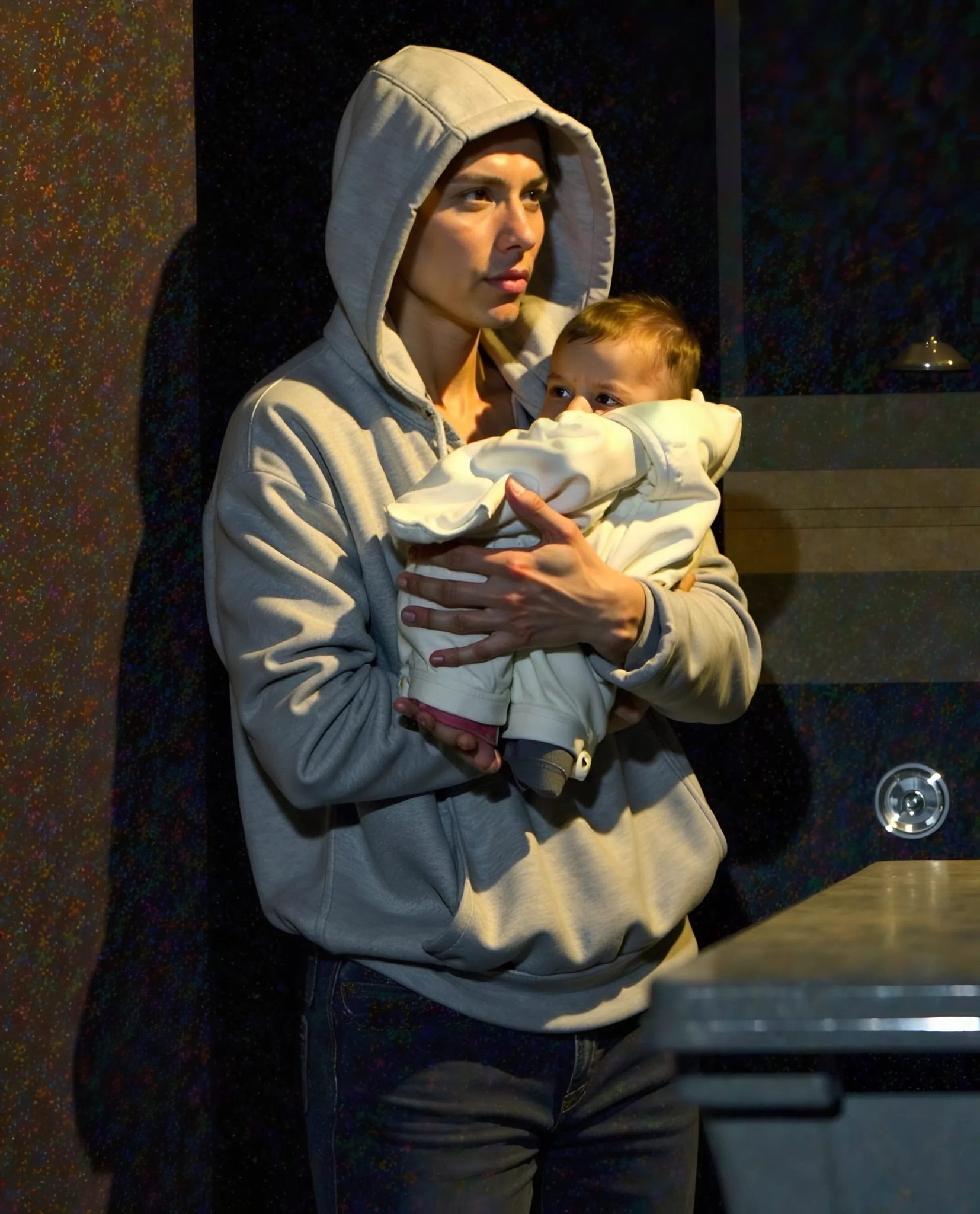
When we got to the house, Kara froze on the porch like she might run. Milo started fussing again, his tiny cries cutting through the cold night air.
I opened the door, and there was Hannah.
She looked at Kara. Then she looked at the baby.
And something flickered across her face — pain, recognition, something raw and exposed. Like her grief stood up and said, “Oh, so the universe wants to torture me now?”
My stomach dropped.
“Oh, so the universe wants to torture me now?”
I rushed through the explanation, stumbling over words. “I found her behind the dumpster near the laundromat. She has nowhere to go. It’s freezing. Just for tonight. I didn’t…”
Hannah didn’t yell, cry, or speak.
She just stared at Milo as if he might vanish if she blinked.
Kara whispered, “I can leave.”
And then my quiet, broken wife stepped aside and said, barely audible, “Come in.”
Hannah didn’t yell, cry, or speak.
That night was tense.
Kara sat on the couch like she was waiting for a trapdoor to open beneath her. I tried to make tea, but nobody drank it. Milo cried off and on, and Hannah stayed in the hallway like she didn’t trust herself to get close.
Then, without saying a word, she went into the kitchen and started moving. Warming water. Finding towels. Setting up a blanket nest near the couch.
Then she grabbed her coat and keys.
That night was tense.
I followed her to the porch. “Where are you going?”
She didn’t look at me. Just said, flat and shaking, “Formula. Diapers. Something warm for him.”
She came back an hour later with bags of baby supplies, like she’d been preparing for this her whole life.
She came back an hour later with bags of baby supplies, like she’d been preparing for this her whole life.
And in the middle of the night, I woke up and found Hannah sitting on the couch, Kara asleep beside her, Milo against Hannah’s chest. His tiny breaths rose and fell like a miracle my wife didn’t believe she deserved.
I stood there in the dark and cried so quietly I tasted salt.
The next morning, I woke up to laughter. Baby laughter.
And Hannah was the one making it happen.
The next morning, I woke up to laughter.
For the first time in months, my wife smiled like she remembered how. She insisted Kara and Milo stay a little longer, just until we could figure things out.
I wish I could say everything was magically perfect after that. It wasn’t.
Healing doesn’t work like that. Some nights Hannah still cried. Some mornings she’d look at Milo, her eyes distant, like she was holding two babies at once.
Some nights Hannah still cried.
Kara was sweet but damaged. She’d apologize for everything and flinch if I closed a cabinet too hard.
But our house started feeling alive again.
And then the storm came.
A few weeks later, there was a knock that didn’t sound normal. Like someone thought the door owed them something.
I opened it and there was a man with hard eyes and a tight jaw.
A few weeks later, there was a knock that didn’t sound normal.
“So this is where you’ve been hiding,” he said, loud enough for Kara to hear.
Kara went rigid behind me.
I stepped outside. “Who are you?”
The man sneered. “I’m Kara’s father. She’s a minor. And she’s coming home.”
“So this is where you’ve been hiding.”
Then he uttered the words that made my blood run cold.
“This girl is hiding something terrible from you.”
He held up his phone. I blinked at the photo. Kara stood between two adults, clean and polished, in what looked like a mansion. She looked nothing like the girl I found behind a dumpster.
“She can come back. But the baby doesn’t,” he added.
No screaming. No threats. Just a casual sentence that told me everything.
She looked nothing like the girl I found behind a dumpster.
The man said Kara “threw her life away” for an older boy. Called her selfish. As though being a scared kid who fell in love was a crime. He’d seen her with us at the store earlier that day, picking out baby supplies, and followed us home.
I could hear Kara crying through the door.
Then Hannah came to stand behind me.
“You kicked your child out. You’re not here to protect her. You’re here to punish her,” she snapped.
I could hear Kara crying through the door.
Kara’s father tried to push past me.
“If you try to come in, I’m calling the police,” Hannah exploded.