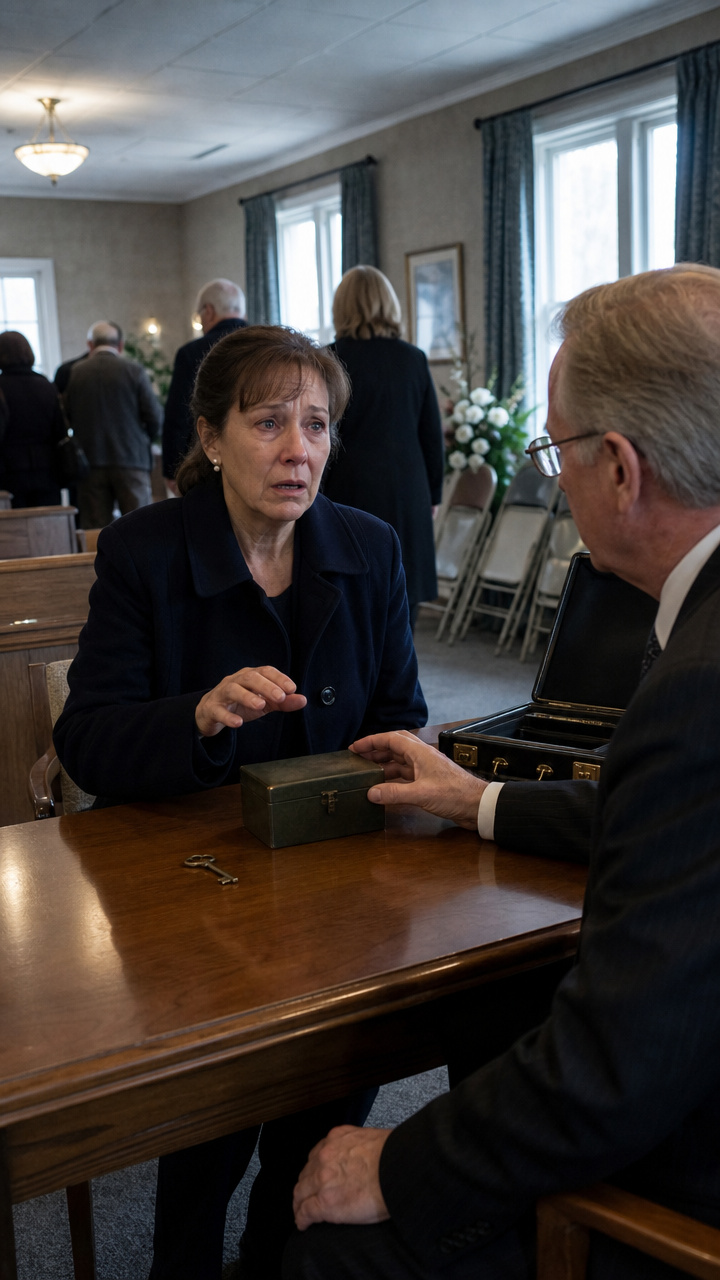
After my husband Henry’s funeral, his attorney unexpectedly asked me to remain behind for a few more minutes. As the last mourners began to leave, he took a small metal box from his briefcase and set it in front of me. It was locked. Beside it lay a tarnished brass key, darkened by age. I could not imagine what Henry might have hidden inside. When I finally managed to turn the old lock, I found several letters, a thick folder filled with financial documents, and a photograph dated 1987. In the picture, Henry stood beside his first wife, Margaret—and next to them was my late mother, Evelyn. For eleven years, my husband’s children, Daniel and Claire, had treated me like a woman who had entered their father’s life for one reason only: money. They had repeatedly insisted that I wanted his house, his possessions, and his inheritance, and that I was merely waiting patiently for the day everything would become mine. But the contents of that old box completely overturned the story they had believed for so long.
The papers revealed a past I had never even suspected. In 1987, Henry’s construction business had been going through its darkest period. His company was close to collapse, and he did not have enough money to finish even the projects already underway. That was when my mother stepped in. Evelyn gave Henry every dollar she had received from an inheritance—thirty-two thousand dollars. At the time, it was an enormous amount. That money kept his company alive, allowed him to pay down some of its debts, and helped him complete the house. But their arrangement had never been based on a casual promise between friends. Henry and my mother had signed a written agreement stating that if he could not repay the full amount, Evelyn would be entitled to one-quarter of the home’s value. Over the years, Henry managed to return only a small portion of what he owed. Then circumstances changed. My mother moved away, their contact gradually faded, and their lives went in separate directions. Decades later, fate unexpectedly brought me into Henry’s life. The moment he heard my surname, he realized that I was the daughter of the woman who had once rescued him from near ruin. Yet he never found the courage to tell me. From the letters, it was clear that he had been too ashamed to admit the old unpaid debt—to me or to his own children.
In his will, Henry had ordered the house to be divided equally among three people: Daniel, Claire, and me. Each of us was to receive the same share. But something far more significant was left only to me—the locked box and everything inside it, the evidence of what had happened years before. I now understood that Henry had known exactly what I would face after his death. Perhaps he had realized that his children’s accusations would continue, and that eventually I would have to defend myself. Two days later, when we gathered for the formal reading of the will, Claire made another cutting remark. She said my years-long “hunt for an inheritance” had finally paid off and that all my waiting had been worth it. Normally, I avoided arguing with her and let such comments pass without answering. That day, however, I decided I had remained silent long enough. I placed the metal box on the table between Daniel and Claire. First, I showed them the old photograph. Then I laid out the agreement, the receipts proving that part of the debt had been repaid, and the letters preserved by my parents. The documents made one thing unmistakable—something Henry had chosen to conceal for decades. It had been my mother’s money that helped their family survive a financial disaster and hold on to the property over which I had later been accused of being greedy.
Daniel and Claire sat without speaking for a long time, as if they could not make sense of what they were seeing. Learning that their parents had carried such a secret for so many years was a shock. But what stunned them even more was discovering that I had known nothing about it myself. I had not married Henry because of some old agreement. I had never heard about the debt, my mother’s money, or the share of the house she might have claimed. After a long silence, Daniel finally asked whether I intended to go to court and demand the quarter of the property that the agreement had once promised to Evelyn. I told him I had no intention of turning their parents’ buried secret into a weapon, and certainly would not use it against them. Claire turned away after hearing my answer. A moment later, she began to cry. Slowly, the conversation moved toward the subject none of us had ever dared to face openly. Daniel and Claire admitted that their resentment toward me had not been caused only by their suspicions about money. Beneath it was an older pain they had never learned to carry. After Margaret died, they had struggled to accept that their father could love another woman, marry again, and try to build a new life.
Naturally, that conversation did not transform us into a perfect family. Too many years had been filled with bitterness, distrust, suspicion, and words that could not simply be erased from memory. Still, for the first time in eleven years, the truth gave us a chance to stop fighting and look at the past from another angle. Several months later, Daniel called to tell me that he had discovered photographs of my mother among his parents’ old belongings. He gathered them together and gave them to me. Claire spoke to me afterward as well. For the first time, she apologized not with vague phrases or empty politeness, but for the specific things she had said throughout the years. She understood now how deeply those words had wounded me. Today, we are handling the inheritance without arguments and slowly sorting through Margaret’s and Henry’s belongings together. Recently, while going through Margaret’s old cookbooks, we found a yellowed recipe card. The handwriting belonged to my mother. I held that little piece of paper for a long time, thinking about how strangely and unexpectedly human lives can become intertwined. Our families had been connected long before I ever met Henry, even though almost none of us knew it. Sometimes the truth comes to light many years later, when it seems far too late to repair anything. And yet, even then, it can break through a wall of resentment and suspicion that people have spent decades building between themselves.