My name is Claire, and after fifty years of marriage, my husband, Richard, walked out of our home carrying two leather suitcases and one bank card.
He placed it beside my chipped blue teacup on the kitchen table and said, “There are two thousand dollars on it. For emergencies.”
I stared at him, then at the suitcases waiting near the door, and finally through the window, where Linda’s red car sat in the driveway.
Linda was the woman from his book club—the woman he had suddenly needed to meet every Thursday evening.
“Fifty years,” I said quietly. “And all I get is emergency money?”
Richard’s face tightened. “Don’t make this ugly, Claire.”
“No,” I replied. “You already did that.”
He said he didn’t want me to struggle. I almost laughed. He should have thought about that before replacing me with another woman.
As he turned to leave, he patted his pockets, searching for something.
“Your blood-pressure pills are on the counter,” I told him.
For one brief second, shame crossed his face. Then he picked up the bottle and walked out.
I waited until Linda’s car disappeared before taking the card and sliding it into an old cookie tin above the stove. I told myself I would never use it. I would stretch every dollar I had before spending Richard’s guilt.
For five years, I kept that promise.
I learned to live carefully. I repaired small things around the house by watching online videos. I made groceries last longer than they should have. At church, whenever people asked whether I was adjusting, I smiled.
Adjusting was a polite word for falling behind.
My children called often. Emily always heard too much in my voice. Daniel offered to come over and fix things that weren’t broken. Sophie called every Wednesday and asked whether I had eaten.
They loved me, and I loved them. But I hid behind their concern because I refused to become a burden.
Then Dr. Harris stopped smiling during one of my appointments.
“Tell me plainly,” I said.
He sat down with my chart. “Your heart valve has deteriorated. We need to schedule surgery soon.”
“How soon?”
“Weeks, Claire. Not months.”
In the parking lot, I got into my car and couldn’t make myself move. A woman about my age walked past, her husband holding her by the elbow. I looked away and pulled Richard’s bank card from my purse. Lately, I had started carrying it with me, though I still hadn’t used it.
“Not yet,” I whispered.
But soon, I would have no choice.
The surgery would cost more than I could cover. Insurance would help, but not enough. There would be hospital bills, medication, and care afterward.
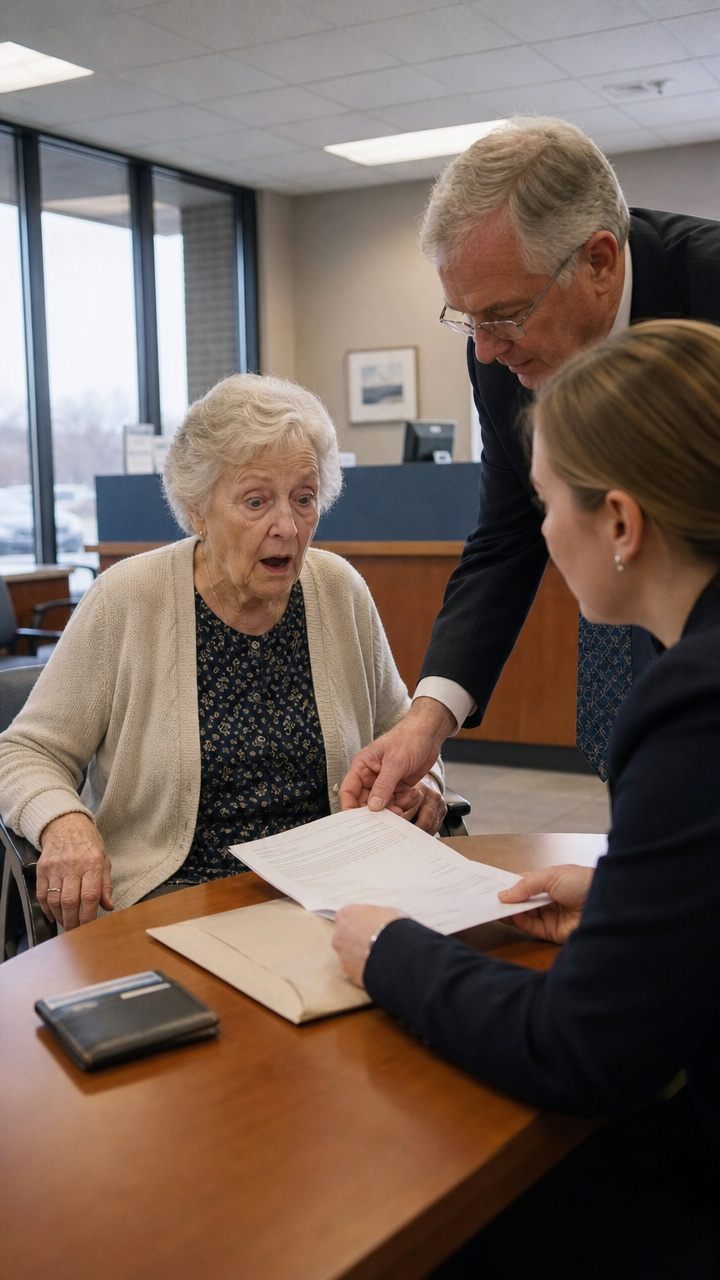
So on a Thursday morning, I put on my best church shoes, tucked the card into my wallet, and took the bus to the bank. My hands were shaking too badly to drive.
The young teller greeted me with a gentle smile.
“I’d like to withdraw the balance,” I told her. “There should be two thousand dollars on the card. I need it for medical expenses.”
She typed for a moment, then asked for my identification. When she looked back at the screen, her smile faded.
“Is there a problem?” I asked. “Was it canceled?”
“No, ma’am,” she said softly. “But I need to speak with my branch manager.”
A few minutes later, Mr. Bennett appeared, holding a sealed envelope with Richard’s handwriting across the front.
“Richard left instructions,” he explained. “We were supposed to give you this when you used the card for the first time.”
“He told me it was emergency money.”
“It was,” Mr. Bennett said. “At first.”
Then he showed me the balance.
$48,216.73.
My knees gave out, and I lowered myself hard into a chair.
“That isn’t mine.”
“It is,” he said. “For the last five years, Richard has deposited part of his pension into this account every month.”
I could barely get the words out. “Why?”
Mr. Bennett pointed to the memo line.
Every deposit carried the same message.
Claire is due.
My throat closed.
Inside the envelope was a letter.
Richard wrote that if I was reading it, I had finally used the card. He admitted he had told me there were only two thousand dollars because that was the largest amount he believed I would accept. He called it a coward’s number—enough to make him feel honest, but not enough to make me believe he cared.
He wrote that I had raised our children, stretched his paychecks, prepared every holiday, remembered every birthday, and cared for his mother when he couldn’t bring himself to deal with hospitals.
Then I reached the line that broke me.
This money is not a gift. It is not kindness. It is part of what I owe you.
I read it again. And again.
The words did not heal the wound. They did not erase his betrayal. But they proved that Richard knew exactly what I had carried all those years.
He had understood enough to write it down, but not enough to say it to my face.
I asked Mr. Bennett to transfer every cent into my account and print three copies of the letter and the transaction history.
“I have three children,” I said. “They need the truth on paper, not just from me.”