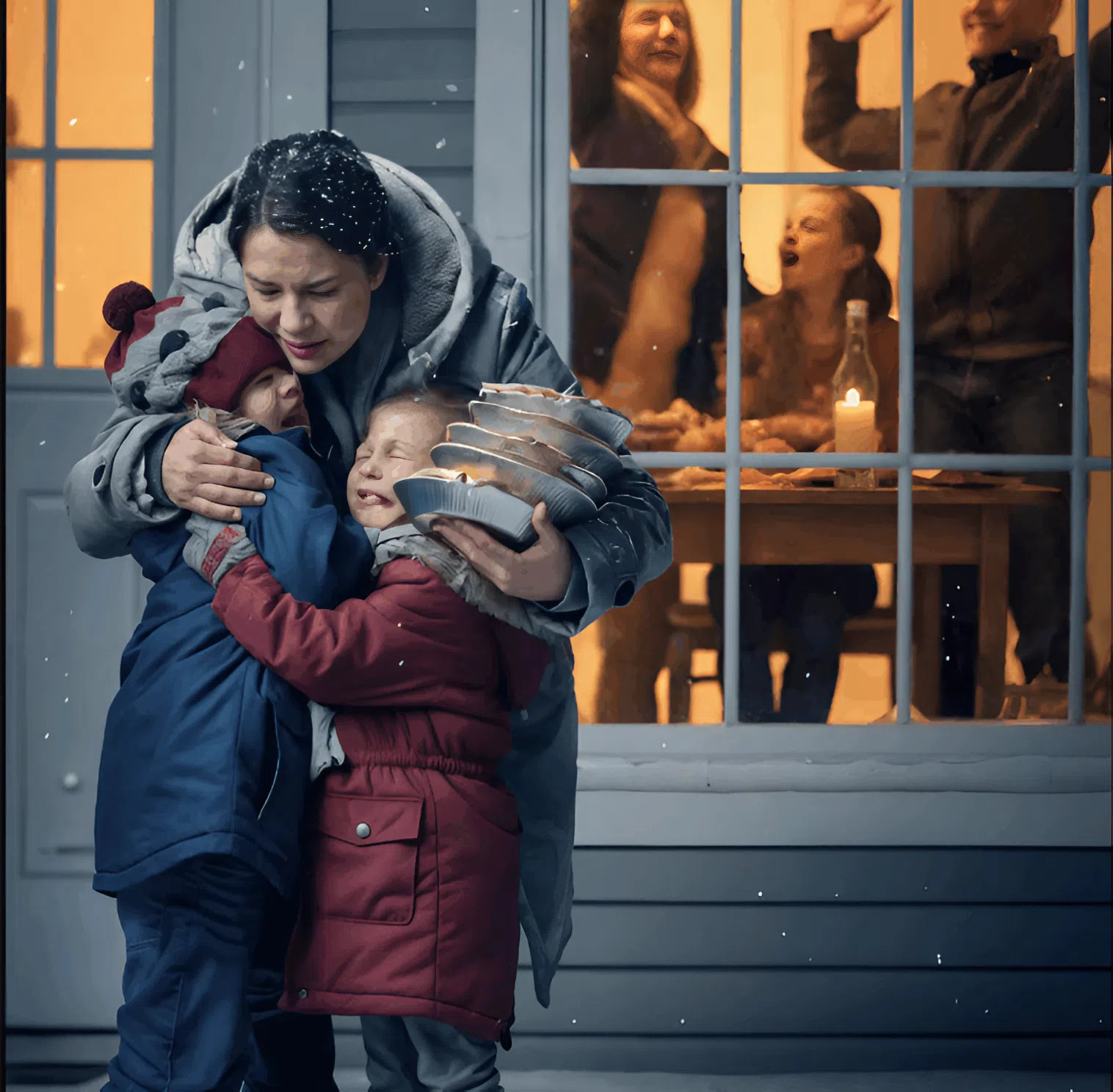
‘My situation?’ My voice tightened. ‘Mum, these are your grandchildren.’

She looked down at them as if they were strangers who had come begging. ‘Yes. Well, maybe next year you’ll plan ahead. Today is for family only.’
‘But we are family!’ The desperation in my voice made me want to disappear. ‘Please, Mum. The children are so excited. I made pies. We can fit somewhere.’
Jessica appeared behind her mother in a cream cashmere sweater that must have cost more than my monthly rent. ‘Seriously,’ she said with obvious contempt. ‘You really came without confirmation? So typical of you, Sarah. Always thinking the world should revolve around you.’
‘You invited me,’ I managed to say. ‘Three weeks ago, you called and said—’
‘Plans change,’ Jessica shrugged. ‘Adults know how to adapt. They don’t show up with kids thinking everything will be arranged for them.’
Emma began to cry, the quiet, broken sobs of a child who had been looking forward to seeing her grandmother.
‘Please,’ I whispered. ‘Let us in. We’ll be quiet. The children will eat in the kitchen. Please.’
My mother’s eyes hardened. ‘You’re causing a scene. It’s embarrassing.’
My father’s voice was sharp again: ‘You need to know when you’re not welcome here. Do you understand, Sarah?’

More laughter. A whole chorus of it. Strangers laughing at me and my crying children.
My mother stepped back. ‘I need to get back to my guests. Have a safe journey.’
The door slammed with such force that I flinched. The sound echoed in the sudden silence. The rain poured harder, soaking my coat, sticking to the hair on my face. I stood there like a fool, clutching my pies while the children cried.
‘Mummy,’ Emma’s voice was tiny, ‘why doesn’t Grandma want to see us?’
Something cracked inside me. Not dramatically, not immediately, just a quiet crack, like ice on a lake stretching and stretching until it breaks completely.
‘Come on, my little ones,’ I said in a surprisingly even tone. ‘Let’s go back to the car.’
I buckled them in, their sobs breaking my heart. I started the car, turned the heat up full blast, and froze for a moment as they cried, trying not to break down with them. My phone vibrated. A notification. A group I didn’t know: ‘Thanksgiving Crew.’ My stomach clenched. The preview showed Jessica’s name. I opened the message with trembling hands.
Jessica: What a clown. She really came.
Brittney: Oh my God, you weren’t kidding. She looked so pathetic with her sad children.

Mum: I almost felt sorry for her, but then I remembered how annoying she is. She always plays the victim.
Jessica: Seriously! We had to ruin our fancy dinner for her and her kids?
Derek (Jessica’s husband): The face she made, lol.
Dad: Best Thanksgiving ever. No whining, no ‘poor me,’ no ill-mannered kids running around.
Jessica: Next year, we won’t even pretend to invite her. It’s too stressful.
I read every message, then reread them again. My hands were shaking so badly that I almost dropped my phone. Behind me, Emma and Tyler’s sobs subsided, leaving only intermittent sniffles. And then something strange happened. The pain and humiliation that had been consuming me just… stopped. In their place came something cold, clear, almost calm. Maybe it was anger — but not the kind that screams. The kind that calculates. The kind that thinks things through.
I opened my banking app and stared at the screen for a long time. My finger hovered over the automatic debits. This ‘financial arrangement’ had begun innocently four years ago, when my father’s commercial real estate company collapsed. He had borrowed too much, taken risky loans, and lost everything. I got the first anxious call in the middle of the night: ‘Sarah, dear, we have problems. Serious problems. The bank is threatening to take the house.’
He had never called me ‘dear’ before.
At that time, I had been divorced for six months and was working two shifts at a dental clinic to pay for nursery and rent. I was barely making ends meet. But these were my parents. ‘Just until I get my consulting business off the ground,’ my dad promised. ‘Six months, maybe a year.’
Over the years, that ‘temporary’ mutated. First, it was just the mortgage. Then car insurance. Then bills. Then, somehow, a country club membership, because Mum ‘needed it for her mental health.’ When Tyler turned four, I was paying almost fifteen hundred dollars a month to support their lifestyle while we were just surviving. Four years of sacrifice, forty-eight months of putting them first. Almost seventy thousand dollars earned through overtime and depriving myself — depriving my children — of the necessities.
Jessica knew. I told her once, hoping for sisterly support. She laughed: ‘It’s your choice. No one forced you to play the martyr.’
They all knew. They didn’t care. Or worse: they thought I owed it to them because I was the failure of the family, and they, the ‘successful’ ones, deserved my support.