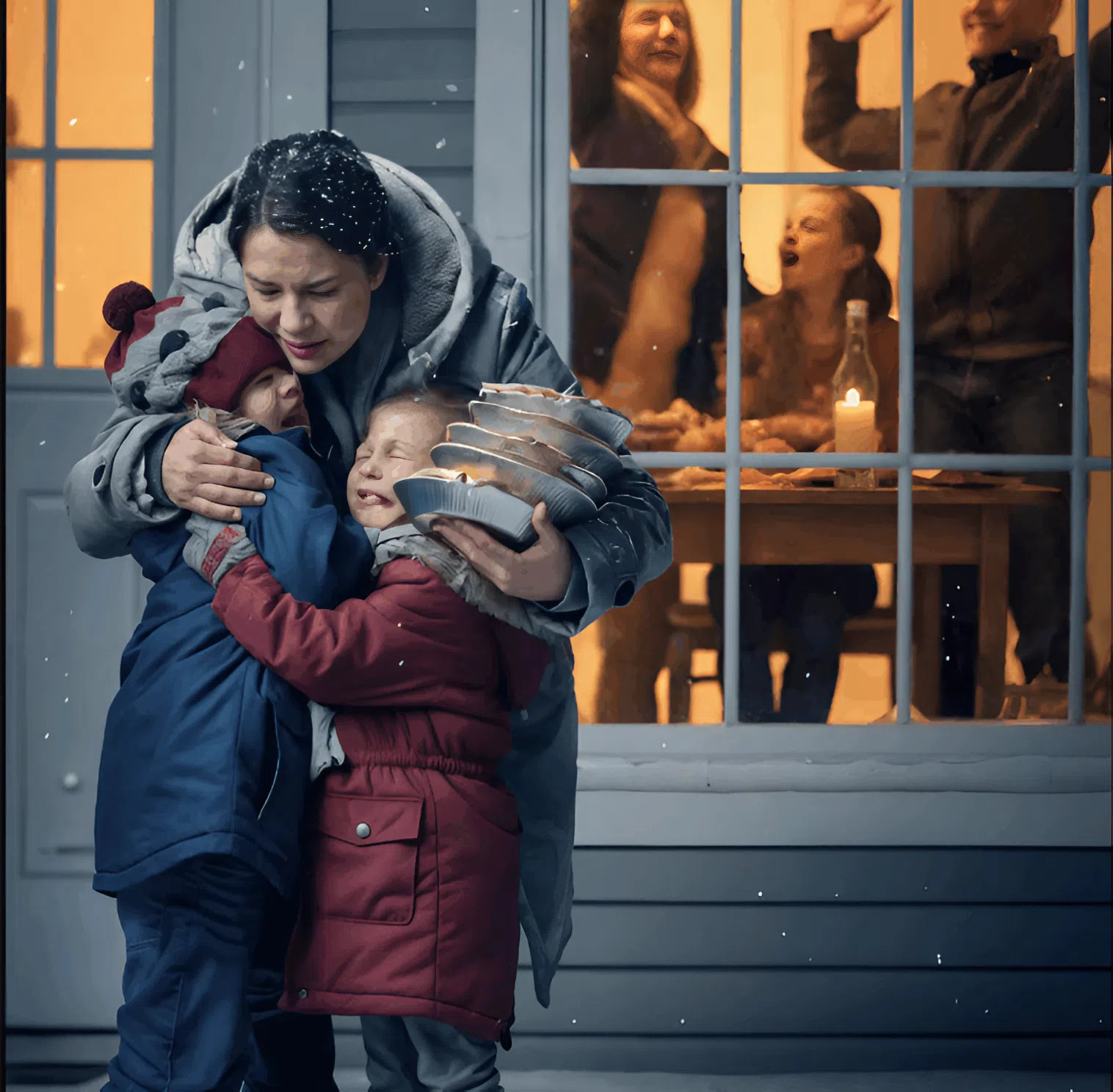
After a six-hour drive with the children, I arrived to surprise my family on Thanksgiving Day. My mother opened the door slightly. ‘Oh, dear… we forgot to warn you. This is only for close relatives.’ My sister’s laughter came from the living room: “Mum, hurry up!
My friend’s children are on their way — we need space!‘ Then the door slammed shut right in front of me. Twenty minutes later, my sister accidentally sent a message: ’What a clown. She really came.” I smiled, opened my banking app… By morning, I had 43 missed calls and a voicemail that began with, ‘Please… don’t do this.’
I watched the motorway stretch out endlessly before me, the lampposts blurring in the flow of traffic, my two children napping in the back seat. Emma, my seven-year-old daughter, had finally stopped asking ‘Are we there yet?’ about an hour ago, and my four-year-old son Tyler was pressing his stuffed cat, Mr. Whiskers, against the window.
The six-hour drive from Ohio to Massachusetts seemed worth it to celebrate Thanksgiving with my family. At least, that’s what I told myself every time my lower back refused to cooperate.
My name is Sarah Mitchell, I’m thirty-two years old, a single mother, and, apparently, the family doormat. But I didn’t know that yet. Not completely. Sure, there were signs that I had ignored for years, but denial is stronger when you desperately want to believe that your family loves you.
The phone vibrated about four hours into the journey. My mother’s name appeared on the screen, but I was merging onto the I-90 and couldn’t answer. She didn’t leave a message. ‘She’s probably just impatient for us to get there,’ I thought.
‘Mum, I’m hungry,’ Tyler moaned from the back seat.
‘Thirty more minutes, darling. Then we’ll be at Grandma’s, and there will be lots of yummy food.’
Emma woke up, rubbing her eyes. ‘Will Aunt Jessica be nice this time?’
That question hit me harder than it should have. At seven years old, my daughter had already learned to expect my younger sister to be mean. Jessica was twenty-eight, married to a wealthy banker named Derek, and never missed an opportunity to remind me that she had ‘made it’ while I was ‘just’ a hygienist raising two children after my ex-husband decided fatherhood wasn’t for him.
‘Of course she will be nice, dear. It’s Thanksgiving,’ I said, my voice sounding false. The taste of the lie was bitter. Last Christmas, Jessica spent the whole day making fun of my weight, my job, my divorce. Mum laughed, saying Jessica was ‘just joking’ and I was ‘too sensitive.’
Dad buried himself in football matches, pretending not to hear anything. But this year was supposed to be different. I brought homemade pumpkin pies, bought good wine that was beyond my means, and even new outfits for the children so that Jessica couldn’t say they were poorly dressed. We were going to have a real family party.
The GPS announced our arrival just as freezing rain began to fall. My parents’ house, a beautiful colonial home at the end of a cul-de-sac, stood behind a lawn so perfect that it must have required a gardener to maintain it. Warm light shone through the windows. The driveway was filled with several expensive cars, including Jessica’s black Mercedes SUV. My old Honda Civic looked pathetic in comparison.
‘We’re here!’ I said with feigned enthusiasm, waking the children. ‘Come on, kids, let’s go see everyone.’
I smoothed their hair, grabbed the pies from the boot, and we ran through the cold rain to the front door. I knocked, holding the pies at my hip. Through the frosted glass, I could see silhouettes and hear laughter — the sound of family, warmth, everything I wanted.
The door opened just six centimetres. Mum’s face appeared in the crack, and something in her expression threw me off balance. She wasn’t smiling. Not really. Her mouth was smiling, but her eyes were cold, calculating.
‘Oh, dear,’ she said with feigned surprise. ‘We forgot to warn you. You’re not needed. It’s only for immediate family.’
At first, the words didn’t make sense. I even laughed, thinking she was joking. ‘Mum, what? I drove six hours. The children are tired and hungry.’
‘Sarah, you really should have called ahead,’ she said louder so that someone behind her could hear. ‘This is so inconvenient.’
From inside the house, Jessica’s sharp, mocking voice rang out, ‘Mum, hurry up! Brittany’s kids are coming too. We need space.’
I stood there, rain soaking my coat, clutching the pies I had baked until midnight. Emma pressed herself against my leg. Tyler began to whine, ‘Mum, this is a joke, right? You invited us three weeks ago.’
Dad’s voice boomed from the living room: ‘Some people never understand that they’re not wanted here.’
The laughter that followed pierced me. Several people were laughing at me, at my children, crying in the rain.
Mum’s expression turned into something like triumph. ‘You need to learn to read the room, Sarah. Jessica is hosting special guests, and frankly, there’s no place for… your situation.’
‘My situation?’ My voice tightened. ‘Mum, these are your grandchildren.’

She looked down at them as if they were strangers who had come begging. ‘Yes. Well, maybe next year you’ll plan ahead. Today is for family only.’
‘But we are family!’ The desperation in my voice made me want to disappear. ‘Please, Mum. The children are so excited. I made pies. We can fit somewhere.’
Jessica appeared behind her mother in a cream cashmere sweater that must have cost more than my monthly rent. ‘Seriously,’ she said with obvious contempt. ‘You really came without confirmation? So typical of you, Sarah. Always thinking the world should revolve around you.’
‘You invited me,’ I managed to say. ‘Three weeks ago, you called and said—’
‘Plans change,’ Jessica shrugged. ‘Adults know how to adapt. They don’t show up with kids thinking everything will be arranged for them.’
Emma began to cry, the quiet, broken sobs of a child who had been looking forward to seeing her grandmother.
‘Please,’ I whispered. ‘Let us in. We’ll be quiet. The children will eat in the kitchen. Please.’
My mother’s eyes hardened. ‘You’re causing a scene. It’s embarrassing.’
My father’s voice was sharp again: ‘You need to know when you’re not welcome here. Do you understand, Sarah?’

More laughter. A whole chorus of it. Strangers laughing at me and my crying children.
My mother stepped back. ‘I need to get back to my guests. Have a safe journey.’
The door slammed with such force that I flinched. The sound echoed in the sudden silence. The rain poured harder, soaking my coat, sticking to the hair on my face. I stood there like a fool, clutching my pies while the children cried.
‘Mummy,’ Emma’s voice was tiny, ‘why doesn’t Grandma want to see us?’
Something cracked inside me. Not dramatically, not immediately, just a quiet crack, like ice on a lake stretching and stretching until it breaks completely.
‘Come on, my little ones,’ I said in a surprisingly even tone. ‘Let’s go back to the car.’
I buckled them in, their sobs breaking my heart. I started the car, turned the heat up full blast, and froze for a moment as they cried, trying not to break down with them. My phone vibrated. A notification. A group I didn’t know: ‘Thanksgiving Crew.’ My stomach clenched. The preview showed Jessica’s name. I opened the message with trembling hands.
Jessica: What a clown. She really came.
Brittney: Oh my God, you weren’t kidding. She looked so pathetic with her sad children.
Mum: I almost felt sorry for her, but then I remembered how annoying she is. She always plays the victim.
Jessica: Seriously! We had to ruin our fancy dinner for her and her kids?
Derek (Jessica’s husband): The face she made, lol.
Dad: Best Thanksgiving ever. No whining, no ‘poor me,’ no ill-mannered kids running around.
Jessica: Next year, we won’t even pretend to invite her. It’s too stressful.
I read every message, then reread them again. My hands were shaking so badly that I almost dropped my phone. Behind me, Emma and Tyler’s sobs subsided, leaving only intermittent sniffles. And then something strange happened. The pain and humiliation that had been consuming me just… stopped. In their place came something cold, clear, almost calm. Maybe it was anger — but not the kind that screams. The kind that calculates. The kind that thinks things through.
I opened my banking app and stared at the screen for a long time. My finger hovered over the automatic debits. This ‘financial arrangement’ had begun innocently four years ago, when my father’s commercial real estate company collapsed. He had borrowed too much, taken risky loans, and lost everything. I got the first anxious call in the middle of the night: ‘Sarah, dear, we have problems. Serious problems. The bank is threatening to take the house.’
He had never called me ‘dear’ before.
At that time, I had been divorced for six months and was working two shifts at a dental clinic to pay for nursery and rent. I was barely making ends meet. But these were my parents. ‘Just until I get my consulting business off the ground,’ my dad promised. ‘Six months, maybe a year.’
Over the years, that ‘temporary’ mutated. First, it was just the mortgage. Then car insurance. Then bills. Then, somehow, a country club membership, because Mum ‘needed it for her mental health.’ When Tyler turned four, I was paying almost fifteen hundred dollars a month to support their lifestyle while we were just surviving. Four years of sacrifice, forty-eight months of putting them first. Almost seventy thousand dollars earned through overtime and depriving myself — depriving my children — of the necessities.
Jessica knew. I told her once, hoping for sisterly support. She laughed: ‘It’s your choice. No one forced you to play the martyr.’
They all knew. They didn’t care. Or worse: they thought I owed it to them because I was the failure of the family, and they, the ‘successful’ ones, deserved my support.
My finger slipped. Cancel payment. Cancel payment. Cancel. Six automatic debits deleted in thirty seconds. Mortgage payment scheduled for Tuesday morning? Cancelled. Car insurance in three days? Cancelled. Electricity, water, phone — all cancelled.
A notification appeared: ‘You have successfully cancelled six recurring payments. This action cannot be reversed through the app.’
I closed the app.
‘Mummy,’ Emma sniffed, ‘are we going home?’
‘Yes, my angel. We’re going home.’
‘Are we still going to celebrate Thanksgiving?’
I looked at my daughter in the rear-view mirror, her face swollen from crying. ‘We’re going to have the best Thanksgiving of our lives,’ I said, and I really meant it. ‘The three of us. We’ll buy a roast chicken, make mashed potatoes in a minute, and eat pie for dinner. How does that sound?’
Emma’s smile was wet but genuine. ‘Can we watch films?’
‘All night long, if you want.’
I pulled away from the kerb, away from the lit windows, the laughter and the family that didn’t want me.
The journey back took seven hours because of the weather. I drove in silence, replaying every detail in my head: Mum’s grimace, Jessica’s cashmere jumper, Dad’s thunderous voice, the slam of the door, the messages calling me a clown and the children brats. ‘What kind of people are they?’ I asked myself. The ones I always found excuses for.

We returned to our small flat around eleven o’clock at night. I carried Tyler, Emma walked, limping, half asleep. I put them to bed fully clothed, kissed them on the forehead and closed the doors. Then I sat in the dark living room and waited.
The first call came at 6:30 the next morning. Dad. I hung up. Then Mum. I hung up. Jessica. I hung up. The messages kept coming.
Mum: Sarah, we need to talk. Misunderstanding.
Dad: Call me back immediately. This is serious.
Jessica: You’re overreacting. We were joking, so what? Don’t get back at Mum and Dad.
I made coffee and scrambled eggs. We ate at our tiny kitchen table, and I listened as Emma told Tyler a story about a princess in an ice castle. The phone wouldn’t stop ringing. By 9 a.m., I had twenty-seven missed calls. By noon, forty-three.
I finally listened to the voicemail. Mum’s voice was shaking: “Sarah, please, please don’t do this. I just checked the bank, and the mortgage payment didn’t go through. Neither did the car insurance or the bills… I don’t understand what’s going on. Your father has chest pains from stress… Please, dear, we’re so sorry. Whatever we did, we’re sorry. Call us back… Don’t do this to us. We’re your family. We love you. Please call us back.”
I sat with the phone to my ear long after the message ended. Her voice sounded genuinely frightened. Part of me, the old Sarah, programmed to fix everything, felt a pang of guilt. Dad’s chest hurts? Then I remembered the grimace. Mum’s look at my crying children, as if they were stray dogs. A group of messages. ‘What a clown. She really came.’
I deleted the message. A new message — now from Dad. His voice was harsher, sharper: ‘Sarah, I don’t know what game you’re playing, but this is unacceptable. We have bills, obligations. You can’t stop supporting us without warning. Call me back immediately so we can settle this like adults.’
‘Like adults.’ I almost laughed.
Jessica’s messages became increasingly panicked.
Jessica: Sarah, this is crazy. Mum is hysterical. You’re punishing everyone for a misunderstanding. We thought you knew about the change of plans. Call me back.
Jessica: Fine. Do whatever you want. But if something happens to Dad’s heart, it will be your fault.
It had a different tone. The threat was clear: everything that happens to them is your fault. Same manipulation, just repackaged. Their emotions were always my responsibility. And mine? No one’s. Apparently, I’m just ‘too sensitive.’
Over that long weekend, we built a blanket fort, watched films, and ate Halloween candy for breakfast — so what? We celebrated Thanksgiving on Saturday. We spent only twenty quid, and it was better than any dinner I’d ever had at my parents’ house.
‘This is the best Thanksgiving ever,’ Emma proclaimed, her mouth full of mashed potatoes. ‘No one made me feel bad. No one was mean. And we got to stay in our pyjamas.’
My phone finally went quiet on Sunday evening. After forty-three missed calls and dozens of messages, they seemed to get the message.
On Monday morning, I did something radical. I went to the operator and changed my number. The saleswoman didn’t ask any questions, but I saw understanding in her eyes. ‘A new life,’ she said, handing me back my phone.
‘Exactly,’ I replied.
The peace that followed was incredible. My flat felt lighter. I went to work, came home, played with the children. No more calls demanding money. No more messages making me feel guilty. Just silence.
I found out the rest from each other. The house was repossessed three months later. They had to sell their luxury cars. Mum lost her country club membership. They moved to a small flat in a cheaper neighbourhood.
Jessica showed up at my work in April. I went out to the reception area, and there she was, tired, aged. ‘We need to talk,’ she said.
‘No.’
‘Sarah, please. I’m sorry. We’re all sorry. What we did was terrible. But you can’t abandon your family.’
‘I didn’t abandon anyone,’ I replied calmly. ‘You said yourself that I wasn’t part of the family. You laughed. You called my children brats. I’m just respecting your wishes by removing myself from your life.’
‘We were drunk, we were stupid! It was just one day!’
‘It wasn’t just one day, Jessica. It was a whole lifetime of you treating me as if I were less than you. That day was just the first time you were honest.’
Her eyes filled with tears — sincere, it seemed to me. “Mum might lose her flat. Dad has health problems. They need help.”
‘They’re screwing you over.’
‘I can’t support them! Derek’s business has laid off employees!’
I almost laughed. ‘So you want me, a failure with my “situation”, to save everyone else?’
‘You’re cruel.’
‘No,’ I said softly. ‘I’m smart. I protect my children and myself from people who don’t respect us. That’s different.’
Security probably escorted her out when she refused to leave.
In February, I got a raise. With the raise — and with the money I was no longer sending to my parents — I started saving. I opened education accounts for each child. I took them to Disney World, just because I could.
My life has become smaller in some ways — no more big family dinners — but bigger in ways that matter. More complete, more comfortable, happier.
People ask me if I feel guilty. Honestly, no. What I feel is freedom. For the first time in my adult life, I feel like I matter — to myself and to my children. The old me would have given in, sent the money back, convinced myself that “family is family” and that I should forgive. But standing there in the freezing rain with my crying children changed everything. It showed me the truth I had been avoiding: they didn’t love me. Maybe they never loved me. Maybe I was only ever useful to them.
So thank you, Mum. Thank you for finally being honest. Thank you for showing me in the cruelest way that I was wasting my time, money, and heart on people who saw me as nothing more than a joke. I don’t laugh anymore. But I smile. And I am free.