
‘Are you always so… stubborn?’ asked Victoria, and there was no longer anger in her voice, but a kind of almost childish resentment, as if her favourite toy had suddenly been taken away from her. She leaned in a little closer, and Elena felt the warmth of her breath — the warmth of a person accustomed to the space around them obediently expanding to suit their desires.
Elena closed the book again and cupped the cover in her hand, as if shielding a dear old friend from prying eyes. The gesture was slow, almost ritualistic: her fingers slid over the worn spine, and she remembered how, in the last months of her life, her mother had held this very book in her trembling hands and read aloud to distract herself from the pain. ‘The world is full of people who loudly demand what is theirs,’ Lucia used to say, ‘but true strength belongs to those who know how to remain silent and yet do not fade away.’
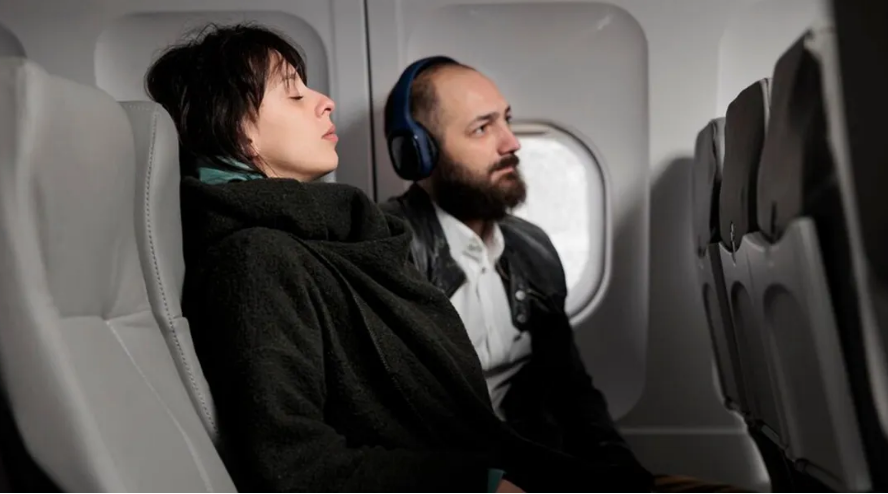
“Stubbornness is when a person clings to what does not belong to them,” Elena replied quietly, but every word rang out like a drop of water wearing away a stone over the years. “And I’m just sitting in my seat.”
She didn’t even turn towards Victoria. Her gaze drifted back to the window, where night had already closed in completely around the aeroplane. Rare clouds drifted slowly past the glass, illuminated by the cold silver of the moon, and for a moment it seemed to Elena that the features of her mother’s face were emerging from one of them — blurred, almost ephemeral, like a memory that could vanish at any second. A familiar wave of loneliness rose in her chest — not sharp, as in the first years after her parents’ death, but deep, muffled, like the distant sound of the ocean heard through a seashell. Four billion euros could not fill this void. They merely gave her the chance to fly to where her old nanny lived, to take her by the hand and, perhaps for the first time in many years, tell the unvarnished truth.
In the cockpit, Alejandro Martínez was checking the heading and altitude, but his thoughts were elsewhere entirely. He caught himself picturing the woman from 2A over and over again: her simple plait, her lack of make-up, that imperturbability in which there was neither pretence nor weakness. It was precisely this calmness that annoyed him more than an open scandal. It made him feel… small. As if all his thirty years in the air, all the authority he’d built up, all the respectful glances from the crew — were nothing but a thin layer of gilding on an old, cracked tree. He turned to the co-pilot, Raúl, and said something trivial about the wind, but his own voice sounded unusually muffled to him.
Enrique Santos sat motionless, staring at the back of the seat in front of him. The sweat on his forehead had already dried, but inside he was still seething. He recalled the day Elena became the company’s owner: she had walked into the office in the same simple linen dress, without security, without assistants, without fanfare. And she asked to see not the financial statements, but the reports on the salaries of flight attendants and mechanics. ‘The people who lift these planes into the sky,’ she said then, ‘must also feel that the sky belongs to them.’ At that moment, Enrique decided that this was just another whim of a rich heiress. Now, however, he understood: it was no whim. It was her quiet, stubborn revolution.

The plane entered a steady cruising phase. The hum of the engines became almost lulling—low, steady, and bone-deep. Elena felt her body gradually relax, but her mind remained on guard. She knew that silence was her greatest weapon. And at the same time, her heaviest burden. There was no sense of victory in it. Only sadness at how easily people build walls out of their own assumptions and prejudices. Victoria had already turned away, but her shoulders were still tense, and her fingers still clung to the pearls. Alejandro in the cockpit gripped the steering wheel a little tighter than necessary. And Elena simply breathed — slowly, deeply, inhaling air that belonged to no one.
Somewhere over the Atlantic, in this metal capsule suspended between sky and water, a crack was beginning to form in the familiar order of things. Not loud, not dramatic — just a thin, almost invisible fissure through which the truth could already seep. Elena knew: when the plane landed in New York, one of them would no longer be able to look at the world as they had before. And that person, most likely, would not be her.
She opened the book again. The pages, warmed by her palms, felt almost alive. There were still seven hours of the journey ahead — more than enough for the silence to do its work better than any words could. And New York awaited her with its lights and promises, which, like so much in her life, might turn out to be nothing more than a beautiful reflection in the windowpane — bright, mesmerising, but not real.