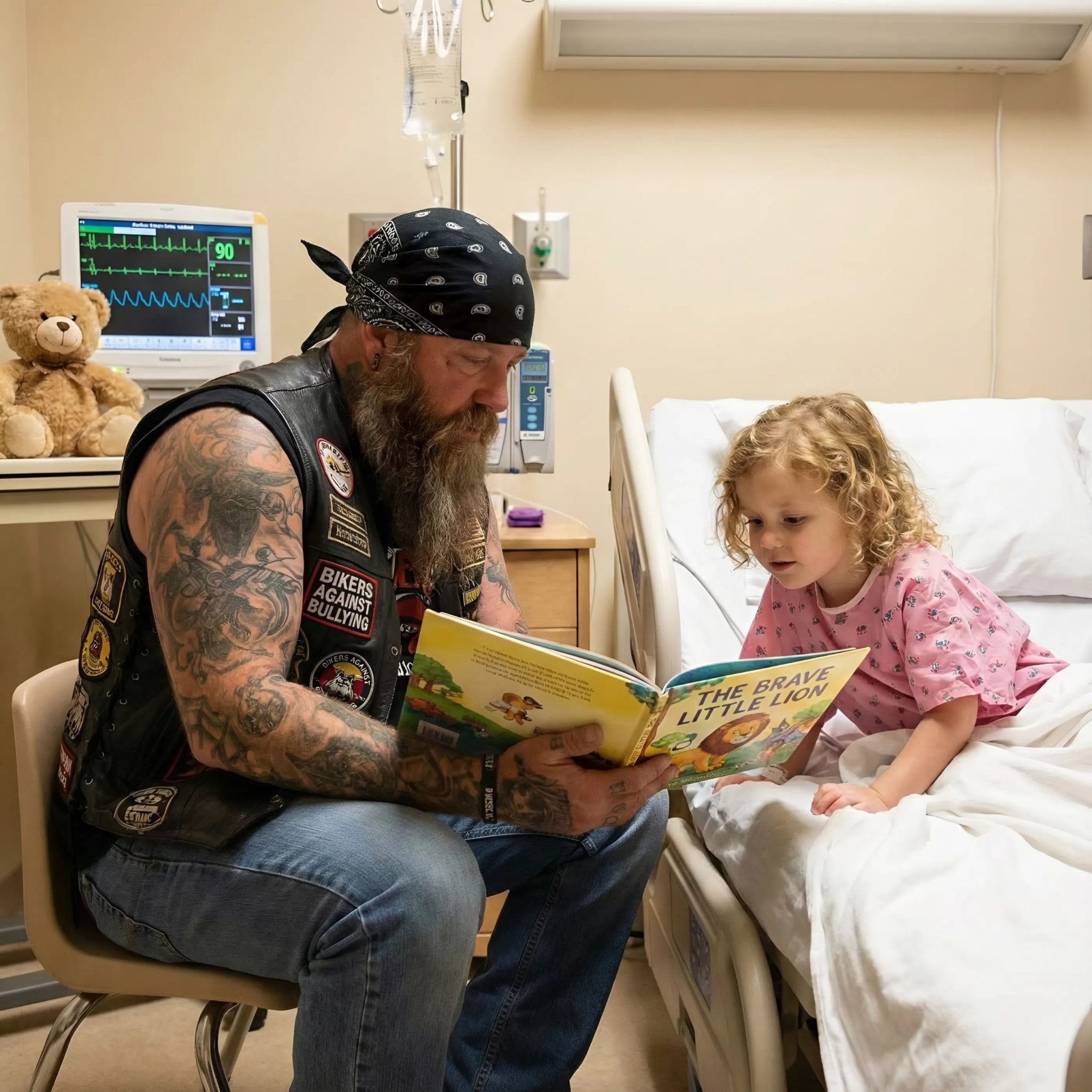
The little girl asked me if I could be her daddy until she died. Those were the exact words out of her mouth. She was seven years old, sitting up in a hospital bed with tubes in her nose, and she looked straight at me—a total stranger, a rough-looking biker—and asked if I’d pretend to be her father for however much time she had left.
My name’s Mike. I’m fifty-eight, covered in tattoos up both arms, beard down to my chest, and I ride with the Defenders Motorcycle Club.

Every Thursday, I volunteer at Children’s Hospital, reading stories to sick kids. Our club started doing it about fifteen years ago, after one of our brother’s granddaughters spent months in the pediatric oncology unit.
Most kids are afraid of me when they first see me. I don’t blame them. I look like I belong in some biker gang movie, not in a children’s ward. But once I start reading, they stop seeing the beard and the leather. They just hear the story.
That’s what I thought would happen when I met Amara.
It was a Thursday afternoon in March when I walked into room 432. The nurse had warned me beforehand: new patient, seven years old, stage four neuroblastoma. Three weeks in the hospital, and not a single family visit.
“No family at all?” I’d asked.
Her face tightened. “Her mother left her here for treatment and never came back. We’ve called and called. Nothing. CPS is involved now, but there’s no other family. Once she’s stable enough, she’ll go into foster care.”
“And if she never gets stable?” I asked.
The nurse looked away. “Then she’ll die here. Alone.”
I stood outside that door for a full minute before I could bring myself to go in. I’ve read to dying kids before. It never stops hurting. But the idea of a child dying alone was something else entirely.
I knocked softly and stepped inside. “Hey there,” I said. “I’m Mike. I come by on Thursdays to read stories. Would you like that?”
The little girl turned her head toward me. Big brown eyes. No hair left from chemo. Skin tinted that grayish color that says the body is fighting hard. But she smiled.
“You’re really big,” she rasped.
“Yeah, I hear that a lot,” I said, holding up the book I’d brought. “This one’s about a giraffe who learns how to dance. Want to hear it?”
She nodded, so I took the chair beside her bed and began to read.
Halfway through, she stopped me. “Mr. Mike?”
“Yes, sweetheart?”
“Do you have any kids?”
The question hit like a punch. “I had a daughter,” I said. “She died when she was sixteen. Car accident. That was twenty years ago.”
Amara was quiet for a moment. Then she asked, “Do you miss being a daddy?”
My throat tightened. “Every single day, honey.”
“My daddy left before I was born,” she said in a flat little voice. “And my mama brought me here and never came back. The nurses told me she’s not coming back at all.”
I had no idea what to say. What words fix that kind of truth for a seven-year-old?
She kept going. “The social worker said I’ll go live with a foster family when I get better. But I heard the doctors talking. They don’t think I’m getting better.”
“Sweetheart—”
“It’s okay,” she said calmly—too calmly. “I know I’m dying. They think I don’t get it, but I do. I heard them say the cancer is everywhere now. They said maybe six months. Maybe less.”
I set the book down. “Amara, I’m so, so sorry.”
She looked at me with those enormous eyes. “Mr. Mike, can I ask you something?”
“Anything, honey.”
“Would you be my daddy? Just until I die? I know it’s not for long. But I always wanted a daddy. And you seem nice. And you miss being a daddy. So maybe we could help each other?”
I felt my chest cave in. This little girl, dying and abandoned, was trying to comfort me. Trying to turn her own loneliness into a gift.
“Sweetheart,” I managed, my voice shaking, “I would be honored to be your daddy.”
Her whole face lit up. “Really? You mean it?”
“I mean it,” I said. “For as long as you need me, I’m your dad.”
She held out her small hand. I took it as gently as I could. Her fingers were so thin, so fragile.
“Okay, Daddy,” she whispered. Then she grinned. “Can you finish the story?”
I picked the book back up with my free hand, still holding hers with the other. My eyes were full of tears, but I kept reading. When that story ended, she asked for another. So I read another. And another.
I stayed for three hours that day, reading until she fell asleep with her hand still wrapped around mine.
Out in the hallway, the nurse stopped me. “That’s the happiest I’ve seen her since she arrived,” she said. “Thank you.”
“I’ll be back tomorrow,” I replied. “And the next day. And every day until she doesn’t need me anymore.”
Her eyes filled. “You’re a good man, Mike.”
I shook my head. “I’m just a dad who misses his little girl. And now I’ve got another little girl who needs a dad.”
After that, I came every day. I started arriving around 2 p.m., staying until visiting hours ended at 8. Six hours a day with Amara—reading, watching cartoons, playing simple games when she felt up to it, or just sitting quietly while she slept, holding her hand.
The nurses started calling me “Amara’s dad.” Doctors began updating me like I was legal family. CPS stopped searching for a foster placement. On paper, Amara still had no one. But in reality, she did: me.
Two weeks in, she had another question. “Daddy Mike, do you have a picture of your daughter? The one who died?”
I took my wallet out. “This is Sarah,” I said, handing her the photo. “She was sixteen here. We took this a week before the accident.”
Amara studied it. “She’s really pretty,” she said. “She looks nice.”
“She was the best kid you could imagine,” I said. “Smart, funny, kind. Wanted to be a vet. Loved animals more than anything.”
“I bet she loved you lots.”
“I hope so,” I said quietly. “I loved her more than life.”
Amara handed the picture back. “Daddy Mike, do you think Sarah would be okay with you being my daddy now? I don’t want her to be sad.”
That did me in. I started sobbing right there beside her bed. This little girl, who knew she was dying, was worried about my dead child’s feelings.
“Baby girl,” I said through tears, “Sarah would have loved you. And she would be so happy that I found you. That I get to be a daddy again.”
Amara reached up and patted my cheek. “Don’t cry, Daddy,” she said. “It’s okay. We found each other.”
That night I called my club president. “Brother, I need the club,” I said. “I’ve got a situation.”
Within a day, around fifteen of my brothers had come to see Amara. They brought stuffed animals, books, toys. They made her an honorary member of the Defenders MC. We gave her a tiny leather vest with her name stitched on it.
Her room transformed from cold and empty to full of life, laughter, and love.
The guys started taking turns sitting with her when I couldn’t be there, so she always had someone—an “uncle,” a “grandpa,” a friend. She was never alone again.
Three months later, her body began to fail faster than expected. The cancer spread. Her pain increased. She slept more and ate less.
One evening, I was reading Goodnight Moon to her for what felt like the hundredth time when she stopped me mid-sentence.
“Daddy Mike, I need to tell you something.”
“What is it, baby girl?”
“I’m not scared anymore,” she said softly. “Before, I was really scared. Scared to die alone. Scared no one would remember me. Scared I didn’t matter.” She squeezed my hand as best she could. “But you made it not scary. You and my uncles. You made me feel like I matter.”
“You matter more than you’ll ever know, Amara,” I told her. “You matter to me. You matter to all of us. You changed our lives.”
“Good,” she whispered. “Because you changed mine too. I got to have a daddy. I got to have a family. Even if it’s just for a little while.”
“It’s not just for a little while,” I said. “You’re my daughter forever. Even when you’re not here. You’ll always be my girl.”
She smiled. “Forever?”
“Forever, baby girl.”
Amara died on a Saturday morning in June. I was holding her hand. Three of my brothers stood beside us. She went peacefully, no pain, just drifting away while we sang her favorite song.
The hospital let us hold a memorial service in the chapel. Over two hundred bikers came. We filled the chapel, the hallways, the parking lot. Nurses, doctors, janitors, other families, food service workers—every person who had met Amara in those three months showed up.
Because in just three months, that little girl had touched more hearts than some people do in a lifetime.
CPS eventually tracked down her mother. She didn’t come to the service. Didn’t call. But she signed the papers so I could claim Amara’s body. The social worker cried telling me.
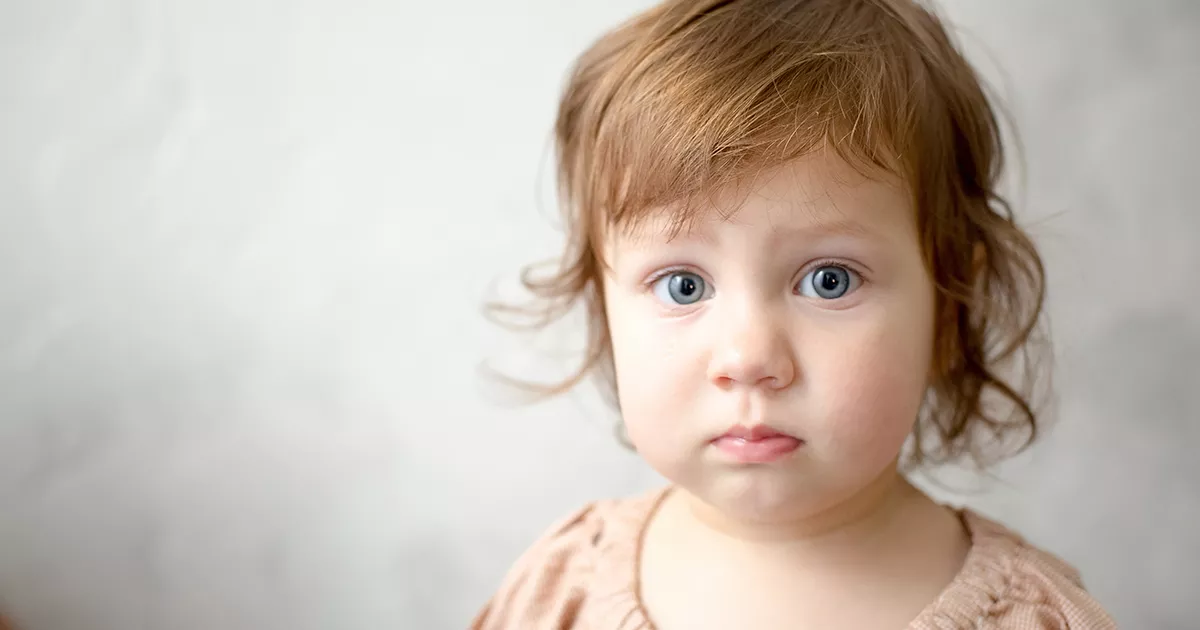
“In thirty years of this work,” she said, “I’ve never seen anything like what you did for that child. You gave her a father’s love.”
We buried Amara in the same cemetery where my daughter Sarah is buried, right beside her. Amara was right—Sarah would’ve loved her. Now they rest together.
Her headstone reads:
“Amara ‘Fearless’ Johnson. Beloved Daughter. Forever Loved by the Defenders MC and her Daddy Mike.”
That was four years ago. I still go to her grave every Sunday. I still read her stories. I still tell her about my week, about what her uncles are up to.
And every Thursday, I’m still at Children’s Hospital, reading to sick kids. But now, when they ask if I have children, I answer differently. I tell them I have two daughters. One who’s been in heaven for twenty-four years. One who’s been there for four. Both of them forever in my heart.
Because of Amara, the nurses started a program called the Defender Dads program. Men sign up to be a steady presence for kids in the hospital who don’t have family around. They come regularly and become whatever that child needs—a dad, a grandpa, an uncle, a friend.
So far, sixty-two men have gone through the training. They’ve been matched with over a hundred kids in four years. Children who would have died alone now leave this world surrounded by people who love them.
All because one little girl looked at a big, scary biker and asked if he could be her daddy until she died.
I didn’t save Amara. I couldn’t stop the cancer or keep her from dying. But she saved me—from twenty years of grief, from feeling like I’d never be a father again, from the empty place I’d been living in.
For three months, I got to be a dad again. I got to read bedtime stories, hold a small hand, hear a child call me “Daddy.” I got to love and be loved.
She gave me purpose. She gave me healing. She gave me hope.
Most people just see the leather and the tattoos when they look at me. They see “biker” and think trouble. Someone to avoid.
Amara saw something else. She saw a father. She saw someone safe. She saw someone who could love her.
And she was right.
I was her daddy. I am her daddy. I always will be.
Because being a father doesn’t end when your child is gone. You carry them. You honor them. You live in a way that would make them proud.
Every story I read to a child now, I’m reading to Amara. Every small hand I hold, I feel hers. Every kid I comfort, I’m comforting her again.
She asked if I could be her daddy until she died. The truth is, I’ll be her daddy for the rest of my life—and, God willing, beyond that too.
She was my daughter.
She is my daughter.
She will always be my daughter.
And I will love her until my last breath, and hopefully forever after that.