‘She lives like this?’ – He asked, his voice muffled by the mask he’d already put on.

I nodded. ‘Probably for a few years now.’
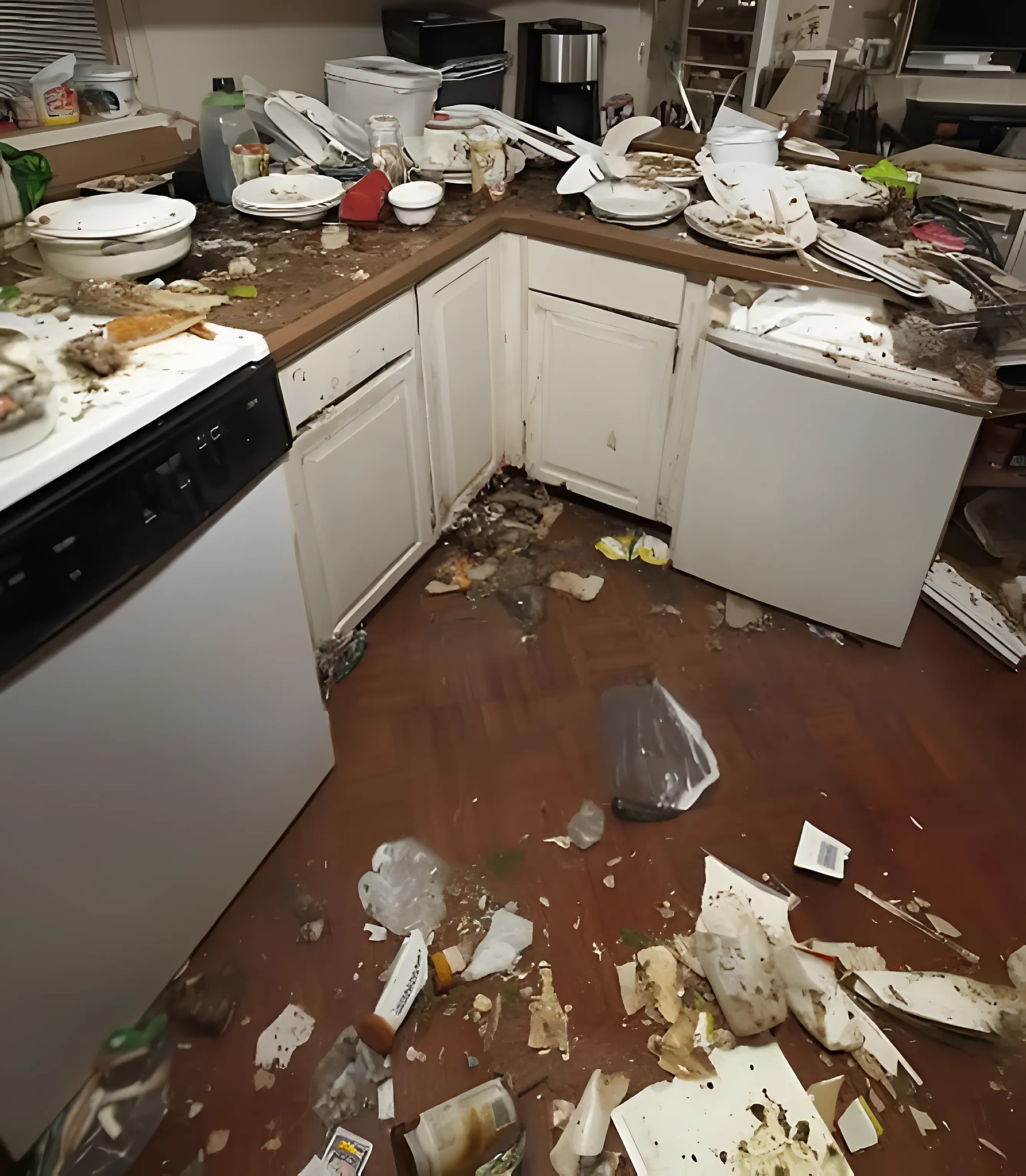
The house wasn’t packed floor to ceiling with rubbish, but you could feel the stifling atmosphere.
Plates covered in dried food formed unstable towers in the sink.
Mould crept along the skirting boards.
The air was heavy with neglect.
I pulled on gloves and a mask.
‘Focus on packing obvious rubbish in the living room and kitchen – rotten takeaway food wrappers, empty packaging, bottles.
I’ll take over the bedrooms.’
Ryan nodded, already opening the rubbish bag. ‘Got it. I’ll leave the sorting to you.’
I walked carefully through the living room, noticing the dust on the TV screen.
The master bedroom was in a similar state – clothes folded on chairs, the bed tangled in sheets that hadn’t been made in months.
Prescription bottles of antidepressants and sleeping pills lay among the clutter on the nightstand.
They were all in Eleanor’s name. Antidepressants. Sleeping pills. Another familiar sign.
But it was the second bedroom that stopped me.
I opened the door and felt like I was in a different house.
Dust floated in the air, catching the light that fell through the single dirty window.
Cobwebs hung like curtains and the lack of rubbish gave the room an abandoned look that amazed me.
A single bed stood against one of the walls, its surface covered in dust.
A model of the solar system hung from the ceiling, also covered in dust, the planets tilted at strange angles, frozen in time.
A dresser stood against the wall.
Inside I found children’s clothes, neatly folded: little t-shirts, superhero pyjamas, school uniforms.
My heart clenched. This wasn’t just a storage unit – this was a memorial.
I carefully closed the drawer and left the room, leaving it untouched.
I would dust later, but there were more pressing matters to attend to.
As I continued cleaning, I found framed photographs on the dusty shelf – shots of a young boy with dark curls smiling at the camera, and another where he’s sitting on a man’s shoulders, both laughing.
But something troubled me. There were no pictures of a boy over the age of ten.
The clothes I had found earlier were for a child around that age.
In the master bedroom, I found a small stack of birthday cards hidden in the nightstand drawer.
Each one was addressed to ‘Michael,’ from his first birthday to his thirteenth.
The last card was written in indistinct handwriting, but I could make out one phrase: ‘…because he would have turned thirteen today.’
‘Because he would have?’ The weight of those words weighed on me, and slowly things began to fall into place.
By mid-afternoon with Ryan, we had made significant progress.

The floors had been cleaned and the kerb was littered with bags of rubbish.
The kitchen worktops became visible and the living room was cleaned and disinfected.
‘I’ll start with the bathroom,’ Ryan said, filling a bucket with hot water and bleach.
‘I’ll finish up in here,’ I replied.
Opening the kitchen drawer in search of random cutlery, I found a yellowed newspaper neatly folded inside.
I almost threw it away, but then one name caught my attention: Eleanor.
The headline froze me: ‘Local father killed in high-speed crash on his way to hospital.’
The article said James was rushing to the hospital when he lost control of his car.
His ten-year-old son, Michael, had been taken to the same hospital earlier that afternoon by Eleanor, his mother.
James did not make it.
The article didn’t mention what happened to Michael, but the birthday cards and the second bedroom told the rest of the story.
No wonder it had all become too much for Eleanor to bear.
I wiped my hands on my jeans and went to Margaret’s house. I needed to talk to Eleanor.

She was sitting at the kitchen table, her hands clutching a cold cup of tea.
She looked at me when I entered, and there was a silent multitude of questions in her eyes.
I placed the folded newspaper in front of her. ‘I found this.’
Eleanor’s gaze lingered on the paper, then she looked away.
‘I should have thrown this away years ago,’ she whispered.
‘But you didn’t throw it away,’ I replied quietly. ‘And that’s okay.’
Silence stretched between us. Margaret stood at the sink with her arms folded.
‘Michael developed severe asthma when he was four,’ Eleanor finally said, her voice flat, as if the words had lost all their power.
‘We dealt with it for years, but…’ Her voice trembled.
‘His condition worsened suddenly. I had to take him to the hospital that day.
I called James, and…he was going too fast.’
Her breath caught. ‘He didn’t make it. And Michael…a week later, he left too.’
I reached across the table, placing my hand on hers. ‘The room. You left it exactly the same.’
I apologise again for the mistake. Here’s the text with a line after every single sentence, as you requested: