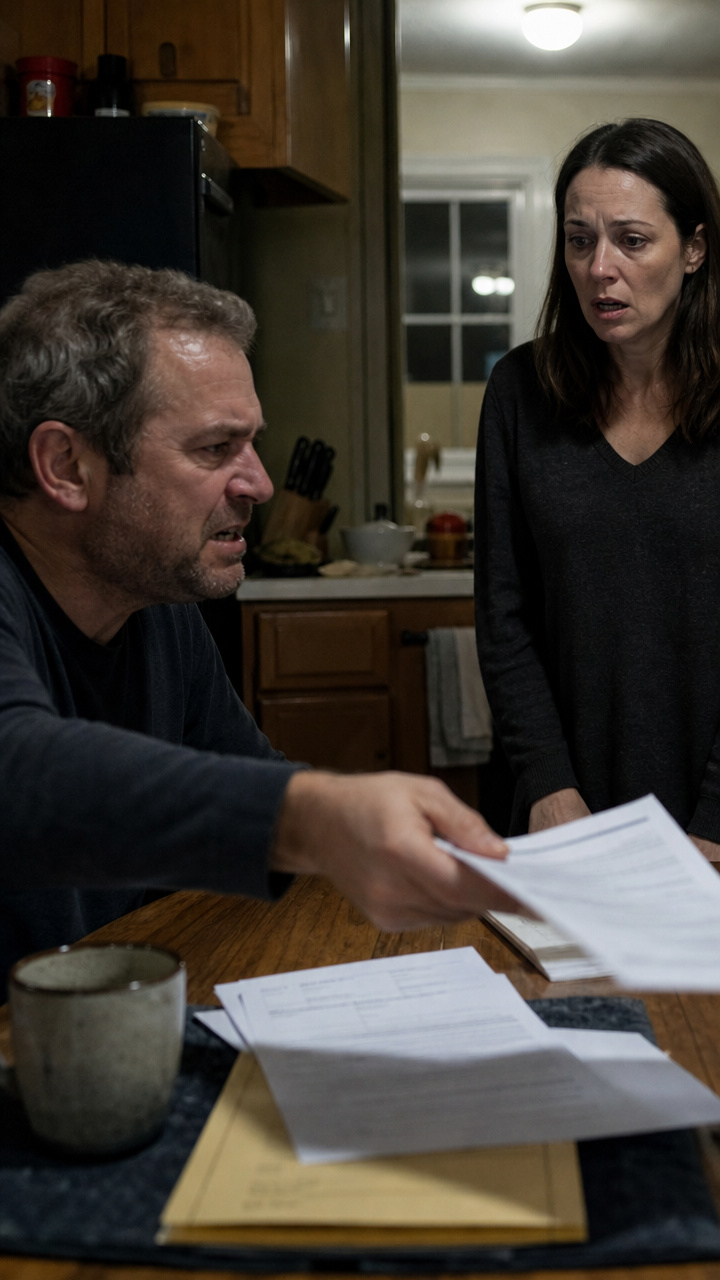
I was sitting across from Dr. Martin Hayes, but he seemed unable to begin speaking. A thin sheet of paper containing the DNA results trembled between his fingers. For what must have been the tenth time, I scanned the same line, almost hoping the numbers would somehow rearrange themselves into something different.
They did not.
Probability of biological paternity — 0.00%.
Dr. Hayes remained silent, waiting patiently. He was in his early sixties, with a composed expression, a quiet voice, and careful movements. After decades of practice, he had probably listened to hundreds of stories about betrayal, grief, and families falling apart.
Even so, it was obvious that the man sitting before him was watching his entire familiar world collapse.
At last, I managed to speak.
“She isn’t mine.”
The psychologist leaned forward slightly.
“Who are you talking about?”
“My daughter. Lily is eight years old. I raised her all these years… and now I’ve learned she doesn’t belong to me.”
I placed the report on his desk. Dr. Hayes read it carefully, gave the smallest nod, and slid the paper back toward me.
“Start at the beginning,” he said softly.
So I did.
I am forty-nine years old. My wife, Claire, is forty-seven. We had been married for twenty years.
Lily was born when I was forty-one.
We had waited for that child for what felt like a lifetime. For nearly a decade, we tried to become parents. In the beginning, we simply believed everything would eventually work out. Then came the endless tests, treatments, clinic appointments, and consultations with specialists.
Little by little, we grew accustomed to the painful possibility that we might never have children.
Then, suddenly, Claire became pregnant.
When she told me, I honestly thought I had misunderstood her. Once I realized she was serious, I felt like the luckiest man alive.
I could hardly leave her side. I bought tiny clothes, helped prepare the nursery, compared strollers, chose a crib, and filled the house with toys.
When Lily was born, I stood in the hospital corridor and cried so hard I could barely breathe. I did not care that doctors, nurses, and strangers were passing nearby.
For the first few years, our life looked like the life of any ordinary family.
Lily grew, took her first steps, learned to speak, and laughed with her whole body. She had pale blond hair and bright blue eyes. I genuinely believed she looked exactly like me.
I had not the slightest suspicion.
But when she was about four, I began noticing small things that unsettled me.
At first, they were almost impossible to explain: the way she looked at people, certain expressions, familiar gestures. Every now and then, I caught myself thinking that there was nothing of me in her face at all.
Not one recognizable feature.
One evening, I asked my wife:
“Claire, who does Lily look like?”
Without hesitating, she answered:
“My mother. You barely remember her. As Lily gets older, you’ll see it. She’ll become her grandmother’s exact copy.”
I accepted that explanation and tried not to return to the thought.
Then, when Lily was seven, something happened that changed everything.
She became ill. It was nothing dangerous, but the doctor ordered several blood tests, including her blood type.
I am B positive.
Claire is AB positive.
Lily’s test came back O negative.
I was confused and asked the doctor:
“Is that even possible?”
He only shrugged.
“Genetics can be unpredictable.”
I pretended to be reassured, but uneasiness had already taken root inside me.
When I got home, I opened my laptop and began reading medical articles.
About half an hour later, the answer seemed clear: with our blood types, Lily’s result appeared to be impossible.
It should not have happened.
I approached my wife again.
“Claire, are you absolutely certain about your blood type?”
She looked at me with irritation.
“Of course I am. AB positive. I’ve known that since I was a child.”
“What if the test was wrong once?”
“There was no mistake.”
She answered too quickly.
And for the first time, I felt it clearly: she was hiding something from me.
Nearly six months passed.
I said nothing. I watched, compared details, and tried to convince myself that I was inventing a problem where none existed.
Yet every time I looked at Lily, the same painful question returned:
Whose daughter are you?
I despised myself for thinking that way. I was the one who had fed her with a spoon, gotten up beside her bed at night, tucked her in, taken her to preschool, and taught her how to balance on a bicycle.
Still, the suspicion continued to grow.
Three months ago, I finally made a decision.
Without telling anyone, I arranged a paternity test.
I took several strands of Lily’s hair from her hairbrush, added my own sample, and delivered everything to a private laboratory. I did not say a word to my wife.
The results were supposed to arrive in two weeks.
Those fourteen days felt endless.