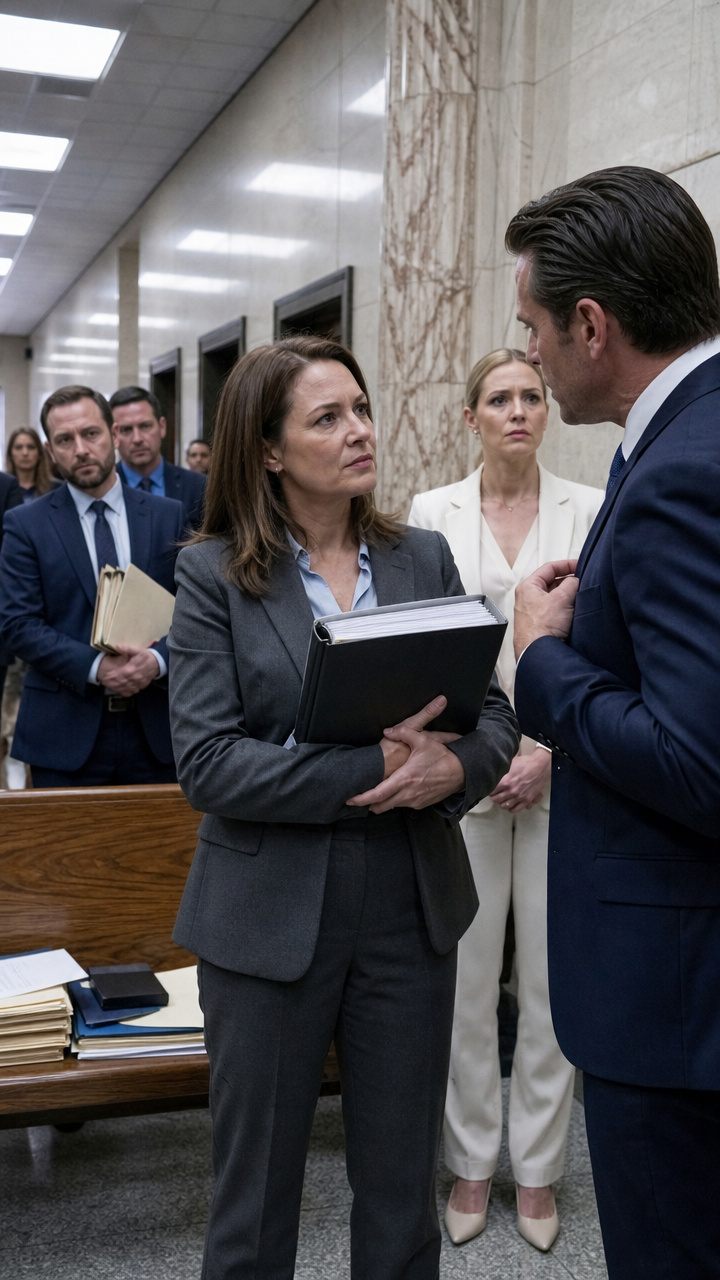
The corridor outside the family courtroom was washed in harsh white light, the kind that made every face look tired and every secret feel exposed.
Daniel Carter stepped toward me until only a few inches separated us.
I could smell his cologne.
Sandalwood, leather, cedar, and the dry, expensive scent he associated with power.
He wore it only on days when he expected to win. He had worn it after receiving his promotion, when he signed the papers for his new luxury sedan, and before a business conference where he had proudly told a crowded room that everything he owned came from his “predator’s instinct.”
To Daniel, that fragrance meant conquest.
It was polished aggression concealed beneath tailored clothes, controlled gestures, and a calm voice.
The moment it filled my lungs, I understood why he had come to court.
He had not come to negotiate our divorce.
He had come to celebrate a victory he believed was already his.
“This is the best day of my life,” he murmured.
He had waited until a group of clerks moved farther down the hallway before speaking again. His expression remained pleasant, but his voice changed into the colder tone he used whenever there were no witnesses close enough to challenge him.
“Today, I’m taking everything from you, Emily. The house. The accounts. Your future. You should have accepted my offer while I was still willing to be generous.”
Then he smiled.
It was a narrow, practiced smile that never reached his eyes. The smile of a man accustomed to selling confidence, even when the product was nothing more than a carefully wrapped lie.
A few steps behind him stood Sophie Bennett.
Her ivory suit belonged at a rooftop cocktail party rather than a divorce hearing. She did not need to say anything. Her raised chin and satisfied mouth announced exactly how she saw herself.
She was not there as a witness.
She was there for a coronation.
The courthouse swallowed people and released them again—lawyers carrying folders, frightened spouses clutching handbags, relatives speaking in whispers, strangers walking as though they were afraid their own names might be called.
A young attorney hurried past with too many files pressed against his chest. Near the vending machines, a woman in sweatpants cried quietly into her phone. An elderly man sat alone on a bench, staring at the floor.
The building was full of lives coming apart.
Yet no one paid attention to us.
From the outside, we looked like another well-dressed couple arriving to divide twenty years of marriage into percentages, signatures, and financial obligations.
Daniel adjusted his jacket.
“You were always far too quiet, Emily,” he said. “Quiet women don’t win in court. My lawyer is a shark. Yours looks like a retired literature professor who spends his afternoons feeding birds in the park.”
Sophie crossed her arms.
The diamonds around her wrist caught the ceiling light.
Daniel had always possessed exquisite taste when he was spending someone else’s money.
He leaned closer until his breath brushed my ear.
“After today, you won’t have anything left. No home. No control. Nothing. You’ll be nobody—a middle-aged woman driving an old car and doing meaningless bookkeeping from home. That will be your entire life.”
A figure emerged from beside a marble column.
Arthur Whitmore never hurried.
He walked with the measured calm of a man who considered unnecessary movement a form of bad manners. Nothing about him resembled the shark Daniel had described.
He looked more like an old university lecturer—the kind of man who would politely correct your grammar before offering you tea.
His gray suit hung loosely from his narrow shoulders. His thin-framed glasses seemed to belong to another decade. He carried the faint scent of pipe tobacco, although I had never once seen him smoke.
He ignored Daniel.
His eyes went straight to me.
“Mrs. Carter,” he said, in the same mild tone someone might use to ask whether you had remembered to buy bread, “did you bring the documents we discussed?”
I turned my head.
For the first time that morning, I looked directly into my husband’s eyes.
His certainty was still there. Smooth, shining, untouched by doubt. He wore the expression of a man who believed the ending had been decided before the first word was spoken.
What struck me was how familiar that expression remained.
After everything he had done, I still knew Daniel by heart.
For years, I had watched that same look appear whenever he decided that a conversation was over, a negotiation settled, or another person’s future determined before they had been given the chance to speak.
I had seen it most clearly when he convinced me to move my grandmother’s inheritance into our joint investment account.
“No one has a better instinct for growing capital than I do,” he had told me.
Once, I had called his confidence talent.
Now I understood it was simply arrogance wearing a more attractive name.
“Yes,” I answered Arthur. “Everything you requested is ready.”