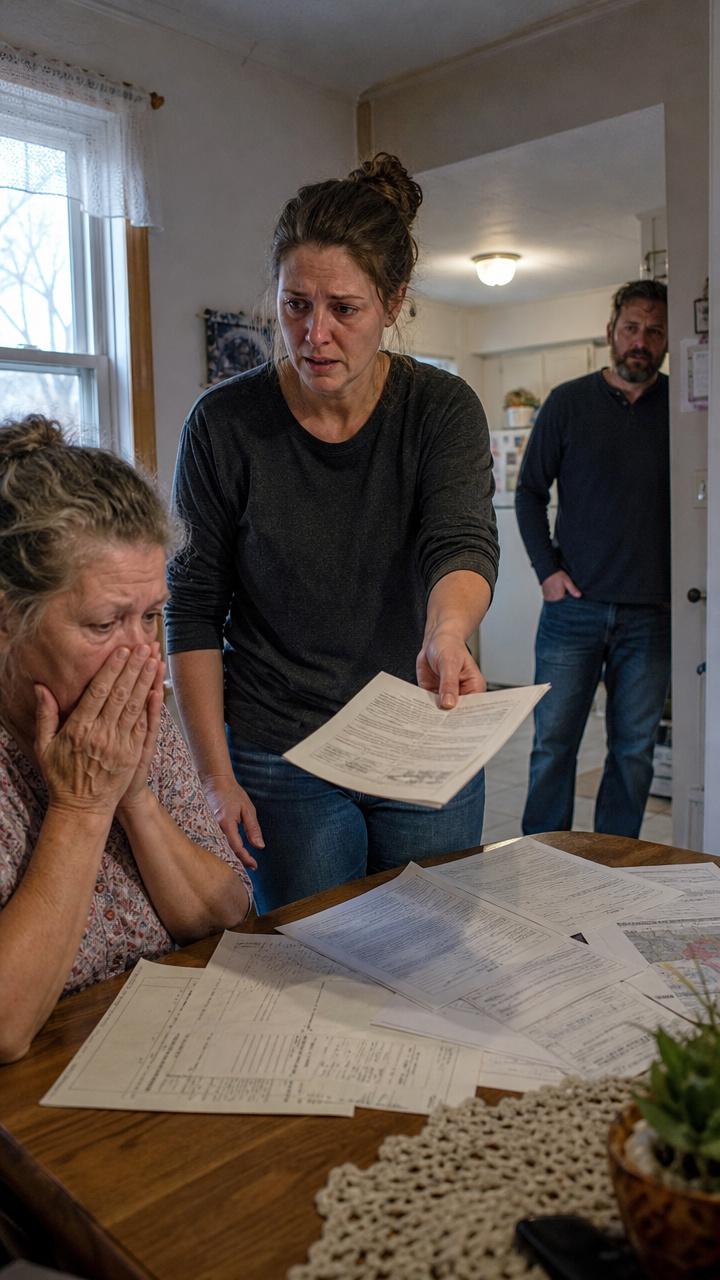
“Emily, Daniel told me you’re planning to sign the country house over to your brother!” Margaret shouted as she flung open the front door, looking less like a visitor than someone arriving to reclaim property she believed was already hers.
Emily looked up from the folder spread across the table and slowly removed her glasses.
“Good afternoon. Have people stopped knocking before they come in?”
Her mother-in-law acted as though she had not heard a word.
“Don’t change the subject! Answer me right now!”
Daniel appeared in the hallway. He closed the door behind him with unusual care and stood against the wall, already looking as if he regretted agreeing to come with his mother.
Emily turned toward her husband.
“You told her that?”
Daniel cleared his throat.
“I only mentioned that you met Matthew recently and that the two of you spent a long time talking. Mom made up the rest herself.”
“Made it up?” Emily set her pen beside the folder. “So now someone’s assumption automatically becomes proof?”
Margaret threw up her hands.
“Don’t make me sound guilty! My son said you were trying to take the house away from our family!”
For several seconds, Emily said nothing.
Then she opened the folder without the slightest hurry.
“Here is the inheritance certificate. And this is the official property registration. After Granddad died, I waited the required six months, completed the inheritance process, and registered the land in my name. That was years ago. Nothing has changed since then.”
She turned the papers toward Margaret.
“Show me one document stating that ownership has been transferred to someone else.”
Silence filled the room. The clock on the wall seemed louder than before, each tick marking the growing discomfort.
Margaret bent over the table. She studied the documents for a long time, as if the right sentence might suddenly appear between the lines and support everything she had decided to believe.
There was nothing.
At last, she straightened.
“Perhaps the paperwork simply hasn’t been completed yet. These things can be handled differently now.”
Emily gave a small shake of her head.
“No. Real estate doesn’t change hands because people discuss it around a kitchen table.”
Daniel looked away.
That was when Emily understood that the matter was not going to end with one awkward conversation.
The house had always meant far more to her than an ordinary piece of property.
When her grandfather was still alive, Emily spent every summer there, helping him care for the land. Together they painted the weathered fence, replaced rotting boards on the porch, and planted young apple trees along the edge of the garden.
Her grandfather used to tell her:
“A house stays alive as long as it has someone who truly belongs to it.”
After he died, none of the relatives challenged the inheritance. Everyone knew exactly who he had intended to receive the place.
Emily completed the legal process, repaired the house little by little, and never thought of it as a convenient venue for endless family gatherings or noisy weekends.
The property gave her peace.
Sometimes she went there alone.
Other times she brought her brother Matthew.
That was why it hurt so much to hear people discussing her home as if its future had already been decided without asking the person who owned it.
Margaret first visited the property not long after Emily and Daniel got married.
She spent hours wandering from one end of the land to the other, peered inside the shed, inspected the greenhouse, and kept repeating:
“What a wonderful place. Such a shame it sits empty most of the time.”
Emily had only smiled then.
A month later, the requests began.
First Margaret asked whether her sister could stay there during a vacation.
Then she suggested holding her birthday celebration at the house.
Soon after that, she proposed sending her nieces and nephews there for the entire summer.
Every time, Emily answered in the same even tone:
“If we decide to invite someone, that’s fine. But I will be the one deciding who stays here and when.”
Margaret would nod and pretend to accept the answer. Then, after some time had passed, she would raise the subject again.
A few days before the confrontation, Emily really had met with Matthew.
He worked for a construction company and knew exactly how to deal with a damaged roof.
A recent storm had loosened several old roofing panels, leaving them raised and dangerous. The fence also needed to be replaced from one end to the other.
The brother and sister spent several hours walking around the property. They measured the damaged sections, made a list of supplies, and discussed the best way to arrange the repairs.
That was when one of Daniel’s acquaintances, who lived nearby, happened to pass the house.
Later, he ran into Daniel outside a grocery store.
“I saw your wife at the property with some man today. They were walking around the land and looking at papers.”
Daniel immediately realized that the man must have been Matthew.