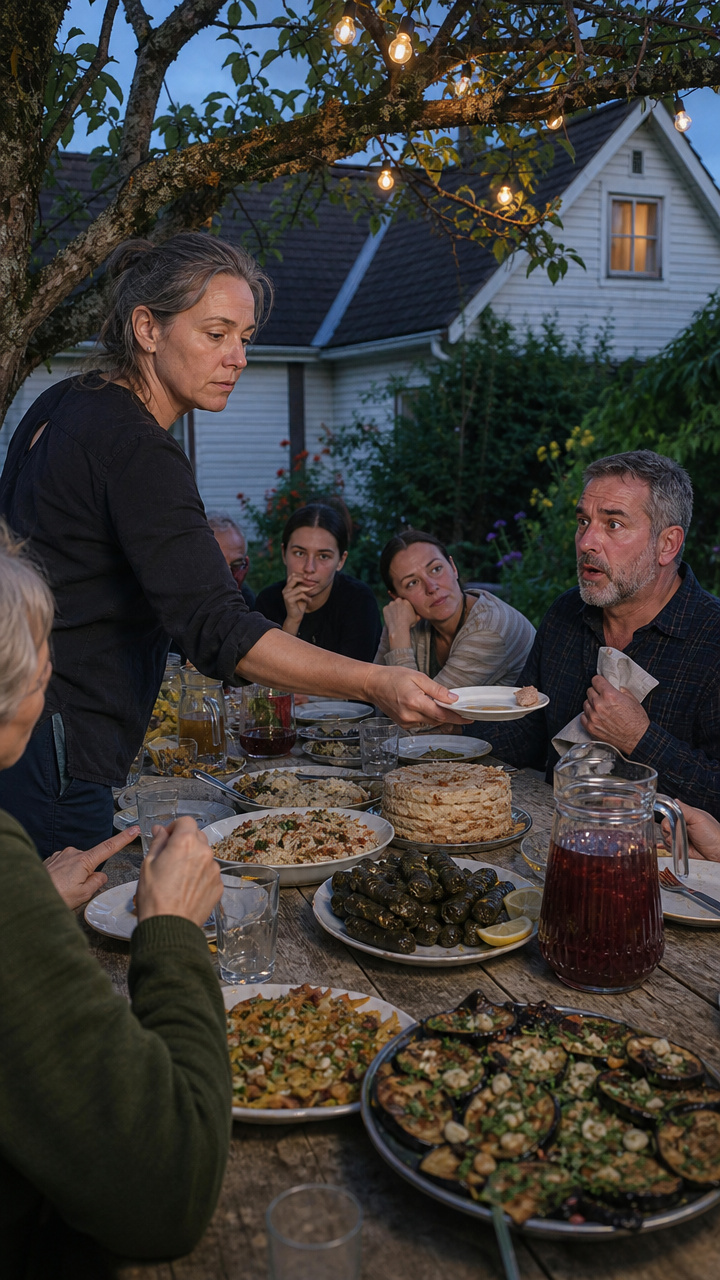
I was rolling out the twelfth cake layer at half past four in the morning.
The house felt cold. September had already begun stealing warmth from the nights, and the chill made the dough wonderfully obedient. It stretched beneath the rolling pin until it was almost transparent, gliding across the table as if it knew exactly what to do. Outside, darkness still covered the yard. A neighbor’s dog barked once and fell silent. On the windowsill lay an open squared notebook inside a clear plastic sleeve, protected from accidental splashes of cream.
It was Margaret’s notebook. Page forty-two. Blue ink. The handwriting slanted sharply to the right.
“Napoleon. Dough—as for Danny.”
Beneath it, in smaller letters and a different hand, someone had added: “Do not take the custard off the heat until it thickens. Patience, Claire.”
My mother-in-law had given me that notebook three years earlier. She simply carried it out of her room, placed it on the table in front of me, and said:
“Take it. My fingers aren’t what they used to be, but these recipes mustn’t disappear.”
At the time, I thought she was exaggerating.
Then I watched her try to grate a carrot and set the grater aside less than a minute later.
Daniel was turning thirty-five.
He had refused to celebrate in a restaurant. He wanted no hired cooks, no catering, and no disposable plates.
“Make everything the way Mom used to,” he had asked me. “I don’t need anything else.”
So that was what I did.
For nearly two days, I barely sat down.
By lunchtime, the smell drifting across the yard had become so tempting that the neighbors started peeking over the fence.
The pilaf was finishing in a heavy pot over an open fire. I had learned to make it right there, beneath the old apple tree, while Margaret watched with disapproving patience.
“You should have turned the heat down five minutes ago,” she would grumble.
Stuffed grape leaves simmered in a large clay pot. I had gathered the young leaves back in June near Aunt Helen’s house and fermented them in a three-liter jar.
Beside them sat roasted eggplant with garlic.
Zucchini fritters.
A large glass jug of spiced fruit drink, still faintly warm.
We set the table beneath the apple tree. It was long and made of rough boards, covered with a white tablecloth that had come with the house.
We had bought the place five years earlier, almost completely empty.
The kitchen was the first thing we tackled. The renovation lasted all winter. We replaced the ancient stove with a proper oven, and now those thin cake layers were baking in it one after another.
Guests began arriving around noon.
Family friends.
Aunt Helen and Uncle George.
Neighbors from our street.
My mother, Susan, had come by bus early that morning so she could help with the dishes and the final preparations.
Daniel brought Margaret himself.
She stepped into the yard, paused, looked toward the cooking pot, and said nothing.
She only settled into a chair at the end of the table, close to the warmth.
Then, around three, a gray sedan stopped by the gate.
Victor, my husband’s older brother, climbed out carrying two bottles of lemonade.
That was, essentially, his entire contribution.
Later, he drank almost all of it himself.
Victor was one of those people who knew absolutely everything.
The proper way to brew coffee.
How a foundation should be poured.
The angle at which light ought to fall across a photograph.
The true price of a square foot of housing in the capital.
He lived alone on the fifth floor of a city apartment building. He rarely cooked; most of the time, he simply reheated something prepared by someone else.
Yet every time he returned from a trip, he brought back stories so impressive that a travel magazine might have felt threatened.
“Well,” he said, surveying the table, “this is certainly a country-house kind of celebration. Very romantic.”
Then he took the seat at the head of the table.
The seat that was supposed to belong to the birthday boy.
At first, everything went smoothly.
We raised our glasses to Daniel.
Uncle George gave a long toast about how a man only truly begins living at thirty-five.
The women laughed.
Wasps circled the dishes of plum jam.
Evening slowly settled over the garden, and a thin ribbon of smoke drifted in from the vegetable patch.
Then Victor turned his attention to the pilaf.
He prodded the rice for a long time with his fork. He lifted several grains toward the light. He smelled a piece of meat.
“Danny, who cooked this?”
“Claire,” my husband answered, helping himself to a second serving. “I think it turned out perfectly.”
“It’s overcooked,” Victor declared, setting down his fork. “This isn’t pilaf. It’s ordinary meat porridge. Real pilaf has separate grains. Once, at a hotel in Turkey, I was served rice so perfect that I remembered it for three days afterward.”
“Then go back to Turkey,” one of the family friends said quietly.
Someone gave a restrained laugh.
I said nothing.
Once, you can pretend you didn’t hear.