THE WOMAN THE GRAND HOTEL REFUSED TO RECOGNIZE

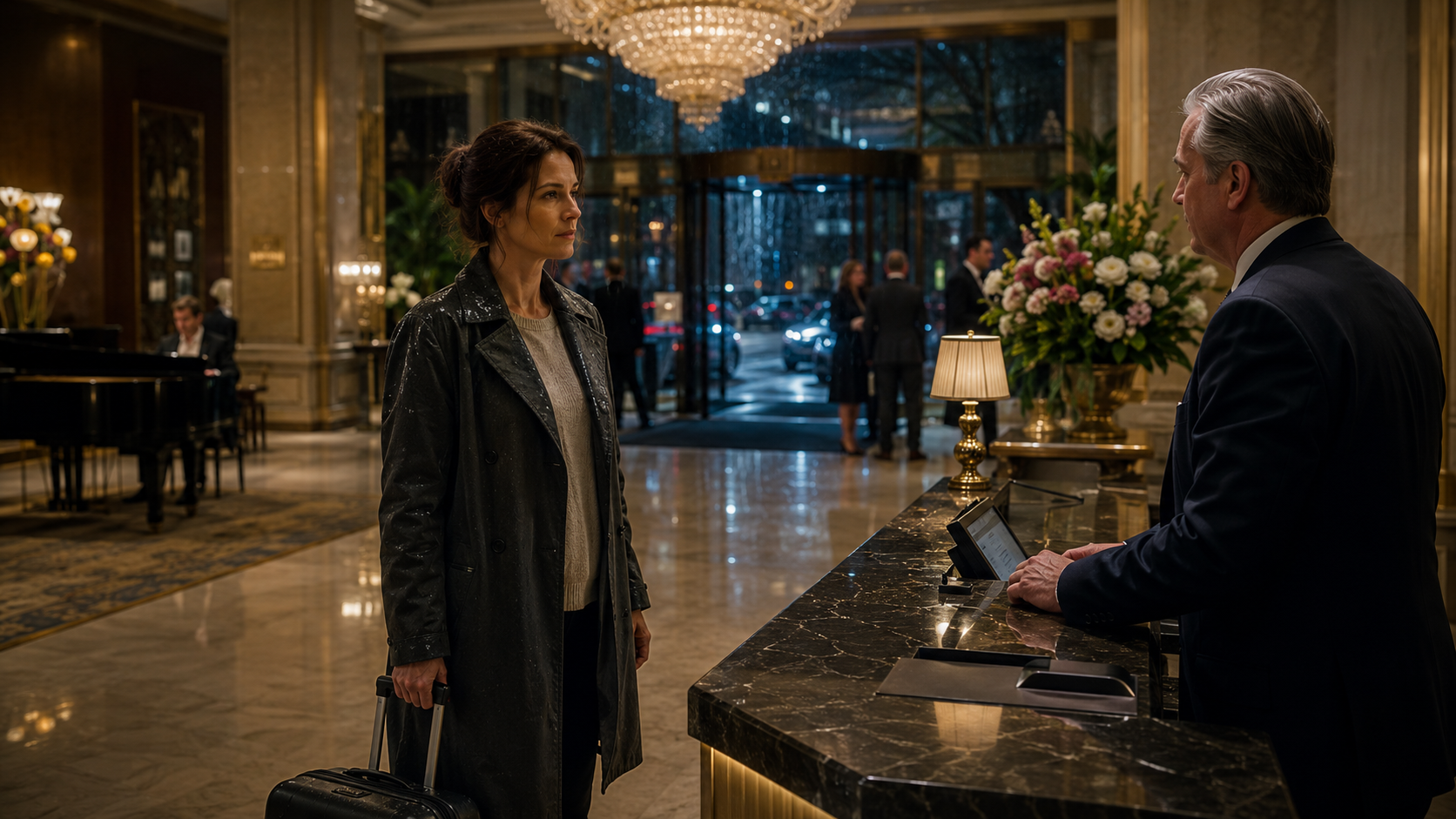
Rain had turned the city into a blur of silver by the time Naomi Reed stepped out of the taxi.

She stood beneath the enormous glass canopy of the Bellwether Grand with one small suitcase, a folded umbrella, and a dark wool coat that had seen better days.

Around her, polished cars glided toward the entrance.

A chauffeur opened the door of a black limousine for a woman wrapped in a cream-colored fur coat. A young couple climbed out of a sports car while a bellman hurried forward to collect their luggage. Another employee appeared instantly with an umbrella.

No one moved toward Naomi.

She noticed.

She noticed everything.

That was why she had come.

The Bellwether Grand was one of the most profitable luxury hotels in the city. Marble floors, crystal chandeliers, a rooftop restaurant booked months in advance, and suites that cost more per night than some people earned in a month.

For nearly seven years, the property had been managed by Asterion Hospitality.

And for nearly six months, Naomi had been receiving disturbing reports about the way the hotel treated certain guests.

Reservations mysteriously disappeared.

Complimentary upgrades went to people who looked wealthy.

Guests with foreign accents were asked for additional identification.

Families wearing inexpensive clothes were quietly redirected to less visible areas.

Older guests complained about being ignored.

Employees said managers used phrases such as “protecting the atmosphere” and “maintaining the right clientele.”

Nothing was ever written clearly enough to prove discrimination.

Everything had an explanation.

A computer error.

A misunderstanding.

An inexperienced employee.

A fully booked floor.

An unfortunate coincidence.

Naomi had stopped believing in coincidences.

She pushed through the revolving door.

Warm air surrounded her.

The lobby was magnificent.

A pianist played near a towering arrangement of white flowers. Soft golden light reflected from the marble floor. Guests spoke in low voices beneath an enormous chandelier.

Naomi approached the reception desk.

Three employees stood behind it.

One was helping a man wearing an expensive suit.

Another was arranging key cards.

The third looked directly at Naomi.

Then looked away.

Naomi waited.

Thirty seconds.

A minute.

Nearly two.

Finally she cleared her throat.

“Excuse me.”

The young receptionist looked up.

“Yes?”

“I have a reservation.”

The receptionist glanced at Naomi’s coat, suitcase, and rain-soaked shoes.

“Name?”

“Naomi Reed.”

The woman typed.

Her expression changed slightly.

She typed again.

“I don’t see anything.”

Naomi remained calm.

“Would you check again?”

“I already did.”

“The reservation was confirmed yesterday.”

The receptionist sighed quietly.

“Do you have the confirmation?”

“Yes.”

Naomi reached into her bag for her phone.

Before she could unlock it, a man approached from behind the desk.

He appeared to be in his early fifties, with perfectly combed gray hair and the controlled expression of someone accustomed to being obeyed.

His name tag identified him as Roland Price, General Manager.

“Is there a problem?” he asked.

The receptionist lowered her voice.

“She says she has a reservation, but there’s nothing in the system.”

Roland looked at Naomi.

Not at the computer.

At Naomi.

His eyes paused on the wet hem of her coat.

“Perhaps,” he said, “you booked one of our partner properties.”

“No.”

“There are several Bellwether-branded hotels in the region.”

“I booked this one.”

“Do you remember the room category?”

“Executive king.”

The receptionist looked up sharply.

Roland’s expression remained polite.

But the politeness had become colder.

“Executive floor?”

“Yes.”

“I’m afraid that seems unlikely if there is no reservation.”

Naomi studied him.

“Why would the room category make it unlikely?”

He smiled.

“It doesn’t.”

“Then why mention it?”

For the first time, his smile disappeared.

The receptionist pretended to examine her screen.

Roland straightened his jacket.

“If you have a confirmation number, we’ll investigate. But tonight is extremely busy.”

Naomi showed him her phone.

He glanced at the reservation.

There it was.

Bellwether Grand.

Executive King.

Three nights.

Paid in full.

Roland looked toward the receptionist.

“Search the number.”

She typed it.

This time she found something.

“Oh.”

Naomi waited.

The receptionist looked uncomfortable.

“It appears the reservation was cancelled this afternoon.”

“By whom?”

“I don’t know.”

“I didn’t cancel it.”

Roland leaned toward the monitor.

“Unfortunately, cancellations sometimes occur through third-party booking systems.”

“I booked directly.”

Silence.

Naomi looked at him.

“Do you have another executive room available?”

Roland hesitated.

That hesitation told her more than his answer.

“We’re nearly full.”

“That wasn’t my question.”

A voice interrupted them.

“Mr. Price?”

Everyone turned.

A bellman had approached with a well-dressed young man and woman.

The man wore a tailored navy suit.

The woman was filming the lobby with her phone.

Roland’s expression transformed immediately.

“Mr. Laurent. Welcome back.”

He stepped around the desk personally.

The young man grinned.

“Good to see you, Roland.”

“Your suite is ready. We’ve moved you to the Presidential East Suite.”

“Seriously?”

“Compliments of the hotel.”

Naomi looked at the receptionist.

Then at Roland.

“Nearly full?”

He heard her.

His jaw tightened.

The young couple disappeared toward the elevators.

Naomi turned back to him.

“You just upgraded someone.”

“That is unrelated to your situation.”

“So rooms are available.”

“That particular guest has a long-standing relationship with the property.”

“And I have a paid reservation.”

“Which, as we’ve explained, was cancelled.”

“Without my permission.”

Roland lowered his voice.

“Ms. Reed, I understand that you’re frustrated.”

“No. You understand that I’m asking questions.”

Several nearby guests had begun listening.

Roland noticed.

His voice became even softer.

“We are trying to resolve this discreetly.”

Naomi almost smiled.

“Then resolve it.”

He stared at her.

For several seconds neither spoke.

Finally he turned to the receptionist.

“Find something on the lower floors.”

She began typing.

Roland looked back at Naomi.

“We can offer you a standard room tonight.”

“I paid for an executive room.”

“The rate difference can be refunded.”

“That isn’t the point.”

“Then I’m not sure what you expect us to do.”

Naomi looked around the lobby.

The pianist kept playing.

A waiter crossed the marble floor carrying champagne.

A doorman laughed with a guest.

Everything appeared perfect.

That, she thought, was the problem.

Perfection was easy when everyone knew they were being watched.

“I’ll take the standard room,” she said.

Roland seemed surprised.

“Very good.”

“But I want written confirmation that the hotel cancelled my original reservation.”

His face hardened.

“We don’t normally provide internal documentation.”

“Then write down what you just told me.”

“There is no need.”

“There is for me.”

The receptionist stopped typing.

Roland leaned slightly closer.

“Ms. Reed, we are offering you accommodation despite tonight’s circumstances. I suggest we don’t make this more complicated than necessary.”

There it was again.

Not an insult.

Not a threat.

Something cleaner.

Something practiced.

Naomi nodded.

“Room number?”


Room 214 overlooked an alley.

The heating rattled.

The carpet near the window was stained.

A lamp beside the bed didn’t work.

Naomi placed her suitcase on the luggage rack and sat quietly for several minutes.

The room itself didn’t matter.

What mattered was that it existed in the same hotel where another guest had just received a complimentary presidential upgrade.

She opened her laptop.

There were already three messages waiting.

The first came from her attorney.

The second came from the investment committee.

The third came from a name she didn’t recognize.

Mara Velez. Housekeeping.

The message contained only six words.

Please don’t leave before tomorrow morning.

Naomi stared at it.

Then someone knocked.

She closed the laptop.

“Who is it?”

“Housekeeping.”

Naomi opened the door.

A woman around thirty-five stood outside holding two towels.

Her dark hair was tied back, and she wore the gray uniform of the housekeeping department.

“Extra towels,” she said.

“I didn’t request any.”

“I know.”

Naomi stepped aside.

The woman entered, closed the door behind her, and immediately looked frightened.

“You’re Naomi Reed.”

“Yes.”

“You’re really her?”

Naomi said nothing.

The woman swallowed.

“I saw your picture once. In an investor newsletter.”

Naomi’s attention sharpened.

“What’s your name?”

“Mara.”

“You sent the message?”

Mara nodded.

“I wasn’t sure you’d come.”

“Why did you think I would?”

“Because I sent the complaint.”

Naomi stood very still.

The original anonymous complaint had included dates, employee schedules and enough internal information to suggest the writer worked inside the property.

“You?”

“Some of it.”

“Some?”

“Other employees helped.”

Mara looked toward the door.

“No one wanted their name attached.”

“Why?”

“You haven’t met everyone yet.”

“I met Roland Price.”

Mara gave a humorless laugh.

“He’s only part of it.”

She removed a folded piece of paper from beneath the towels.

Naomi unfolded it.

It was a staff checklist.

Most of the language was ordinary.

Lobby presentation.

Guest flow.

Executive arrival preparation.

But halfway down the page was a section called Placement Considerations.

Beside it were handwritten codes.

Naomi pointed at them.

“What do these mean?”

Mara hesitated.

“V-one means visible.”

“Visible?”

“Guests they want near the lobby, restaurant entrance, main bar.”

“And V-three?”

“Put them somewhere else.”

Naomi looked at her.

“Based on what?”

Mara’s eyes filled with anger.

“Whatever management decides doesn’t match the image.”

“Clothes?”

“Yes.”

“Age?”

“Sometimes.”

“Accent?”

Mara looked down.

“Yes.”

“Race?”

Another pause.

“They’ll never say that.”

“But?”

“You already know the answer.”

Naomi folded the paper.

“Who created this?”

“Management says it came from Asterion’s brand consultants.”

“Do you have proof?”

“Not yet.”

Naomi looked at her carefully.

“Why risk your job?”

Mara’s expression changed.

“Three months ago, my mother came to visit me.”

Naomi waited.

“I saved for almost a year so she could have dinner at the rooftop restaurant. I made the reservation myself.”

Mara’s voice tightened.

“She arrived early. She was wearing the nicest dress she owns.”

“What happened?”

“They told her the reservation couldn’t be found.”

Naomi felt a familiar anger rising.

“Was it there?”

“Yes.”

“What did they do?”

“They seated her in the lounge downstairs and told her the restaurant had become private for the evening.”

“And had it?”

“No.”

Mara looked toward the floor.

“Two hours later, my manager joked that we couldn’t turn the rooftop into a bus station.”

Neither woman spoke.

Outside, a car horn echoed from the street.

Finally Naomi asked, “Why didn’t you report it?”

“I did.”

“To whom?”

“Human resources.”

“And?”

“My schedule changed the next week. Fewer hours.”

Naomi closed her eyes briefly.

There were many ways to punish someone without admitting they were being punished.

“Is that why you contacted me?”

“That was when I stopped being afraid.”

Naomi opened her laptop.

“Show me everything.”


For the next two hours, Naomi listened.

Not as an owner.

Not as an investor.

As a witness.

Mara described staff meetings where employees were told to identify “high-value visual guests.”

She described older couples moved away from windows because influencers had requested better tables.

She described families being told the lobby lounge was reserved when managers considered them too loud.

She described employees being instructed to offer complimentary services according to “brand compatibility.”

She described a front-desk agent who resigned after refusing to cancel a legitimate reservation.

Naomi stopped her.

“Whose reservation?”

Mara looked at her.

“Yours.”

Naomi’s hand froze above the keyboard.

“My reservation wasn’t cancelled by a computer?”

“No.”

“Who cancelled it?”

“I don’t know. But the morning team saw your guest profile.”

“What profile?”

Mara gave her a look Naomi would remember for a long time.

“That’s the part you need to see yourself.”


At seven the next morning, Naomi returned to the lobby.

She wore the same coat.

The same shoes.

The same simple clothes.

Roland was already there.

When he saw her, his expression suggested disappointment that the previous evening’s inconvenience had survived until morning.

“Ms. Reed.”

“Mr. Price.”

“I trust the room was satisfactory.”

“The heater sounded like a freight train.”

“I’ll have maintenance inspect it.”

“The lamp doesn’t work either.”

“I’m sorry to hear that.”

Naomi looked around.

“Is breakfast included?”

“Not with the room you accepted.”

“My original reservation included executive lounge access.”

“Your original reservation was cancelled.”

Naomi nodded.

“Of course.”

She turned toward the restaurant.

Roland called after her.

“Ms. Reed.”

She stopped.

“Yes?”

“The restaurant is reserved for hotel guests.”

“I am a hotel guest.”

“I meant guests with breakfast privileges.”

Naomi looked directly at him.

“Do you personally supervise every guest this closely?”

The receptionist from the previous night glanced up.

Roland’s expression tightened.

“I supervise my hotel.”

Naomi smiled faintly.

“That’s an interesting choice of words.”

Before he could answer, a commotion near the entrance interrupted them.

An elderly man was standing beside two pieces of luggage, arguing with a concierge.

“My wife cannot walk that far,” he said.

The concierge maintained a rehearsed smile.

“The accessible entrance is located on the west side.”

“The taxi brought us here.”

“Unfortunately, this entrance has stairs between the lobby and the north elevator.”

“Then help us.”

“Sir, our staff are currently assisting arriving guests.”

Naomi looked around.

Two bellmen were standing beside the desk.

Neither was busy.

The man’s wife sat in a wheelchair just inside the revolving door.

Roland watched.

He did nothing.

Naomi walked over.

“Do you need help?”

The man looked embarrassed.

“Apparently.”

Naomi took one suitcase.

A bellman finally moved.

Roland immediately snapped, “Daniel.”

The bellman stopped.

“Finish the Laurent departure first.”

Naomi turned.

Mr. Laurent—the young man upgraded the night before—was nowhere in sight.

His luggage, however, had been placed neatly near the entrance.

Three employees were waiting for him.

Naomi looked at Roland.

“You have three employees waiting for one man who hasn’t arrived, and none available for a woman in a wheelchair.”

Roland’s face reddened.

“This isn’t your concern.”

The lobby became quiet.

Naomi set the suitcase down.

“What exactly is my concern, Mr. Price?”

“Your stay.”

“What kind of stay?”

“Excuse me?”

“The kind where I pay and remain invisible?”

“Ms. Reed—”

“The kind where I don’t ask why some guests get three employees while others get none?”

Roland walked toward her.

“I think we’ve tolerated enough disruption.”

Naomi didn’t move.

He lowered his voice.

“You have complained about your reservation, your room, breakfast, and now another guest’s arrangements.”

“Correct.”

“If you’re unhappy here, I can arrange accommodation elsewhere.”

Several employees looked toward him.

Mara had appeared beside the hallway leading to the service elevators.

Naomi saw her.

Roland didn’t.

“You want me to leave?” Naomi asked.

“I think that would be best.”

“For whom?”

“For everyone.”

Naomi studied him.

Then she glanced at the clock.

7:46 a.m.

“Not yet.”

His eyebrows drew together.

“What does that mean?”

“I have a meeting at eight.”

“Here?”

“Yes.”

“With whom?”

Naomi picked up the elderly man’s suitcase again.

“You, actually.”


At 7:58, the doors of the Bellwether Ballroom opened.

Roland Price entered quickly.

He had changed his jacket.

Behind him came the director of guest services, the food and beverage manager, two regional executives from Asterion Hospitality and a brand consultant Naomi recognized from photographs.

At the far end of the room stood a long table.

Folders had been arranged at each chair.

Coffee was waiting.

A screen displayed a corporate presentation.

Everyone was preparing for what Roland believed would be another management review.

Then Naomi walked in.

Still carrying her small black handbag.

Roland stopped.

“What are you doing here?”

No one answered.

One of the regional executives turned pale.

Naomi walked toward the head of the table.

Roland stepped in front of her.

“This meeting is private.”

“Yes,” Naomi said. “It is.”

“Then you need to leave.”

The regional executive finally found his voice.

“Roland.”

Roland turned.

“What?”

The man stared at Naomi.

“That’s Naomi Reed.”

“I know her name.”

“No.”

The executive’s face had become almost gray.

“You don’t understand.”

Naomi pulled out the chair at the head of the table.

The room fell silent.

The regional executive continued.

“She’s chair of Reed Meridian Capital.”

Roland blinked.

Naomi removed her coat and placed it over the chair.

Reed Meridian Capital was the investment group that owned the Bellwether Grand property.

Asterion Hospitality did not own the hotel.

It managed it.

And the contract allowing it to do so expired at noon.

Naomi sat down.

Roland did not.

For several seconds, he simply stared at her.

“You…”

“Yes.”

“You own the hotel?”

“The property company owns it.”

Her voice remained calm.

“I control the property company.”

Nobody moved.

Naomi opened the folder in front of her.

“Please sit down.”

Roland slowly took a chair.

The regional executives followed.

Naomi looked around the table.

“This meeting was originally scheduled to discuss renewal of Asterion Hospitality’s management agreement for another ten years.”

She closed the folder.

“That agenda has changed.”

The brand consultant leaned forward.

“Ms. Reed, I’m sure whatever happened can be explained.”

“Excellent.”

Naomi placed the staff checklist on the table.

“Explain this.”

Silence.

Roland stared at it.

The consultant looked away.

Naomi pointed toward the handwritten codes.

“V-one. V-two. V-three. Explain them.”

No one spoke.

“Last night,” Naomi continued, “my confirmed executive reservation was manually cancelled. I was told no comparable accommodation was available while another guest received a complimentary presidential upgrade.”

Roland opened his mouth.

Naomi raised one hand.

“You’ll have time.”

He stopped.

“This morning, two available bellmen were prevented from assisting a guest using a wheelchair because they were waiting for the luggage of a preferred guest.”

The regional director looked at Roland.

Naomi continued.

“I have also reviewed statements from current and former employees describing a system in which guests are ranked according to appearance, age, perceived wealth, accent, social influence and something repeatedly described as brand compatibility.”

The consultant finally spoke.

“That terminology is being taken out of context.”

Naomi turned toward him.

“Then put it in context.”

He hesitated.

“The goal was to maintain a consistent luxury experience.”

“For whom?”

“Our target customer.”

Naomi leaned back.

“I’d like you to answer one question.”

“Of course.”

“If a person pays the advertised price, follows the rules and treats the staff respectfully, what additional qualification must that person satisfy to become your target customer?”

The consultant said nothing.

Naomi looked toward Roland.

He was sweating now.

“Ms. Reed, I didn’t know who you were.”

The sentence seemed to surprise even him.

Naomi watched him for a long moment.

Then she said quietly, “That may be the most useful thing you’ve said since I arrived.”

Roland swallowed.

“I mean, if I had known—”

“You would have treated me differently.”

“No. That’s not what I meant.”

“It is exactly what you meant.”

The ballroom was completely silent.

Naomi leaned forward.

“A hotel does not prove its standards by how it treats someone powerful. Any organization can perform when the important person walks through the door.”

She looked around the table.

“You prove your standards by how you treat the person you believe has no power at all.”

Nobody answered.

Then the ballroom doors opened.

Mara entered.

Behind her came six employees.

Housekeeping.

Front desk.

Maintenance.

Food service.

Bell staff.

Security.

Roland looked horrified.

“What is this?”

Naomi answered.

“The rest of the meeting.”

Each employee carried a folder.

Mara sat beside Naomi.

Roland stared at her.

“You contacted them?”

Mara’s hands trembled.

But her voice did not.

“I contacted the owner.”

Naomi looked toward the regional executives.

“Over the last month, these employees preserved schedules, directives, emails and training material.”

One executive whispered, “Oh God.”

Naomi continued.

“Enough evidence to establish that this wasn’t one manager making poor decisions.”

She looked at the consultant.

“It was a system.”

Then at Roland.

“And systems survive because people decide that silence is safer than integrity.”

Roland removed his glasses.

“Are you firing me?”

Naomi’s answer came immediately.

“You are suspended pending an independent investigation.”

He looked almost relieved.

Then Naomi turned toward the regional executives.

“As of noon today, the Bellwether Grand will not renew Asterion Hospitality’s management agreement.”

Their faces changed.

One of them stood.

“Naomi, this is a forty-million-dollar operating relationship.”

“Sit down.”

He did.

“This decision affects hundreds of employees,” he said.

“I know.”

“You can’t restructure a hotel overnight.”

“I don’t intend to.”

“Then what exactly are you doing?”

Naomi looked toward Mara and the other employees.

“Keeping the people who actually run it.”

Roland stared at her.

Naomi continued.

“Hotel employees will remain employed during the transition. Salaries and benefits continue. An independent operating team arrives this afternoon. Every discriminatory service directive is suspended immediately.”

The food and beverage manager whispered something under his breath.

Naomi heard him.

“What was that?”

He shook his head.

“Nothing.”

“That’s how we got here,” she said. “Too many people saying nothing.”


Three months later, Naomi returned to the Bellwether Grand.

This time there was no rain.

A taxi stopped beneath the glass canopy.

She stepped out wearing jeans, sneakers and a simple blue jacket.

A young bellman approached.

“Welcome to the Bellwether. May I help with your bag?”

Naomi smiled.

“I can manage, thank you.”

“Of course.”

He held the door anyway.

Inside, the lobby looked almost the same.

The chandelier remained.

The flowers were still enormous.

The pianist was playing.

Luxury had not disappeared.

But some things had changed.

There was no secret placement system.

Complimentary upgrades were recorded and auditable.

Employees had an independent reporting channel.

Accessibility assistance had priority status.

Anonymous guest audits took place every month.

Managers were evaluated partly on complaint resolution and equal-service metrics rather than social media visibility.

Mara now worked upstairs.

Not in housekeeping.

In guest standards and employee advocacy.

When she saw Naomi, she walked across the lobby.

“You didn’t warn us you were coming.”

“That would defeat the purpose.”

Mara laughed.

“How was the entrance?”

“Almost disappointing.”

“That good?”

“Very.”

They walked toward the elevators.

Near the restaurant, Naomi noticed an older woman sitting beside the windows.

Mara noticed her looking.

“My mother.”

Naomi stopped.

The woman was drinking tea beneath the morning sunlight.

Beside her was a small plate of pastries.

“The rooftop restaurant?” Naomi asked.

“Tonight.”

“Good.”

Mara looked toward the lobby.

“Do you ever wonder whether any of this would have happened if Roland had recognized you that first night?”

Naomi thought about it.

“Yes.”

“And?”

Naomi watched guests cross the marble floor.

A businessman carrying his own suitcase.

A family with three noisy children.

An elderly couple walking slowly together.

A young woman in an expensive dress taking photographs.

A delivery driver asking the concierge for directions.

Different people.

Different lives.

The same front door.

“If he had recognized me,” Naomi said, “I probably would have received the best suite in the building.”

Mara smiled.

“Presidential?”

“Definitely.”

They both laughed.

Then Naomi’s expression became serious.

“And I might never have learned what the hotel was really like.”

The elevator doors opened.

Before stepping inside, Naomi looked once more across the lobby.

For years, executives had spoken about protecting the hotel’s image.

Naomi finally understood what had been wrong with that idea.

A building did not have character because of chandeliers, marble floors or expensive rooms.

Its character was revealed in smaller moments.

Who received a smile.

Who was made to wait.

Who was believed.

Who was helped.

Who was ignored.

Who was welcomed before anyone knew whether they were important.

The elevator doors began to close.

Mara pressed the button for the eighth floor.

“Where are you staying this time?” she asked.

Naomi smiled.

“Room 214.”

Mara stared at her.

“You’re joking.”

“No.”

“The heater still sounds like a freight train.”

“I know.”

“And the view is terrible.”

“I remember.”

“So why?”

Naomi leaned against the elevator wall.

“Because if the least impressive room in the building isn’t good enough for me, it isn’t good enough for anyone.”

The doors closed.

And this time, nobody needed to know who she was.

THE WOMAN THE GRAND HOTEL REFUSED TO RECOGNIZE
A wrestling icon who redefined strength, beauty and power!